
Talk of the Town
We’ll be back to business-as-usual on Monday but in the meantime we’ll leave you with this week’s New Yorker piece about our one-year anniversary party last fall. One recent Saturday afternoon, some three hundred and sixty years after Dutch settler chartered the town of Breuckelen representatives of a more recent migration were milling around the…

We’ll be back to business-as-usual on Monday but in the meantime we’ll leave you with this week’s New Yorker piece about our one-year anniversary party last fall.
One recent Saturday afternoon, some three hundred and sixty years after Dutch settler chartered the town of Breuckelen representatives of a more recent migration were milling around the back patio of one of the borough’s newer bars. They had come to toast the first birthday of Brownstoner, a blog professing an unhealthy obsession wit historic Brooklyn brownstones and th neighborhoods and lifestyles they define. The party was in Red Hook, Brooklyn’s defunct dock district, so there were no brownstones in sight, but the bar’s name (Pioneer Bar-B-Q and the up-and-coming character of th neighborhood (Ikea and Fairway due to arrive soon) fit the spirit of the occasion.
Brownstoner is a virtual back fence for Brooklyn real-estate watchers. In frequent postings, its users vet listings, trade tips on brokers and neighborhoods, and gossip about who saw what at which open house. That place is a ‘five minute walk to Prospect Park’ only if you’re a giraffe, Linusvanpelt wrote recently. Why is the Chester Court listing so relatively affordable? Clinton hillbilly said. Was someone murdered there or something?
Housing Department: Emigres [New Yorker]
The blog’s founder, who works on Wall Street and who last year bought a fixer-upper in Clinton Hill, is known to readers as Brownstoner; his wife is Mrs. Brownstoner, or Mrs. B. Like Mr. and Mrs. B., most of the guests at the party were in their thirties; many wore expensive jeans and sneakers, and a disproportionate number of them had on eyeglasses with square frames. They travelled in pairs, towing a stroller and a child or two, and lived in neighborhoods that they described in optimistic tones as improving, including not only Clinton Hill but also Windsor Terrace, Bedford-Stuyvesant, and Crown Heights.
The group had its own vernacular, sprinkled with terms like pocket door, parquet, gut reno, Farrow & Ball (a brand of English paint with extra pigment), and the verb to rehab (as in, I bought a single-family house from a Louisiana minister. There were illegal tenants, one of whom died in contract. And then I rehabbed it). Some expressed feelings of connection to a bygone era. One woman on her move to Clinton Hill: I was reading a lot of Edith Wharton last summer, and it seemed so appropriate.
As Beck played over the loudspeakers and children tossed horseshoes, adults drank bottles of Stella Artois, gnawed on ribs, and compared notes about their paths to the outer boroughs. It was my dream, when I first found Brooklyn, to own a brownstone, one transplant from Manhattan to Crown Heights by way of Park Slope said. I didn’t think that Brooklyn was cool enough at first, an industrial designer said. But it’s, like, the cool borough right now. We really wanted to be in Clinton Hill, said his wife, a writer, describing their house hunt. Unfortunately, we were two years too late to really find a beater.
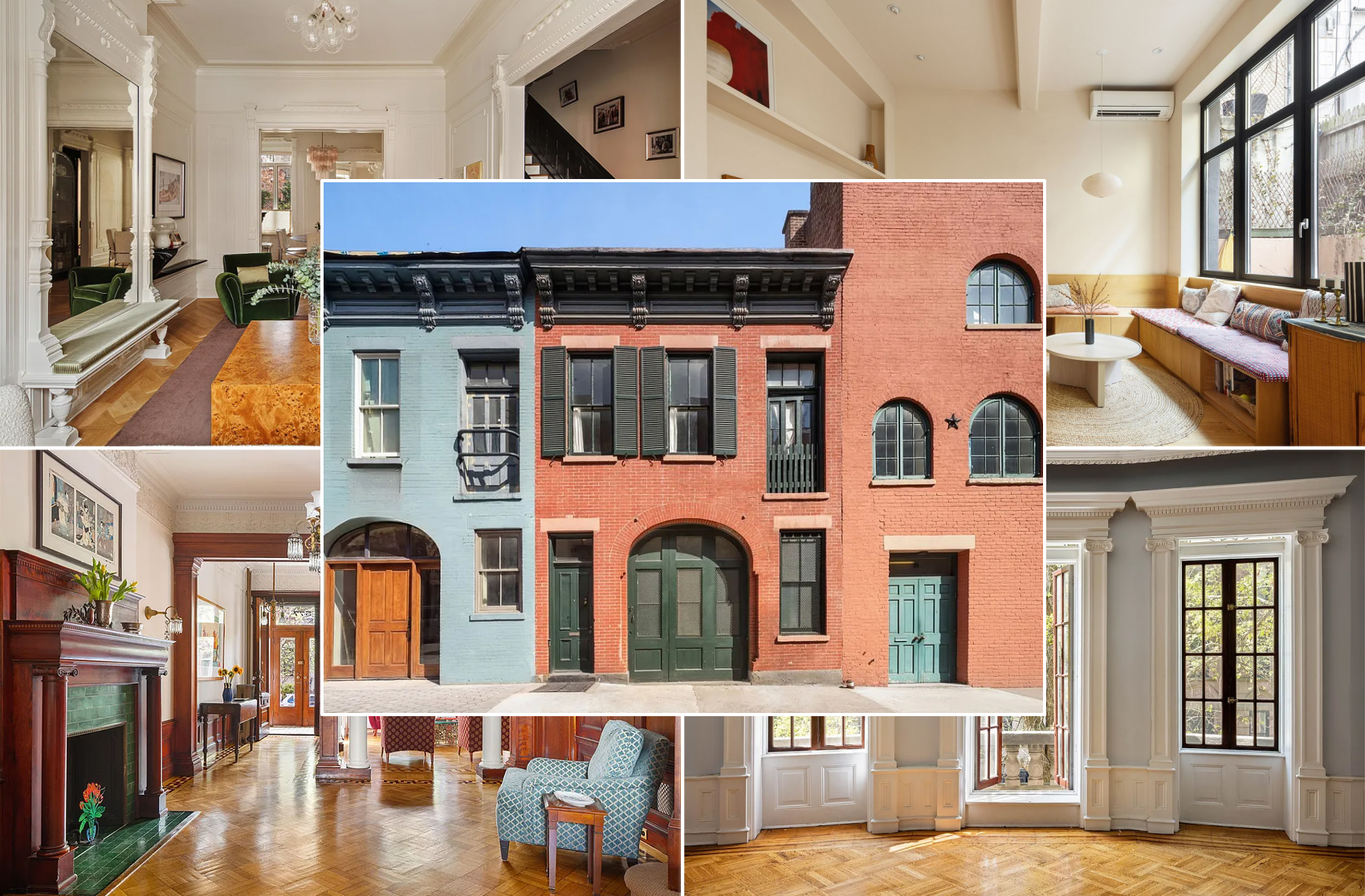
There was much talk about the shoddy upkeep and, some said, bad taste that had been visited on the brownstones during the twentieth century. That’s one nice thing about neighborhoods like Clinton Hill, where we live, Brownstoner said. No one ever had any money. His wife jumped in. It was, you know, basically a crack house, and it was covered in weird linoleum and industrial carpeting, she said. But when you peeled it back you got this incredible parquet. And then there were the mantels.
An exchange between Brownstoner and the buyer of a house in Windsor Terrace went like this:
W.T.: It’s a three-story.
Mr. B.: With a rounded front?
W.T.: It’s like a pointed bay.
Mr. B.: Uh-huh.
W.T.: And it was totally seventies Italian, you know—plastic-wood panelling everywhere and orange carpet and dropped ceilings.
Mr. B.: Wow.
Bystander: I never understood the dropped ceiling.
Mrs. B.: I know! What is it?
W.T.: The modern look, I guess. Or maybe for saving on heating?
Discussion of money matters proved only slightly more circumspect in person than online. Crown Heights and Bed-Stuy are seven, eight, and nine-hundred thousand dollars, the Crown Heights buyer said. Clinton Hill would be 1.5. And Park Slope would be 1.8. There was also talk about how rising prices affected the neighborhoods’ demographics. The diversity of the architecture and the people who live in Clinton Hill is peerless, Nathaniel Frank, an academic, said. I saw a study which said that, counter-intuitively, gentrification doesn’t necessarily lead to displacement. People make ends meet somehow; they double up, if they want to stay. They appreciate the neighborhood as different.
Among the guests at the Pioneer, only Lee Coker-Holmes (Nativegal, on the blog) said that she was Brooklyn-born and bred. She expressed mild bemusement at some of the interlopers, and at the labels they had affixed to various neighborhoods. I would say I grew up in Fort Greene, she said. But people on Brownstoner are, like, no, that’s Bed-Stuy. So I’m, like, O.K., fine. I can’t argue about that, because when I lived there they were both ghettos.
— Kate Julian


The anti-gentrification backlash in New York is negligible compared with other cities that have undergone similar changes.
Chicago, San Francisco — gentrification in these cities was accompanied by significant political movements opposed to the forces of gentrification.
Gentrification is by its very nature a politically charged scenario.
This web site appears to take a stance that gentrification is positive when it involves the renovation of brownstones by owners, but negative when done by flippers. Positive when a local gourmet food shop opens, negative when someone opens a dunkin donuts franchise. Positive when the neighborhood fills up with families, negative when it fills up with youngsters on trust funds. Brokers and developers are generally shown in a negative light, with a few exceptions. Of course, these actors are historically key to any real gentrification.
The political undertones of these choices are interesting, but seemingly go unquestioned on this web site. When someone does make a statement that goes against this conventional wisdom, the backlash is swift and unkind. Perhaps we should ask ourselves what gives us the moral authority to make such deliniations.
Uh, if you’re moving back to rehabilitate old buildings, doesn’t that insinuate that you also, at one point, left?
Also, it’s not racist to call “white people gentrifiers simply because they are moving in and repairing old buildings.” Moving in and repairing old buildings is the definition of gentrification.
What, did you JUST move here?
The earlier poster didn’t say it was racist to point out that truth. However, it is racist to exaggerate tne number of Brooklyn buildings that were used as crack dens in order to justify Brooklyn’s occupation by a bunch of square glass wearing richsters. It’s especially bad when the existence of some crack dens is used to justify taking the neighborhood away from people who weren’t crackheads, but who just happened to be poor and perhaps a little too brown for brownstone living. That sort of bullshit is racist, you self-satisfied little dandy. The (much earlier) post by someone who voted for Bush in spite of telling everyone s/he was voting for Kerry pretty much says it all. It takes more than two little square pieces of glass to hide a cracker.
You seem to miss the point that a lot of these buildings were crack dens at one point. It isn’t racist to point out the truth. It does happen to be racist to call white people gentrifiers simply because they are moving in and repairing old buildings. Besides, we aren’t focusing on the people like you who moved to Jersey and Long Island when things got bad, we are focusing on the people who are moving back now and working in conjunction with the older residents to make these neighborhoods better. Do us all a favor and go mow your lawn in the suburbs and leave the blogging to people who either weren’t so afraid they left or the people who are trying to make a life for themselves by coming here now.
Brownstoner created a forum where people can kiss his sorry ass. Let’s see by Monday how many posts he has deleted from this thread. Kate Julian, of The New Yorker hit the nail on the head. Me and the Mrs, were at Pioneer restaurant that day and what a disgrace. Mr Brownstoner and the rest of his Ilk there that day, have no clue what it is to be a brookynite.
The conversations made me sick to my stomach, and Kate Julian picked up on this, and kudos to her. Mrs. brownstoners’ comments are key.. the way everyone bashed the neighborhoods’ pervious residents, were one step from being raciest. quotes like “No one ever had any money, the pervious owners must have been crack heads, my brownstone had to be used as a crack house” How dare you denigrate the hard working people of this neighborhood. Not everyone has the privilege of working on Wall Street. It wasn’t the racist slander nor the lack of true Brooklyn history, and values that made us leave. It was the abundance of exposed electrical wires, dog shit and cigarette butts in the sand box, and rusty nails on the red benches, that got my wife to blow here top, and deemed it unsafe for our children.
If some people want to say they’re leaving, that’s their right. If you can’t handle that, I suggest you revert to some more heavily censored site.
Come on, Brownstoner created a forum for people to voice their opinions. It isn’t his fault if some of the people who choose to post are vapid egocentric hipsters. The only requirement for posting here is that you want to say something and you can type. The idiots who are saying that they won’t return after reading this thread are missing the point. They were able to post their opinion as well as read those of other people. If they have a problem with the egalitarian nature of the site then they should move somewhere where all of the people are of one opinion, and disenters are shot.
Wow. I just don’t know what to say anymore.
ISN’T BUSHWICK IN BROOKLYN? CAN I GET A JOB WITH MR.RICH? BUT THEN HE SOUNDS LIKE AN ASS SO HE PROBABLY DOESN’T PAY MUCH. CAN BROWNSTONER GET SPELLCHECK?