
Talk of the Town
We’ll be back to business-as-usual on Monday but in the meantime we’ll leave you with this week’s New Yorker piece about our one-year anniversary party last fall. One recent Saturday afternoon, some three hundred and sixty years after Dutch settler chartered the town of Breuckelen representatives of a more recent migration were milling around the…

We’ll be back to business-as-usual on Monday but in the meantime we’ll leave you with this week’s New Yorker piece about our one-year anniversary party last fall.
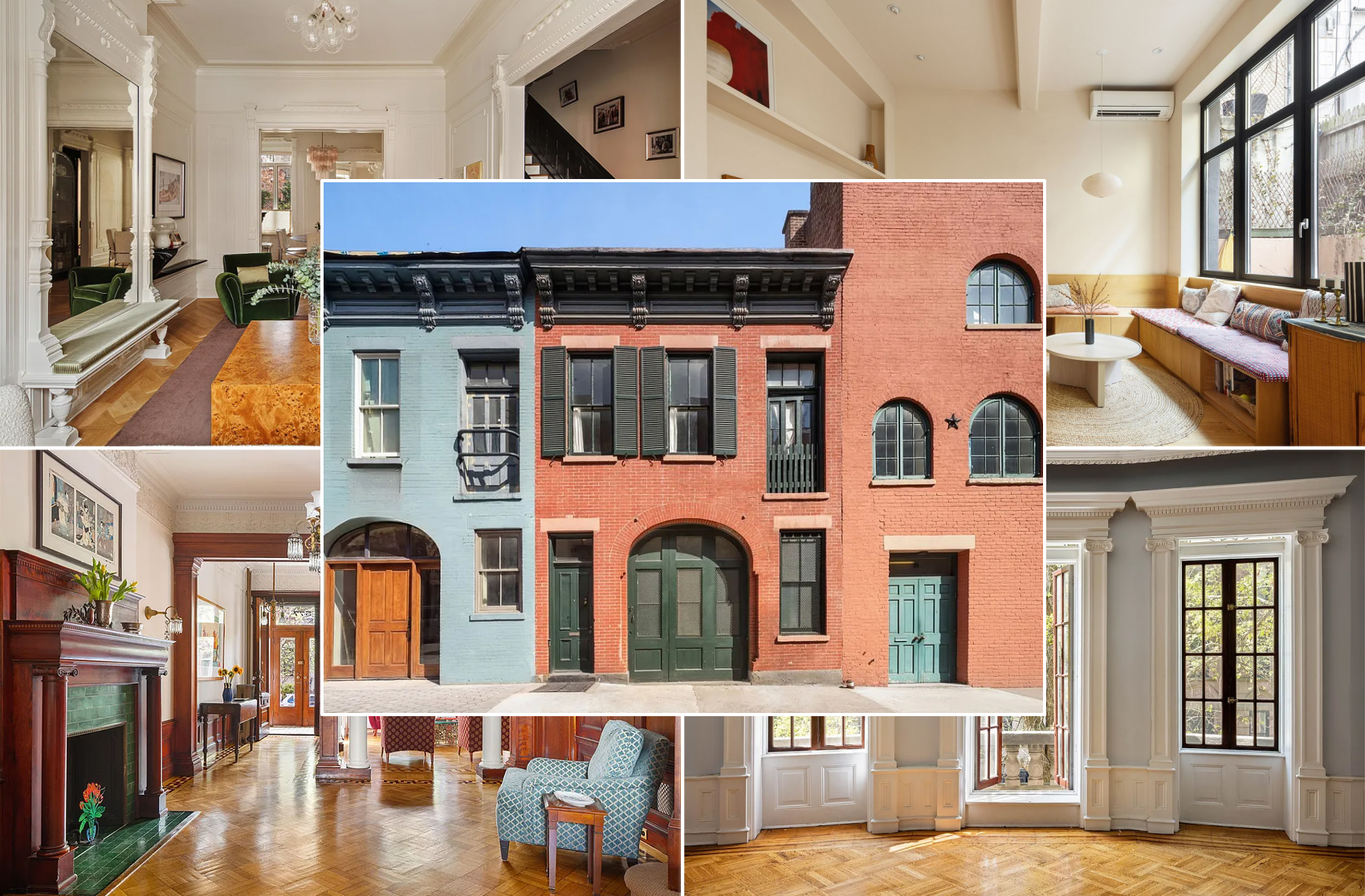
One recent Saturday afternoon, some three hundred and sixty years after Dutch settler chartered the town of Breuckelen representatives of a more recent migration were milling around the back patio of one of the borough’s newer bars. They had come to toast the first birthday of Brownstoner, a blog professing an unhealthy obsession wit historic Brooklyn brownstones and th neighborhoods and lifestyles they define. The party was in Red Hook, Brooklyn’s defunct dock district, so there were no brownstones in sight, but the bar’s name (Pioneer Bar-B-Q and the up-and-coming character of th neighborhood (Ikea and Fairway due to arrive soon) fit the spirit of the occasion.
Brownstoner is a virtual back fence for Brooklyn real-estate watchers. In frequent postings, its users vet listings, trade tips on brokers and neighborhoods, and gossip about who saw what at which open house. That place is a ‘five minute walk to Prospect Park’ only if you’re a giraffe, Linusvanpelt wrote recently. Why is the Chester Court listing so relatively affordable? Clinton hillbilly said. Was someone murdered there or something?
Housing Department: Emigres [New Yorker]
The blog’s founder, who works on Wall Street and who last year bought a fixer-upper in Clinton Hill, is known to readers as Brownstoner; his wife is Mrs. Brownstoner, or Mrs. B. Like Mr. and Mrs. B., most of the guests at the party were in their thirties; many wore expensive jeans and sneakers, and a disproportionate number of them had on eyeglasses with square frames. They travelled in pairs, towing a stroller and a child or two, and lived in neighborhoods that they described in optimistic tones as improving, including not only Clinton Hill but also Windsor Terrace, Bedford-Stuyvesant, and Crown Heights.
The group had its own vernacular, sprinkled with terms like pocket door, parquet, gut reno, Farrow & Ball (a brand of English paint with extra pigment), and the verb to rehab (as in, I bought a single-family house from a Louisiana minister. There were illegal tenants, one of whom died in contract. And then I rehabbed it). Some expressed feelings of connection to a bygone era. One woman on her move to Clinton Hill: I was reading a lot of Edith Wharton last summer, and it seemed so appropriate.
As Beck played over the loudspeakers and children tossed horseshoes, adults drank bottles of Stella Artois, gnawed on ribs, and compared notes about their paths to the outer boroughs. It was my dream, when I first found Brooklyn, to own a brownstone, one transplant from Manhattan to Crown Heights by way of Park Slope said. I didn’t think that Brooklyn was cool enough at first, an industrial designer said. But it’s, like, the cool borough right now. We really wanted to be in Clinton Hill, said his wife, a writer, describing their house hunt. Unfortunately, we were two years too late to really find a beater.
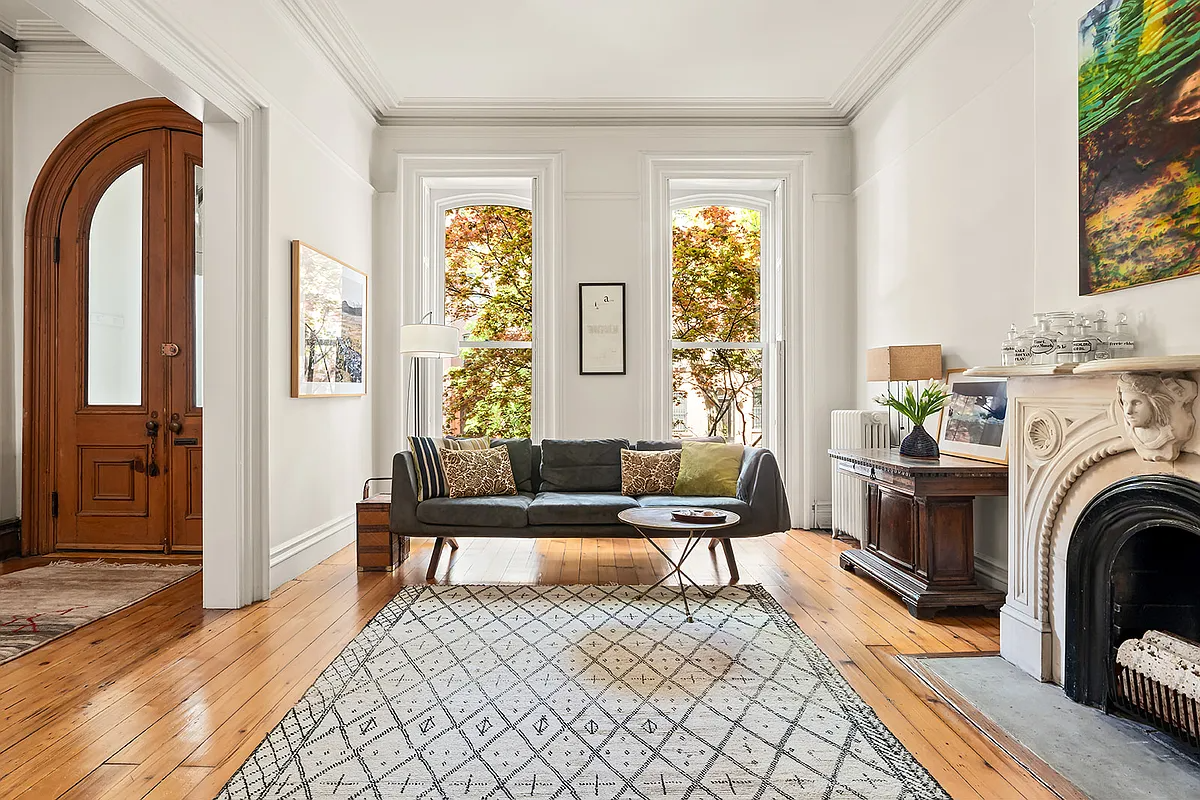
There was much talk about the shoddy upkeep and, some said, bad taste that had been visited on the brownstones during the twentieth century. That’s one nice thing about neighborhoods like Clinton Hill, where we live, Brownstoner said. No one ever had any money. His wife jumped in. It was, you know, basically a crack house, and it was covered in weird linoleum and industrial carpeting, she said. But when you peeled it back you got this incredible parquet. And then there were the mantels.
An exchange between Brownstoner and the buyer of a house in Windsor Terrace went like this:
W.T.: It’s a three-story.
Mr. B.: With a rounded front?
W.T.: It’s like a pointed bay.
Mr. B.: Uh-huh.
W.T.: And it was totally seventies Italian, you know—plastic-wood panelling everywhere and orange carpet and dropped ceilings.
Mr. B.: Wow.
Bystander: I never understood the dropped ceiling.
Mrs. B.: I know! What is it?
W.T.: The modern look, I guess. Or maybe for saving on heating?
Discussion of money matters proved only slightly more circumspect in person than online. Crown Heights and Bed-Stuy are seven, eight, and nine-hundred thousand dollars, the Crown Heights buyer said. Clinton Hill would be 1.5. And Park Slope would be 1.8. There was also talk about how rising prices affected the neighborhoods’ demographics. The diversity of the architecture and the people who live in Clinton Hill is peerless, Nathaniel Frank, an academic, said. I saw a study which said that, counter-intuitively, gentrification doesn’t necessarily lead to displacement. People make ends meet somehow; they double up, if they want to stay. They appreciate the neighborhood as different.
Among the guests at the Pioneer, only Lee Coker-Holmes (Nativegal, on the blog) said that she was Brooklyn-born and bred. She expressed mild bemusement at some of the interlopers, and at the labels they had affixed to various neighborhoods. I would say I grew up in Fort Greene, she said. But people on Brownstoner are, like, no, that’s Bed-Stuy. So I’m, like, O.K., fine. I can’t argue about that, because when I lived there they were both ghettos.
— Kate Julian
just a final ( i hope) note – all this race stuff is being generated by you on this thread – brownstoner and the regulars(many of whom are black) (i am one) do not go around calling black people this or that. Of course given the nature of our discourse, we touch upon issues of class and by extension, race. But I have found that by and large it’s a bunch of contendly nerdy real esate and fixer-upper buffs, who, yes, happen to have saved up to buy their homes in formerly blighted areas…take your hatin’ elsewhere, my friends – attack the real enemy, not a bunch of middle class liberals. Ultimately that’s what i think our friend at the New Yorker was poking gentle fun at…
I’m just waiting now for someone to tell us all about how the black people forced out of Ft. Greene were all drug dealers and crack heads. Good grief….is this Broolyn or Mississippi?
I’m with Meryckawick.
If you really think that there has been no displacement of black people in Fort Greene, you must either be blind or have some kind of stake in believing that. In the past six years—the time I’ve lived there—it’s become so noticeably whiter. It’s probably true that Ft. Greene is one of the richest black communities in America, but what that mainly means is that the black people who remain are the richest ones, who own their apartments and aren’t subject to rent increases. But to argue that rising rents have not forced out black renters is risible. I don’t have any stats, but my eyes saw my rental building go from 90% black to about 10%, and my eyes see the playground in Ft. Greene park almost exclusively used by white children. This is value neutral—I’m not trying (here) to argue that it’s racist, or injust—only that it’s incontrovertible.
District 35 is comprised of a few different neighborhoods. Black Enterprise wasn’t talking about them in their article, just Fort Greene. And however you want to tally wealth, large numbers of people owning homes worth well over a million dollars with no mortgage means a lot of people have are rich. That is why Fort Greene is the richest black neighborhood in America, and why arguments about displacement in Fort Greene and Clinton Hill are the same old racist anti-white arguments we’ve heard for years.
Actually, Fort Greene is definitely NOT rich. My husband used to work there for years, doing community development. The median income there is actually slightly below the median income for Brooklyn.
If you are interested, here’s a link:
http://www.nylcv.org/ecofiles/brooklyn/html/ccd35.htm
I was not surprised to read the description of the party, although I wasn’t there. I do read this site fairly regularly, and there is a bit of a pretentious quality in the comments here (not in Brownstoner’s writing, though, imo). Usually, I just find the competitiveness kind of amusing, and overlook it for the housing discussions that really are worthwhile. Sounds like the reporter may have felt the same way about the “live” crowd.
Seemed to me that she was just repeating stuff that was said and wasn’t being snarky.
Pilgrim, thanks for reminding us of how much we’ve forgotten when it comes to the recent history of NYC real estate. Thanks even more for reminding us not to take our comfortable situations for granted. We’ve somehow acquired a mindset of ‘entitlement’ that makes it hard for us to appreciate just how lucky we are.
TO ALL “URBAN PIONEERS”
Put down your hammers and saws for a minute and give thanks to all those banks and financial institutions who REDLINED most of Red Hook, South Brooklyn, Bushwick, BedSty, almost all of Northern Brooklyn as BAD RISKS for demographic (read racial) reasons back in the early 70’s. As the ethnic whites (read Irish and Italian) left as the “minority” populations encroached on their neighborhoods, banks, by making mortgage financing impossible to obtain, ensured that demand would decrease, property values decrease, building maintenance and repair decrease….Landlords basically ran their buildings into the ground to make a profit. Forget about paying taxes. Decay was assured. However not everyone could afford to flee to the suburbs. By 1975-76 federal and state laws began to address this redlining problem and the American urban housing crisis. One way was to give money to not-for-profit housing coalitions that then began to fight for the renewal of these abandoned people/ properties. This urban renewal made these previously unattractive ghettos suddenly prime targets for speculators, developers, and urban pioneers to rediscover. Does anyone remember when Chelsea was a Hispanic neighborhood? Or for that matter when the Alphabet City was almost entirely Jewish? By the late 70’s-early eighties almost one third of L.E.S. buildings were in REM for failure to pay taxes. Everyone knows gentrification (unstoppable) eventually displaces the poor working class. We need to remember that most did not go willingly. Our sense of history is so short that we don’t have any ideas as to what political and market forces were at work over time to place that crackhead on your front stoop and drive the prices down low enough for you to be able to buy it in the first place.. Ok pick up your hammers and saws and get back to work being thankful for the gift of a roof over your head..