
Harvard Soph Sees Upside of Bubble Bursting
Maybe those Harvard kids are kinda smart. We opened this editorial by sophomore Charles Drummond expecting a chuckle and nothing more. Turned out, the guy has a point, seeing the silver lining of a real estate market correction: There is another bubble that I hope will burst very soon—the ugly housing bubble. If you’ve ever…


Maybe those Harvard kids are kinda smart. We opened this editorial by sophomore Charles Drummond expecting a chuckle and nothing more. Turned out, the guy has a point, seeing the silver lining of a real estate market correction:
There is another bubble that I hope will burst very soon—the ugly housing bubble. If you’ve ever had the misfortune of visiting an upper-middle class subdivision, you know exactly what I’m talking about. Once you’ve found a subdivision that sounds like a WASPish Connecticut country club, you’ll be perfectly prepared to take in the grotesqueness of your surroundings. A guidebook, however, is entirely unnecessary. These subdivisions are filled with the easily identifiable domicile sometimes referred to as the McMansion. The McMansion design seems to me to have been originally conceived as an anesthetized imitation of the past, a sort of fairy-tale version of grandeur meant for mass consumption. As such, it is inevitably an artistic failure.
Luckily for him, this guy isn’t in a glass house throwing stones. He happens to currently reside in Adams House, which has arguably the best architectural bones of any of Harvard’s residential colleges.
The Ugly Housing Bubble [Harvard Crimson]


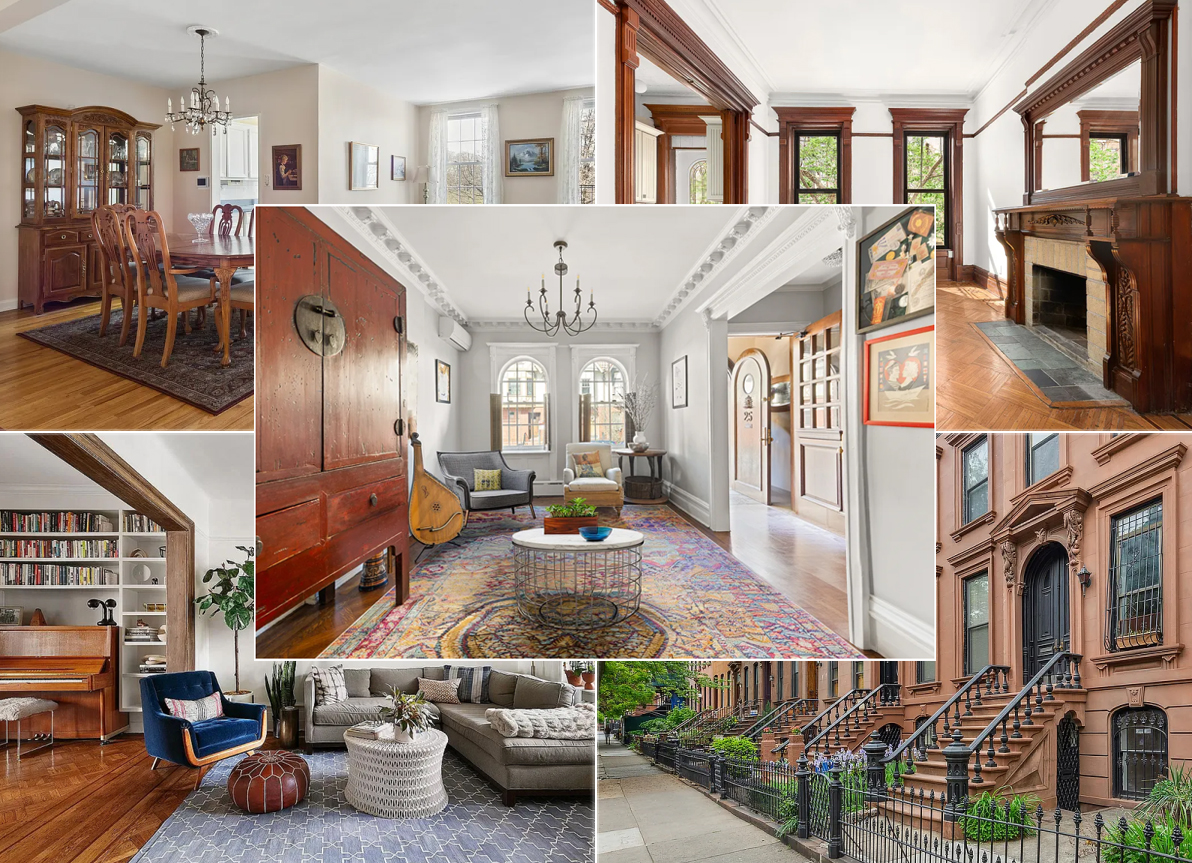
David and Sylvia,
You guys should get together for drinks…
David,
I’m not trying to “claim” anything. You can read into what you want. Yes, I prefer plaster to sheetrock, but if I was building a brand new home, which I would never do, I would probably use sheetrock. Does that make you happy? Have a nice weekend.
super lame and bogus. why are you promoting harvard in your blog? and why do we care to even think about mc mansions, leave it to westchester. LAME
Anon 5:18, thanks for the input. I’m willing to re-examine my ideas about skyscrapers vs brownstones, and I do understand your point that it’s not just an issue of cost effectiveness, but also of energy efficiency/efficiency in other services.
But for now: for skyscrapers to be viable, (and we’re just talking about as residential structures, which, generally, they aren’t) they’d still have to be in a smaller town setting (which, generally, they aren’t). And we’d still have to put some alternative energy source to work to HVAC them and power their elevators and their water pumps.
Here’s what I don’t know: who’s the winner, in terms of energy efficiency, skyscrapers or old townhouses, when you factor in:
– economies of scale
– elevator usage
– water pumping
– the fact that townhomes don’t necessarily need air conditioning/venting, whereas skyscrapers need entire HVAC systems
Maybe that’s putting the question too generally, and we’d need to look at specific skyscrapers vs specific townhouses? I’m not an engineer or an architect, anyone have any input?
Economies of scale have nothing to do with oil or its abundance – in fact it becomes more important if energy is scarce – since if energy is more scarce then each unit saved is more valuable.
Therefore if oil was $1000 a barrel it would be even more important to heat/cool and power our homes in the most efficient manner possible – as well as move people around in the most efficient way possible. And while it certainly looks nice the “New Urban ideal” isnt the most efficient (at least not in terms of energy efficiency) – huge buildings in close proximity to mass transit like trains is far, far better.
This model is also enviromentally better because it concentrates pollution in one are where it can also be handled more economically and where it has a lesser impact on the surrounding enviroment.
Look most people are nostalgic for the simpler time that we think small towns, local farms and even Brownstones represent, but those times werent so rosy and even if they were we live in a different world now and no matter how much we wish it to be the case, the solution to our current and upcoming issues isnt to try to go back to some Norman Rockwell painting.
I’m afraid if you really believe the enviromental and energy diasters you predict are so imminent (I dont btw) then the world you should be advocating for (and the one we will end up anyway – with if we are to survive) – will look alot more like the Atlantic Yards proposal(w/o the Gehery designs) then Brownstone Brooklyn or Main Street USA.
sylvia- David is right… economies of scale apply whatever the resource being used… The question is how much of the resource each person uses. When people live together in a big bldg, each person uses less…
It is hard to argue convincingly that skyscraper apartments are not efficient. They are efficient not just in terms of heat/energy, but even in terms of human services- trash collection, door men, postal delivery, etc.
Your views on the oil crisis, which I think are generally correct, do not necessarily fit well with your pro-brownstone views.
That is ok, you should live with your inconsistencies as we all do. But arguing as you are is just mixing things up, and undermining your argument.
Sorry, I know I sound very pessimistic on this issue. I am. None of these are my own original ideas, by the way, I’ve just done a lot of reading/research on the subject. Google “peak oil” if you want to look up any of the stats yourself. Better yet, start with the wikipedia entry on “Hubbert peak theory”.
David, you don’t need to resort to ad hominem attals to prove your point. I actually don’t live in a brownstone, and don’t own one, although I wish I did and could. Which is why I’m on this site. I’m a lovah, not a hatah.
I do understand your point about economies of scale. We use oil to heat and transport and do everything we do because economies of scale make it more cost-efficient. The reason for that is that oil is cheap. My point is, very soon, it will no longer be cost-efficient. Very soon, demand for oil will outstrip supply, and we will have to change the way we do things.
Anon 3:51, there is no other energy source that is so readily available AND easily storable AND easily transportable AND has such a high return on energy input/energy output. Solar energy is readily available but not easily storable/transportable and it relies on the use of technology that is dependent on oil-based systems of production/shipping of parts. Nuclear is not easily storable or transportable. Ethanol fuel requires almost as much energy inputs (petrochemical fertilizers, for example, to maintain the monocultural farming necessary) as it provides in energy output. Wind, hydro, both wonderful and clean, but not transportable or storable.
So unless we discover something else in the next few years and find the political will to implement a system-wide switch, we’re in trouble.
And David, monocultural megafarms are part of the problem. They continuously farm the same huge tracts of land over and over, with no switching of crops and no lying-fallow time in between, so they completely deplete and erode the topsoil. The only way we’ve been able to keep that soil producing food year after year is by pumping petrochemical fertilizers into it. So that’s about to come to an end too. And we’ll be left with almost no useable topsoil (in Iowa alone they estimate that 50% of the original topsoil is completely gone).
So yeah, economies of scale. Economies of an oil-based society scale. Once oil isn’t the readily available, cheap commodity that it is now, we won’t be able to indulge in that kind of economy of scale.
Brava, Sylvia! Well said, indeed.