
Harvard Soph Sees Upside of Bubble Bursting
Maybe those Harvard kids are kinda smart. We opened this editorial by sophomore Charles Drummond expecting a chuckle and nothing more. Turned out, the guy has a point, seeing the silver lining of a real estate market correction: There is another bubble that I hope will burst very soon—the ugly housing bubble. If you’ve ever…


Maybe those Harvard kids are kinda smart. We opened this editorial by sophomore Charles Drummond expecting a chuckle and nothing more. Turned out, the guy has a point, seeing the silver lining of a real estate market correction:
There is another bubble that I hope will burst very soon—the ugly housing bubble. If you’ve ever had the misfortune of visiting an upper-middle class subdivision, you know exactly what I’m talking about. Once you’ve found a subdivision that sounds like a WASPish Connecticut country club, you’ll be perfectly prepared to take in the grotesqueness of your surroundings. A guidebook, however, is entirely unnecessary. These subdivisions are filled with the easily identifiable domicile sometimes referred to as the McMansion. The McMansion design seems to me to have been originally conceived as an anesthetized imitation of the past, a sort of fairy-tale version of grandeur meant for mass consumption. As such, it is inevitably an artistic failure.
Luckily for him, this guy isn’t in a glass house throwing stones. He happens to currently reside in Adams House, which has arguably the best architectural bones of any of Harvard’s residential colleges.
The Ugly Housing Bubble [Harvard Crimson]


I had a friend who tried to develop a McMansion project upstate in Westchester and you’re right Tinarina. The have a book, and the client picks and chooses. Part of the problem really is that while theses homes are called “custom,” they are really prefab with choices.
They go up relatively quickly and cheaply- costs get cut somewhere. The materials they use, in sheer quantity alone is huge- offsetting that would be cutting down as much as possible in construction and labor. Old framing was set at -what was it? 16 inches. They are more spread out in new construction. Less material cost and less labor. Cast urethane architectural elements are much cheaper than carved wood. etc. The scale is to ego, not biology or practicality. I bet in a 100 years most of those houses (if they are still standing) will have been broken down into apartments and sro’s. McMansions are built huge and flashy. All for show. the old Victorian mansions were built for similar reasons, but also with the underlying idea that quality was the important issue. The Astors, the Hearsts, the robber barons- they demanded the best for their money. Granted they would be totally unaffordable except to the richest, but nothing changes the fact that McMansions are a sad imitation of what architecture should be.
Certainly there are conspicuous consumers of brownstones and McMansions, but Drummund’s right in that most McMansions are UGLY!
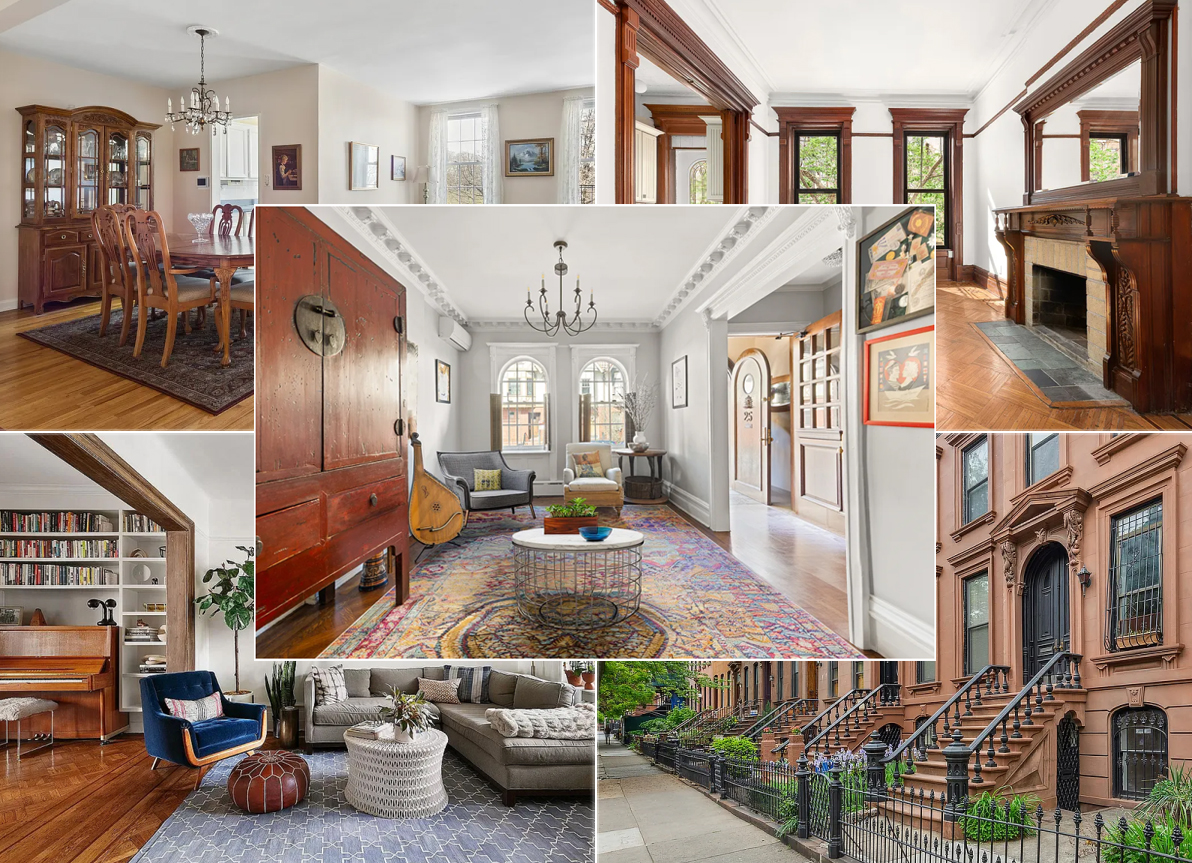
Brownstones were the status symbol of their day, but the proportions were and are still pleasing, and the architectural elements make sense.
I recently drove through a neighborhood of expensive spec houses in New Jersey, and they seem to be built using a checklist of architectural bells and whistles…a Palladian window! I gotta have one of those! Never mind that the window is totally out of scale for the house, and has fake mullions on the inside. Then add on say, a cupola and some Corinthian columns and you have a big mess. Oooh, how fancy!!
Even to the uninitiated, these houses just look wrong, and I suspect they will still look wrong 50 years from now.
This is a 3-day-old thread, so I doubt anyone’s going to check it again, but just to respond to OE really quickly: we’ve already been looking for oil in more and more remote places, and using better and better technology to drill for it once we find it. But oil field discoveries have dropped off dramatically in the last 30 years or so. Our oil field discovery rate is nowhere near keeping pace with our oil field depletion rate. Not to mention that remote areas, like areas that are hostile due to war, political instability, etc, make it exponentially more expensive and difficult to extract the oil once it’s found.
And peak oil as a theory just takes what we know about individual oil fields’ production (which follows a bell curve, more or less), and applies it to larger groups of oil fields. It has been proven correct at least once: Back in the 1950s, Hubbert created an equation predicting our peak in national oil production and said it would happen in the 1970s. And it did. It’s not really an issue of IF there’s going to be a global peak, we know that the model works, it’s just a matter of WHEN.
And hydrogen fuel cells do look very promising. They’re clean, they’re efficient. The only problem is, they’re not very well tested yet, at least not on a large enough scale to make them meaningful. And we would have a huge amount of work ahead of us (decades, probably), if we really wanted to switch all of our energy supply systems over to hydrogen fuel cells. We’d have to get started last year, basically, and build massive numbers of cars/trucks/planes that are capable of using hydrogen fuel cells, using oil-powered production factories to do so. We’d also need to use massive amounts of, among others, platinum, copper and silver, which we don’t have (those particular natural resources are also becoming scarce).
I think hydrogen fuel cells are probably a great idea, and should be pursued with as much public enthusiasm as possible. But I don’t think they’ll be able to save the McMansion culture.
Isn’t the difference between owning a brownstone and building a McMansion, that in the case of a brownstone we are effectively recycling a previous residence thus saving materials and the environment. Also, in terms of scale, I do agree that we might all be better off in studios in skyscrapers, but aren’t brownstones much less conspicuously consumerist than McMansions? Until, I guess, you gut them out and put in granite, stainless steel, concrete floors, forced air systems and whatever the Joneses latest fad is.
Another article downing the ownership of a McMansion here:
http://www.violentacres.com/archives/35/mcmansions-are-for-mcidiots
I think the teardown factor is entirely the point in the development of McMansions. They are not built to last but to be torn down and replace by the next housing fantasy fad thus fueling the economy. Unless we wake up……
That was me @ 8:09pm
the oil peak theory is very speculative… in fact, as oil gets more expensive, the world will just drill in more remote locations, which should sustain mankind for quite a while.
Now what about hydrogen fuel cells? solar, nuclear, hydro, wind will be able to fill up those cells, which we’ll be able to use similiarly to oil today.
How can so many of you look down on someone who buys a McMansion in terms of displaying wealth? Most McMansions outside of the immediate NY area are in the hundreds of thousands of dollars rather than the millions. So does someone who buys a brownstone doing so because they love the home and want to live in a particular spot…or is it to outdo the jones? Give me a break. Lets stop judging everyone else for a moment b/c every single person who reads this blog is just as much of a whore to consumerism as McMansion buyers.