Past and Present: The Stewart McDougall Farm
A look at Brooklyn, then and now.
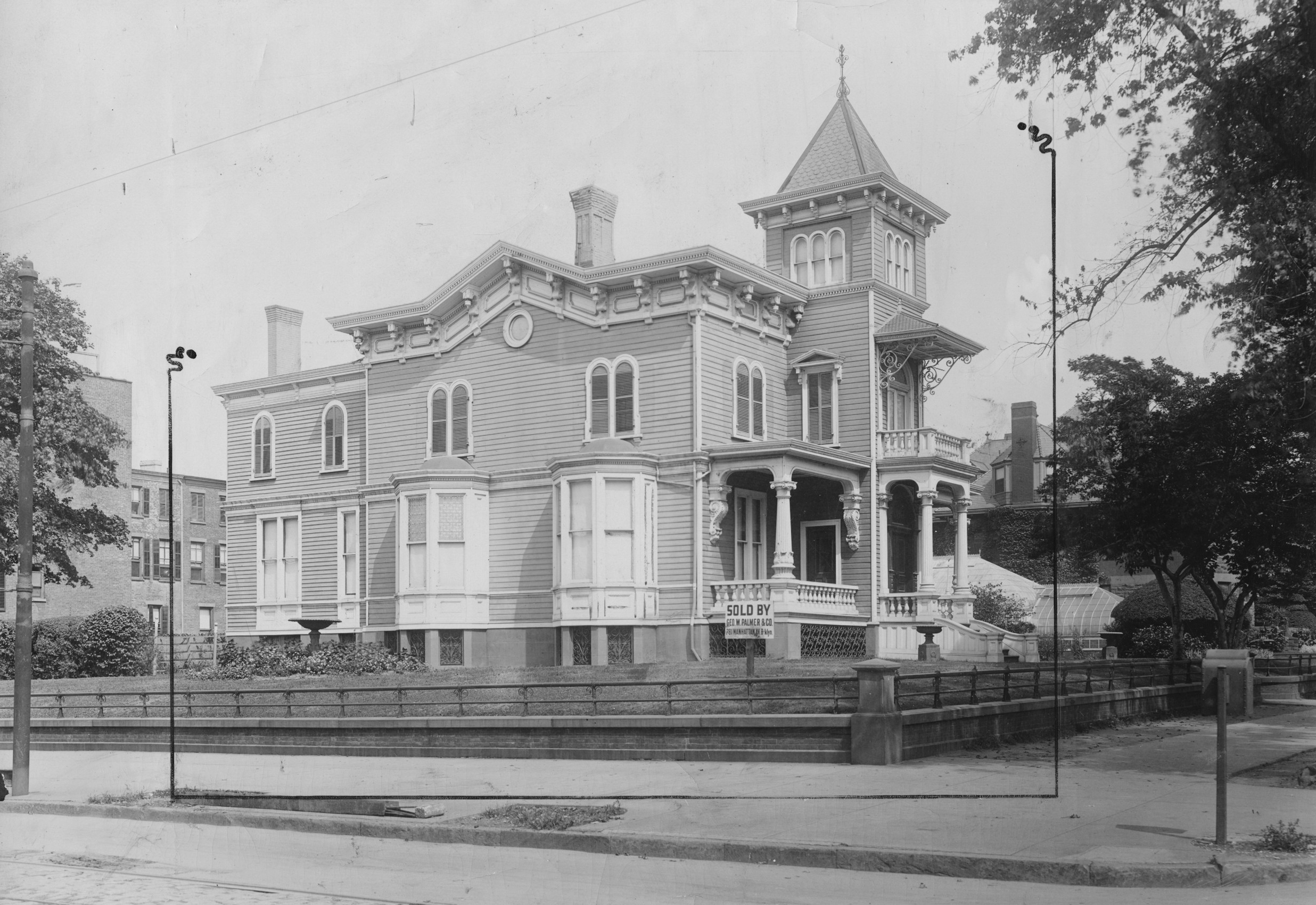
As Brooklyn developed as a city, in the 1800s, communities began to spread out from the ferry and the Heights in a concentric wave. Led by improved transportation facilities, the city grew, as areas once thought remote farming areas then became suburbs, then city. That was just in the old town of Brooklyn. Six towns, as we know, became the city of Brooklyn, and by the late 1800’s, there were people living just about everywhere within the borders of Kings County. Brooklyn, Bushwick and the Williamsburg areas developed first and fastest, due to location, transportation, the piers and shoreline, subsequent industries, and proximity to Manhattan,. The more remote towns, like New Utrecht, Gravesend, and Flatbush, stayed rural farmland much longer. But in the southern parts of Brooklyn, a smart man knew that change would be coming, and wealth and prosperity were tied to the land.
Stewart McDougall was one of those smart men who was there at the right time, with money in his pocket, and the ability to see what the future would hold. He had been born upstate, in Washington County, and came to Manhattan as a young man, and was a successful wholesale poultry and game merchant at the Washington Market, in Greenwich Village. In 1864, he bought his first farm in the southwestern corner of Kings County, in the town of New Utrecht. At the time, there was nothing but farmland in the area as far as the eye could see.
Over the period of the next twenty-five years, he bought more and more land around his original farmstead, eventually becoming the largest landowner of farmland and pasture in Brooklyn. There were certainly other huge landowners, the Bedford branch of the Lefferts family most immediately come to mind, but they sold most of their property back in the 1850s, as the city of Brooklyn grew. Stewart McDougall was just getting started. (more…)
Building of the Day: Prospect Park Picnic House
Brooklyn, one building at a time.
Name: Prospect Park Picnic House
Address: Prospect Park, behind Litchfield Villa at 5th Street and Prospect Park West
Neighborhood: Park Slope
Year Built: 1927
Architectural Style: Colonial Revival
Architect: J. Sarsfield Kennedy
Other Work by Architect: “Gingerbread House,” Bay Ridge; houses in Prospect Park West, Brooklyn Heights, Park Slope and elsewhere.
Landmarked: Prospect Park is landmarked, and this building falls within it, so technically I believe it is.
The story: The grass had hardly begun to grow in the new Prospect Park before eager picnickers swarmed the Long Meadow and other areas, eager to enjoy the outdoor spaces. The year was 1868, and the park wasn’t even done yet, and the city had received seven permits for groups of over 100 people who wanted to be able to have a picnic. In response, a picnic shelter and concession stand was built in 1876 to make a day in the park easier.
The popularity of the park grew steadily, and as time went by, more shelters, restaurants and other buildings were added inside the park, all designed to make the park experience easier for patrons, and to add to the ambiance of the park. Some of the buildings were quite charming, some quite unusual, and some just silly. (more…)
Walkabout: Trains, Automobiles and Undying Love, Part 2
“Can it get any worse?” That’s what Dwight Pardee probably asked his wife Mary, after their oldest child had the details of his very short and very public bad marriage published in newspapers across the country in 1909 and 1910. Dwight W. Pardee was the Secretary of Cornelius Vanderbilt’s New York Central Railway, and twenty year old Roy Pardee was a young man in love with a pretty girl and the idea of marriage. His whirlwind marriage to twenty-two year old Lillian Beasley, a supposed recent widow and current chorus girl, resulted in twenty days of wedded bliss, ended by her spending, and his suspicions of her wandering eye, and finally a messy divorce, with the details written for all of the country to read. For all the details on this juicy story, and the early story of Brooklyn’s Pardee family, check out Part one of our story.
If Mary Pardee had been clairvoyant, she might have answered her husband by saying, “You think this is bad? You haven’t seen anything yet, my dear. Our daughter is going to make even bigger headlines than Roy ever could.” And so she did. The Pardees lived at 1310 Dean Street, in the St. Marks District, now Crown Heights North. Like many wealthy people, they also had a summer home, this one in Bay Shore, Long Island. With all of the mess going on with young Roy, the Pardees found themselves out in Bay Shore a lot, escaping the prying eyes of the press and the curious.
Elsa Pardee was just nineteen, and was herself, tall, dark haired and pretty. She had just graduated from finishing school, and was looking forward to a summer with her friends, especially her best friend, Marion Van Kleek, who lived only three doors away from their Dean Street home, at 1316 Dean. The Van Kleeks had their summer home upstate, at Lake George, and the girls planned to spend time at both cottages during the summer. The only problem was that the Pardees were short on a chauffeur. (more…)
Building of the Day: 145 Lincoln Road
Brooklyn, one building at a time.
Name: Apartment building
Address: 145 Lincoln Road
Cross Streets: Flatbush and Bedford Avenues
Neighborhood: Prospect Lefferts Gardens
Year Built: 1929
Architectural Style: Tudor/Medieval Revival
Architect: Boris W. Dorfman
Other Work by Architect: Similar type apartment buildings all over Brooklyn and Queens
Landmarked: No
The story: I guess in part because I never lived in one until I moved to New York City, I find apartment buildings of a certain age rather fascinating. The American Dream of home ownership has always stressed the single family house as the quintessential American dwelling, but the fact of the matter is that in a city like New York, more people live in apartment buildings than live in houses. There will always be more renters than owners, and most of those renters live in apartment buildings. Chances are, especially if you are in Brooklyn, the Bronx, or upper Manhattan, that apartment will be in a six story apartment building built sometime between 1922 and 1934, a time of great social migration into the “outer boroughs.”
As I have mentioned on several occasions, these buildings were built for the children and grandchildren of the immigrant families who were moving as fast as possible out of the tenements of the Lower East Side, Hell’s Kitchen and Williamsburg. They had become Americans, were educated in New York’s schools, spoke English outside of the home, and were assimilating into the culture. They were getting better jobs, making more money, and wanted out of the crowded tenements. The developers were waiting for them with open arms. (more…)
Building of the Day: 1515 Bedford Avenue
Brooklyn, one building at a time.
Name: Originally the Savoy Theater, then Charity Neighborhood Baptist Church
Address: 1515 Bedford Avenue
Cross Streets: Corner of Lincoln Place
Neighborhood: Crow Hill/Crown Heights North
Year Built: 1926
Architectural Style: Neo-Classical
Architect: Thomas Lamb
Other Work by Architect: Many theaters in Manhattan and Brooklyn, including the Loew’s Bedford, now Washington Temple on Bedford and Bergen, and Loew’s Pitkin Theater in Brownsville. In Manhattan, Loew’s 175th St. Theater and Warner’s Hollywood Theater, now Time Square Church.
Landmarked: No, which is the focus of this story.
The story: I actually featured this building a long time ago, in an early BOTD from 2010. You can see it here. No one commented then; perhaps you will comment today. This last weekend, Morgan Munsey and I were leading a rain soaked but enthusiastic group of people on a walking tour of Bedford Avenue’s Automobile Row, and this building was one of the featured stops on the tour. As I was talking about the building, I noticed that the sign for Charity Baptist was no longer visible, and there was a dumpster in front of the building. One of the guys on the tour lives in Crown Heights, and knew what was going on, and here’s the sad story: The Savoy will soon be rubble. (more…)
Walkabout: Trains, Automobiles, and Undying Love, Part 1
Dwight W. Pardee was born in New Jersey in 1852. He was educated in public schools, and attended the Wilbraham Academy in Wilbraham, Massachusetts. His first job was at the Fourth National Bank in New York City, and then he entered the railroad business. Cornelius Vanderbilt’s many railroad holdings became his career. In 1884, he became the Assistant Treasurer of the Lake Shore & Michigan Southern Railroad Company, and in 1889 he became Secretary of the Dunkirk, Allegheny Valley, and Pittsburgh Railroad Company. He then landing a plum job at the business office at Grand Central Station. When the Secretary of the New York Central Railroad died, Dwight Pardee assumed his job, and successfully handled the business affairs of the largest railroad system in the country. That demanding career was easy, compared to running afoul of the law in his automobile, and the love affairs of his only two children. This is the Pardee family story.
Dwight Pardee and his wife Mary had two children, Roy and Elsa. They were two years apart, and Roy was the eldest. By the time they were young adults, the Pardees were living at 1310 Dean Street, in a George Chappell designed row house featured as a Building of the Day, last week. The Pardees were wealthy; being an executive for the Commodore paid very well, and the family enjoyed all of the perks that came with being quite well-to-do. They, like everyone else in the St. Marks District, had servants in the household, including maids, cooks and chauffeurs. Mr. Pardee was driven to work every day, and after automobiles replaced carriages, he was driven around in a handsome open touring car. (more…)
Building of the Day: 185 Stratford Road
Brooklyn, one building at a time.
Name: Private house
Address: 185 Stratford Road
Cross Streets: Albemarle and Beverley Road
Neighborhood: Prospect Park South
Year Built: 1901
Architectural Style: Colonial Revival
Architect: John J. Petit
Other Work by Architect: 131 Buckingham Road (Japanese House) as well as many other houses in Prospect Park South. Also Saitta House in Dyker Heights, and other works in Brooklyn.
Landmarked: Yes, part of Prospect Park South HD (1979)
The story: This house is one of John J. Petit’s most inventive takes on the Colonial Revival Style. Petit, as the head architect of Dean Alvord’s Prospect Park South development, was unsurpassed at mixing styles and motifs, and his houses in Prospect Park South are a lasting testament to this talent. Where else would one see a Japanese/Queen Anne/Foursquare? Or a block with Tudor, Mediterranean, classic Queen Anne and Colonial Revival Temple front houses, all within sight of each other, all somehow managing to work as a neighborhood whole?
The Landmarks Preservation Commission loved this house. Here’s what they said about the design: “John J. Petit’s imaginative juxtaposition of a symmetrical double-tiered veranda against the front of an asymmetrically-fenestrated dwelling block creates the mannerist effect of a complex, screen-like facade, whose two contrasting layers are unified under a flaring hipped roof. This visual ambivalence — similar in concept to much Post-Modernist design of the 1970s — is intensified by the application of richly-modeled Classical elements to the open porch framework, while the house itself is enclosed by spare, shingle planes with simply framed doors and windows.” (more…)
Building of the Day: 1310-1314 Dean Street
Brooklyn, one building at a time.
Name: Row houses
Address: 1310-1314 Dean Street
Cross Streets: New York and Brooklyn avenues
Neighborhood: Crown Heights North
Year Built: 1888
Architectural Style: Queen Anne
Architect: George P. Chappell
Other Work by Architect: Row and freestanding houses in Park Slope, Bedford Stuyvesant, Clinton Hill, and especially Crown Heights North. Also churches and storefront/flats buildings in Bed Stuy and Crown Heights.
Landmarked: Yes, part of Crown Heights North HD (2007)
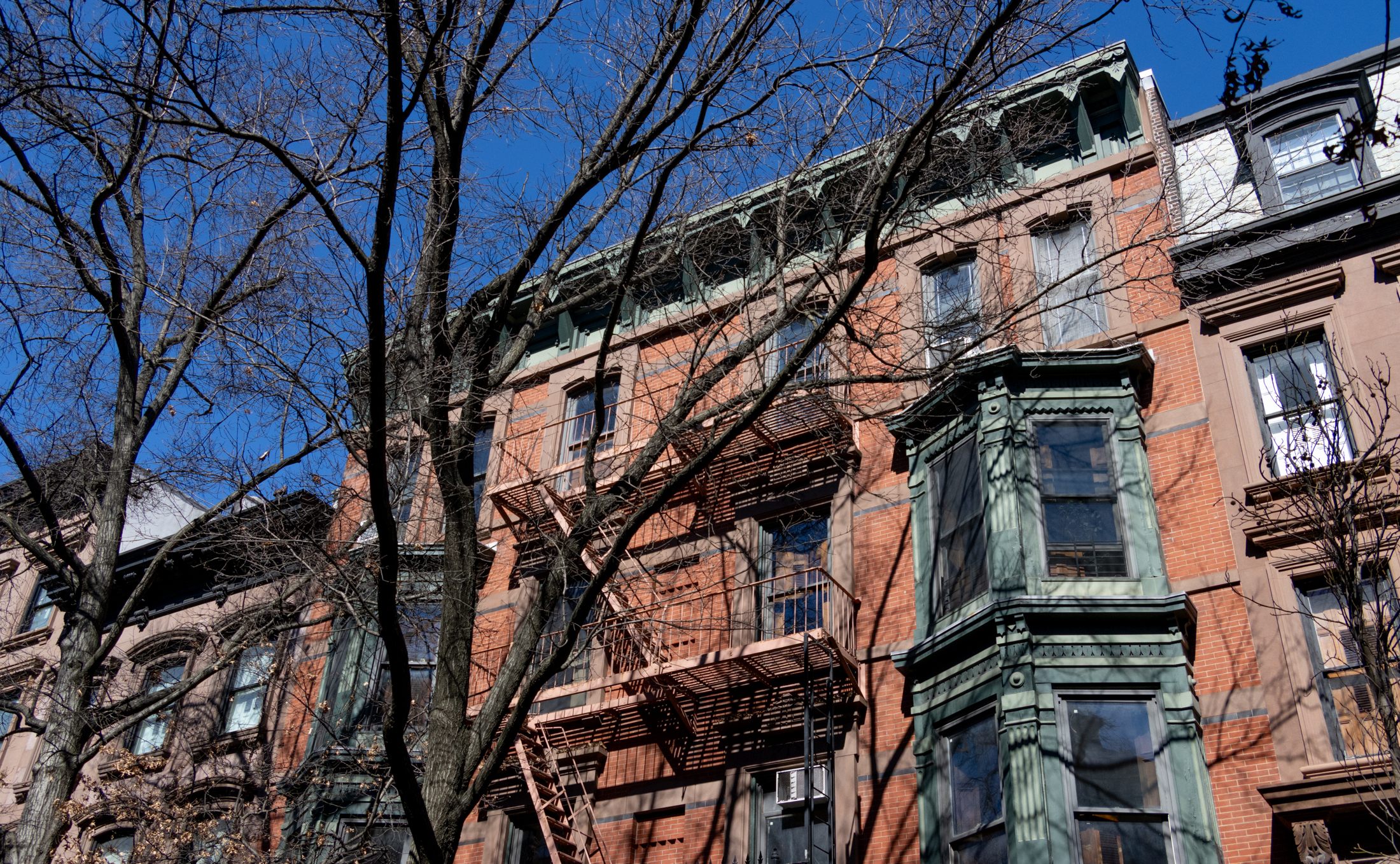
The story: We haven’t had a Chappell group in a while, and it’s always a pleasure to show another example of the work of one of my favorite architects. If neighborhoods were named after the architects who designed so much of the streetscape, Crown Heights North would have been re-named Chappelltown. He contributed that much to the beauty of this neighborhood, which he also called home for much of his life and career.
Although I like certain parts of all of our different styles of row house architecture, one of the favorite things I like about the Queen Anne period is the permission to be creative. Let’s face it; you really can only do so much with three to five stories on a 20-foot lot. Chappell had three lots to work with here, designing these houses for developer D. H. Fowler. Instead of designing three houses that were more or less the same, or totally different, he chose to make the set a unified group that at a casual glance is one very large chateau of a building. (more…)
Past and Present: Fulton Street at Marcy Avenue
A look at Brooklyn, then and now.
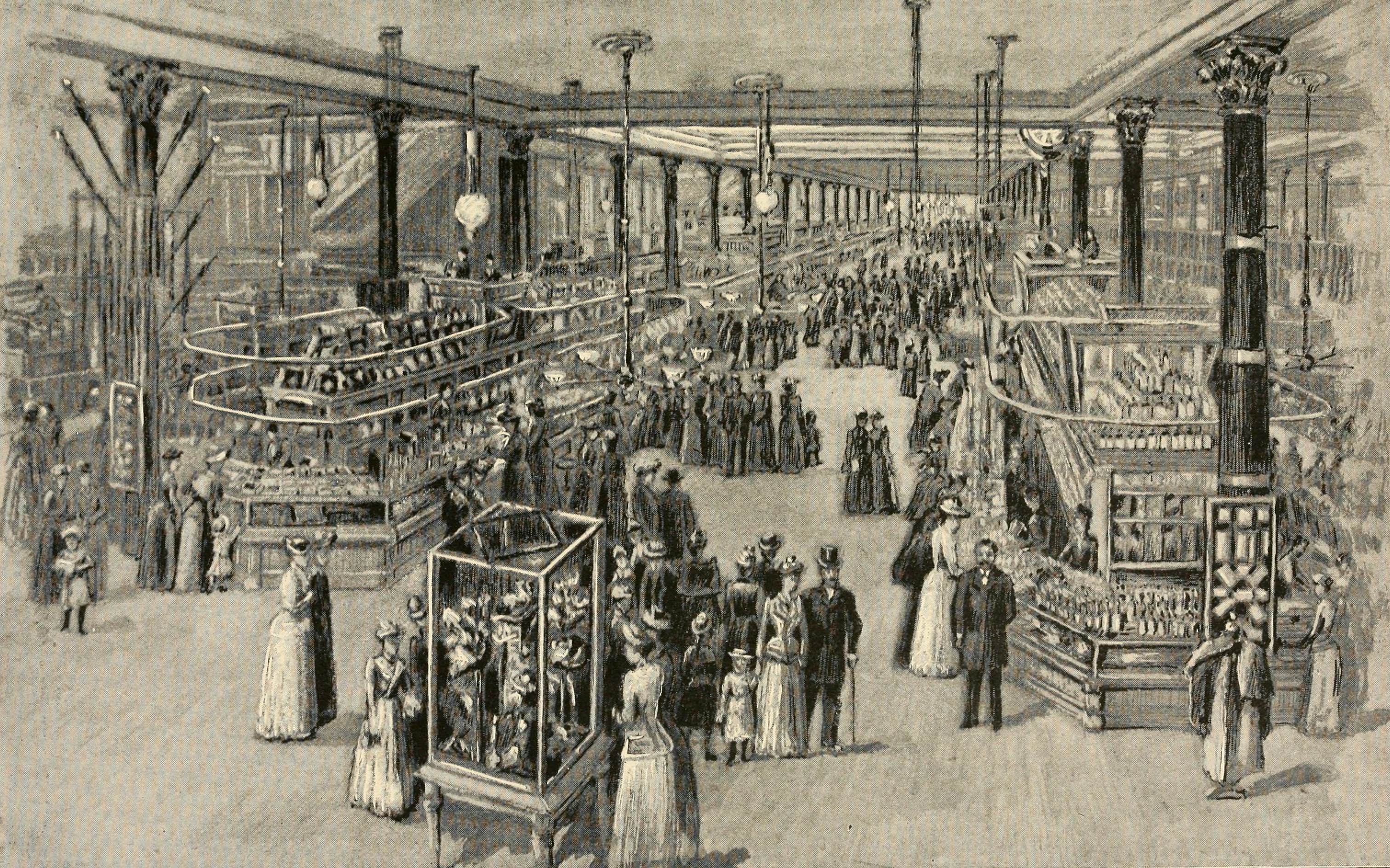
The changes that take place on our streetscapes are often subtle, especially on residential blocks. One can often look at a century old photograph of many of our residential blocks in our brownstone neighborhoods and see the same streetscape as today. That is rarely the case on commercial blocks, which is part of the reason why so many historic districts don’t seem to extend to the major commercial thoroughfares. The changes are too extreme, and the original is often long gone. Take a look at one of Brooklyn’s largest neighborhoods’ main street: Fulton Street in Bedford Stuyvesant, as a prime example.
For much of its length, Fulton Street was filled with brownstone buildings, most dating from the late 1860s, through the 70s and 80s, with ground floor storefronts and flats above. These storefronts held lots of small businesses; including the grocer, butcher, hardware store, bakery, clothing shop and more. Back then, as now, people liked one stop shopping for their needs, and being able to simply walk a length of street, and find everything you need was as important to people in the late 19th century as it is now. And Fulton delivered. (more…)
Building of the Day: 20-26 Willow Street
Brooklyn, one building at a time.
Name: Row houses
Address: 20-26 Willow Street
Cross Streets: Cranberry and Middagh streets
Neighborhood: Brooklyn Heights
Year Built: 1846
Architectural Style: Greek Revival
Architect: Unknown
Landmarked: Yes, part of Brooklyn Heights HD (1965)
The story: The oldest parts of Brooklyn Heights, over near Middagh Street, are a fascinating patchwork of styles and history. Frame houses stand next to Greek Revival row houses, followed by later brownstone styles, late 19th century tenements, early 20th century apartment buildings, and finally, late 20th century apartment housing. I’ve always enjoyed walking around this part of the Heights, as you never know what you are going to come upon next.
This group of Greek Revival row houses was built in 1846, a time when Brooklyn Heights was feeling its oats as the a leafy suburb for the powerful merchants and financiers whose businesses lay below by the docks, or across the river in Manhattan. The houses are brick built on top of a brownstone basement story. Unlike later Italianate houses, the stoops on these houses rise only ten or so stairs from the street level, necessitating an excavated cellar level in order to get light and windows into the ground floor. (more…)
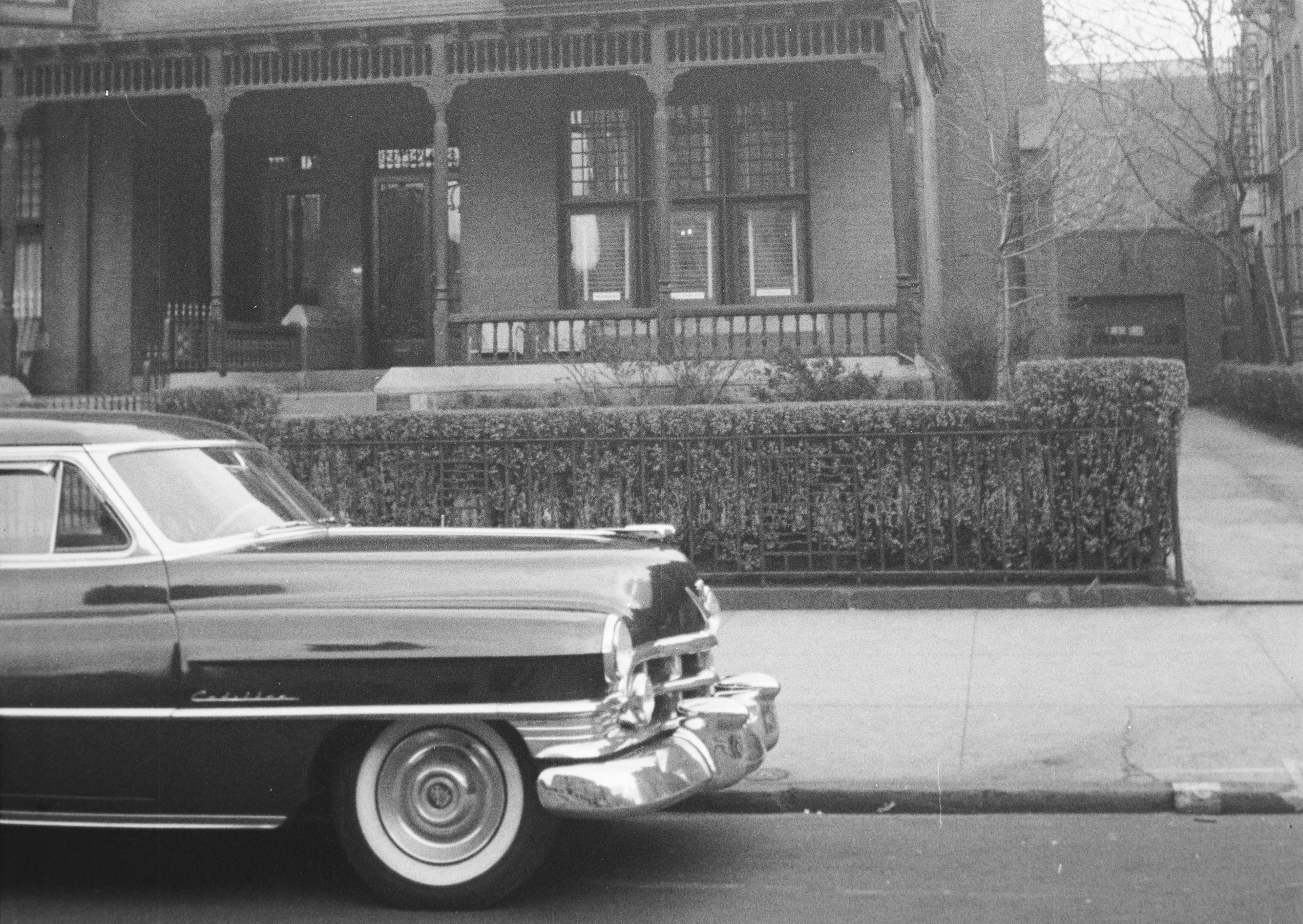
Walkabout: Brooklyn’s Amazing Automobile Industry, Pt. 2
“Automobile Row on Bedford Avenue became almost as well known throughout the United States as Automobile Row on Broadway…In those days, Bedford Avenue was the Sunday afternoon walk of the most substantial portion of Brooklyn. It was the Easter Parade street, the auto parade street, the center of life and recreation. It was Automobile Row!”
These were the fond memories of Charles Bishop, one of the pioneers of Automobile Row in the first half of the 20th century. He and his father, Eli Bishop, were two-thirds of one of the most successful automobile dealerships in Brooklyn: Bishop, McCormick and Bishop, which operated out of a series of showrooms on the corner of Bedford Avenue and Halsey Street. Eli Bishop had started out in the real estate business, and was responsible for a great deal of the development of the Bedford area, but had turned to the automobile in the first years of the 1900s, realizing that this could be big, perhaps as big as real estate. He was right. (more…)
Building of the Day: 348-352 Decatur Street
Brooklyn, one building at a time.
Name: Row houses
Address: 348-352 Decatur Street
Cross Streets: Stuyvesant Avenue and Malcolm X Boulevard
Neighborhood: Stuyvesant Heights
Year Built: 1885
Architectural Style: Neo-Grec, with elements of Queen Anne styling
Architect: John S. J. King
Other Work by Architect: None discovered as of yet
Landmarked: Yes, part of new Stuyvesant Heights Extension HD (2013)
The story: In any discipline there are rules that are expected to be followed in order for a work to meet the criteria of style, convention or even law. My musical education taught me that in Western music, for example, there have been times when certain chords and note progressions were forbidden. The tritone, a diminished fifth or augmented fourth interval, perhaps best illustrated as the first two notes in Leonard Bernstein’s West Side Story song “Maria” – the “Ma-ri” notes, was called “Diabolis in Musica”, the devil in music. Why? It was an uneven and unfinished dissonance that wanted to be resolved. Medieval musicians up through the Baroque period avoided it like plague. It would not be until the Classical period that the interval was freely used, and even then, was most often used to introduce an element of evil or deviltry into a piece. Today, it’s an integral part of jazz, modern classical and popular music. Go figure.
What does that bit of trivia mean to architecture? It’s just an illustration to point out that sometimes, the rules need to be broken, and the result can be delightful. Sometimes the rules are broken by iconoclastic geniuses, but more often than not, they are broken by the small, unnoticed folk who either don’t know better, or don’t care, and don’t have anything to lose. The rules say that rooflines are flat and horizontal across the expanse of buildings. John King said, “Why?” (more…)
Building of the Day: 135-139 Kent Street
Brooklyn, one building at a time.
Name: Flats buildings
Address: 135-137 Kent Street
Cross Streets: Franklin Street and Manhattan Avenue
Neighborhood: Greenpoint
Year Built: 1907
Architectural Style: Renaissance Revival/Neo-Classical
Architect: Philemon Tillion
Other Work by Architect: In Greenpoint – Industrial Home for the Blind, Greenpoint Masonic Lodge, additions to Eberhard Faber Factory buildings, apartment buildings and single family houses on Milton Street. Also row house group in Park Slope, and Trinity Baptist church, Crown Heights North.
Landmarked: Yes, part of the Greenpoint HD (1982)
The story: Kent Street, between Franklin Street and Manhattan Avenue is an architecturally varied and very pleasing block. It shows the development of Greenpoint between the 1850s and the early 1900s, and most of its building stock is pretty much intact, as the block was spared the severe “modernizing” ministrations of siding salesmen who had a field day elsewhere in the neighborhood. The earliest brick houses date from the late 1850s, and were built by some of Greenpoint’s earliest builders and developers, men who came to the area to build for the bourgeoning shipbuilding, ceramics and glass manufacturers and their workers, all who called Greenpoint home. (more…)
Walkabout: Brooklyn’s Amazing Automobile Industry, Pt 1
“As Brooklyn goes, so goes the world,” Charles Bishop told the Brooklyn Eagle in 1941. He was referring to the automobile industry in Brooklyn, a world he knew as well as anyone, being one of the pioneers in the industry that once dominated the core of the city along Bedford Avenue in Central Brooklyn. In the space of forty years, approximately between 1905 and 1945, the automobile industry took over Bedford Avenue and its environs, creating one of the most lucrative and far-reaching areas of business, the likes of which we will never see again.
It all begins with the road and the wheel. The road was Bedford Avenue, the main north-south roadway in Brooklyn, stretching the length of the city, a vital thoroughfare connecting the towns that make up the city of Brooklyn, running from Greenpoint, south to Sheepshead Bay. By the end of the 19th century, Bedford Avenue, between Grant Square in Bedford, and Williamsburg, was one of the busiest and most important streets in the city. There were blocks with fine homes, especially in Williamsburg and central Bedford, but it was also filled with large houses of worship, clubs, theaters, schools, restaurants and businesses. The street was connected by trolleys and omnibuses, and the Long Island Railroad stopped at Bedford, near Fulton and Atlantic, but in the mid-1880s, a new mode of transportation had also taken to the streets. No, not the car, I’m talking about the bicycle. (more…)
Building of the Day: 5424 Fifth Avenue
Brooklyn, one building at a time.
Name: Residential building with ground floor retail
Address: 5424 Fifth Avenue
Cross Streets: Corner 55th Street
Neighborhood: Sunset Park
Year Built: 1897
Architectural Style: Queen Anne
Architect: J. H. Nadigan
Landmarked: No, but part of Sunset Park designation on National Register of Historic Places (1988)
The story: 5th Avenue, between Flatbush Avenue and its end in Dyker Heights, is one of the most densely developed commercial/residential streets in Brooklyn. It’s also an interesting time line of Brooklyn’s development, with the earliest buildings closer to Flatbush Avenue, and the later ones as you go towards Bay Ridge. Unlike other blocks in Brownstone Brooklyn that start out residential and then are transformed into shopping blocks, like parts of Park Slope’s 7th Avenue, 5th Ave was designed to be a mixed use avenue, with virtually all of its original building stock consisting of retail/commercial shop spaces on the ground floor of buildings that had two or more floors of apartments above.
Of course, blocks like this are also a great place to put civic and religious buildings, so 5th Avenue, along its length, also has a fair share of houses of worship, schools, police and fire stations, as well as larger commercial entities such as banks and theaters, too. The Sunset Park stretch of 5th Avenue is a perfect place to find all of these elements. (more…)
Building of the Day: 337-347 Stuyvesant Avenue
Brooklyn, one building at a time
Name: Row houses
Address: 337-347 Stuyvesant Avenue
Cross Streets: MacDonough and Macon Streets
Neighborhood: Stuyvesant Heights
Year Built:1891
Architectural Style: Queen Anne
Architect:W.R. Bell & Co.
Other work by architect: houses around the corner, at 371-375 MacDonough St.
Landmarked: Yes, part of Stuyvesant Heights Extension HD (2013)
The story: For many people, Stuyvesant Avenue is the border of Bedford Stuyvesant, but in reality, it’s only the center of the Stuyvesant Heights neighborhood, which was developed quite independently of Bedford. Bedford Corners was a thriving crossroads town as far back as the end of the 17th century, but Stuyvesant Heights was largely a suburban community, with little development until the latter part of the 19th century. It wouldn’t be until the 1930s that the two communities were joined, called Bedford Stuyvesant by a Con Edison article in a newspaper.
Stuyvesant Heights extends many more blocks eastward from Stuyvesant Avenue,and is one of the main north/south streets. Most of it is residential, with only scattered commercial buildings here and there, primarily on some of the corners. Development here stretches from 1850s wood framed houses, to the early brownstone styles of the Italianate and Neo-Grec variety, to the late 19th century Romanesque Revival, Queen Anne and Renaissance Revival styles, on to the rich Beaux Arts houses near Fulton Park, with a few mansions and much later 20th century infill houses tossed in for good measure. (more…)
Past and Present: The Crescent Athletic Club, Bay Ridge
A look at Brooklyn, then and now.
The Crescent Athletic Club was Brooklyn’s most prestigious sports club. From the confines of its swanky clubhouse in Brooklyn Heights, the elite men of Brooklyn gathered to wine and dine, as well as take part in individual and team sports. The club was founded in 1884 by a group of Brooklyn based Yale alumni who wanted to start a football team. From this team grew a large and wealthy club of not only youngish rich athletes, but their fathers, and other older men who had the money to build a club where they could all socialize, take part in sports, play cards, billiards and sit around drinking, smoking and engaging in the most exciting sport of all – deal making. The Crescent Club had an impressive clubhouse on Clinton Street with a large dome, on top of which their club symbol, a large crescent moon, rose quite prominently from the top of the building.
In 1902, the club built a much larger and more impressive building at the corner of Pierrepont and Clinton, a limestone clubhouse designed by Frank Freeman, one of Brooklyn’s finest architects. This was the culmination of the club’s size, wealth, and success, and gave them room for a swimming pool, club, dining and gaming rooms, as well as much more, but it wasn’t the only facility they had. Team sports need fields and facilities to play in, and in the Crescent’s early days, they played football, hockey, baseball, and other team sports in rented arenas and fields, but they wanted their own athletic complex. In 1889, they merged with the Nereid Rowing Club and acquired their large boathouse on the shores of Bay Ridge’s Gold Coast, the Shore Road. (more…)
Building of the Day: 99-109 Berkeley Place
Brooklyn, one building at a time.
Name: Flats buildings
Address: 99-109 Berkeley Place
Cross Streets: Sixth and Seventh Avenues
Neighborhood: Park Slope
Year Built: 1888-89
Architectural Style: Romanesque Revival
Architect: C.P.H. Gilbert
Other Work by Architect: In Brooklyn, most of Montgomery Place, as well as houses on Carroll between 8th and Prospect Park West, Adams house on Carroll and 8th, and others in Park Slope.
Landmarked: Yes, part of Park Slope HD (1973)
The story: According to the Brooklyn Eagle in 1889, “it was freely predicted that flats would soon forfeit popular favor, but the continual additions to their number seem to contradict the theory.” In 1888, architect C.P.H. Gilbert was hired to design six adjoining flats buildings in Park Slope for developer S. F. Hill. Gilbert was only twenty-seven at the time, but was already in demand. The same year he designed this building, he wowed the gentry with his design of the Adams House, on Carroll and Eighth Avenue. His career would take off in Brooklyn, with his commissions for the fine houses on Montgomery Place, Carroll Street and elsewhere to soon follow. It’s a good thing he got these flats buildings out of the way first, because they are gems, as well, and should be as appreciated as his fine houses.
One look at these flats buildings, and you know someone very good, who knew the style backwards and forwards, was responsible for these buildings. Brooklyn was graced with some amazing Romanesque Revival architects, and Gilbert was certainly one of the best. He began by pairing up the six buildings, creating large arched entryways that spanned two buildings. The six buildings now look like three very large and expensive manors. (more…)
Walkabout: Safe Driving in Brooklyn’s Schools
Ever since Henry Ford’s assembly line made it possible for the average American to purchase a car, we’ve been in love with the automobile. But Ford was not the only automaker around, and no sooner than the first cars started to appear, than it seemed that every inventor and blacksmith with a knack for engines and enough money to go into business, was becoming a car maker. The beginning of the 20th century was a marvelous time for the automobile, and there were dozens of companies, long before the “Big Three” took over the industry. Most of these names are long forgotten. Some of the cars produced by these smaller companies no longer exist outside of photographs and drawings. But back then, they were all here, rolling down the streets of Brooklyn.
Although there were dealerships, garages and suppliers all over the borough, Bedford Avenue, especially between Malbone Street (now Empire Boulevard) and Fulton Street, a long stretch of road starting in Flatbush, through the entirety of Crown Heights, and on into Bedford Stuyvesant, became known as “Automobile Row.” Residential development in this area had been slowed down by the looming and forbidding presence of the Brooklyn Penitentiary on Bedford and Union, but as soon as that structure was torn down in 1907, things started to take off. (more…)
Building of the Day: 81 and 85 Rugby Road
Brooklyn, one building at a time.
Name: Private Houses
Address: 81 and 85 Rugby Road
Cross Streets: Church Avenue and Albemarle Road
Neighborhood: Prospect Park South
Year Built: 1936
Architectural Style: Neo-Tudor
Architect: Robert T. Schaefer
Other Work by Architect: 799 18th St. and other houses in Fiske Terrace, Midwood and Ditmas Park. Other buildings in Flatbush and Long Island.
Landmarked: Yes, part of Prospect Park South HD (1979)
The story: By 1905 Dean Alvord, the developer responsible for Prospect Park South, had grown bored with his very successful project, and was looking towards the next housing development on his list of successful transformations of former farmland into gracious upscale and exclusive neighborhoods. He sold his remaining lots, and moved on. Over the next twenty years, the remaining lots of PPS were built up. In the beginning of this second period of growth, some of the houses were quite large, but as time went by, they got smaller and more efficient. The days of huge mansions with a staff of servants to keep them running was ending, and people began to want houses that were much less high maintenance. The economy was changing as well, and by the 1930s, the Great Depression had taken most of the steam out of the building market.
If you look at the real estate ads in the Brooklyn Eagle and other local papers during the 1930s, you can see that the downturn in the economy had also reached the leafy confines of this exclusive and wealthy enclave. Some of the largest houses began to take in boarders, or rent out their upper floors as apartments. Even today, some are still permanently divided, large enough to provide adequate space for more than one family, even by today’s roomy standards. A few people couldn’t hold on at all, and sold their large homes and moved on. This was the case here. 81 and 85 Rugby Road was once home to one large single family house. The Brooklyn Eagle documents several ads searching for boarders, and then renters, then a buyer. (more…)


May 21, 2013 | 09:56 AM