
Walkabout With Montrose: Parlez-Vous French Flat?
The French Flat was marketed to the growing middle classes.

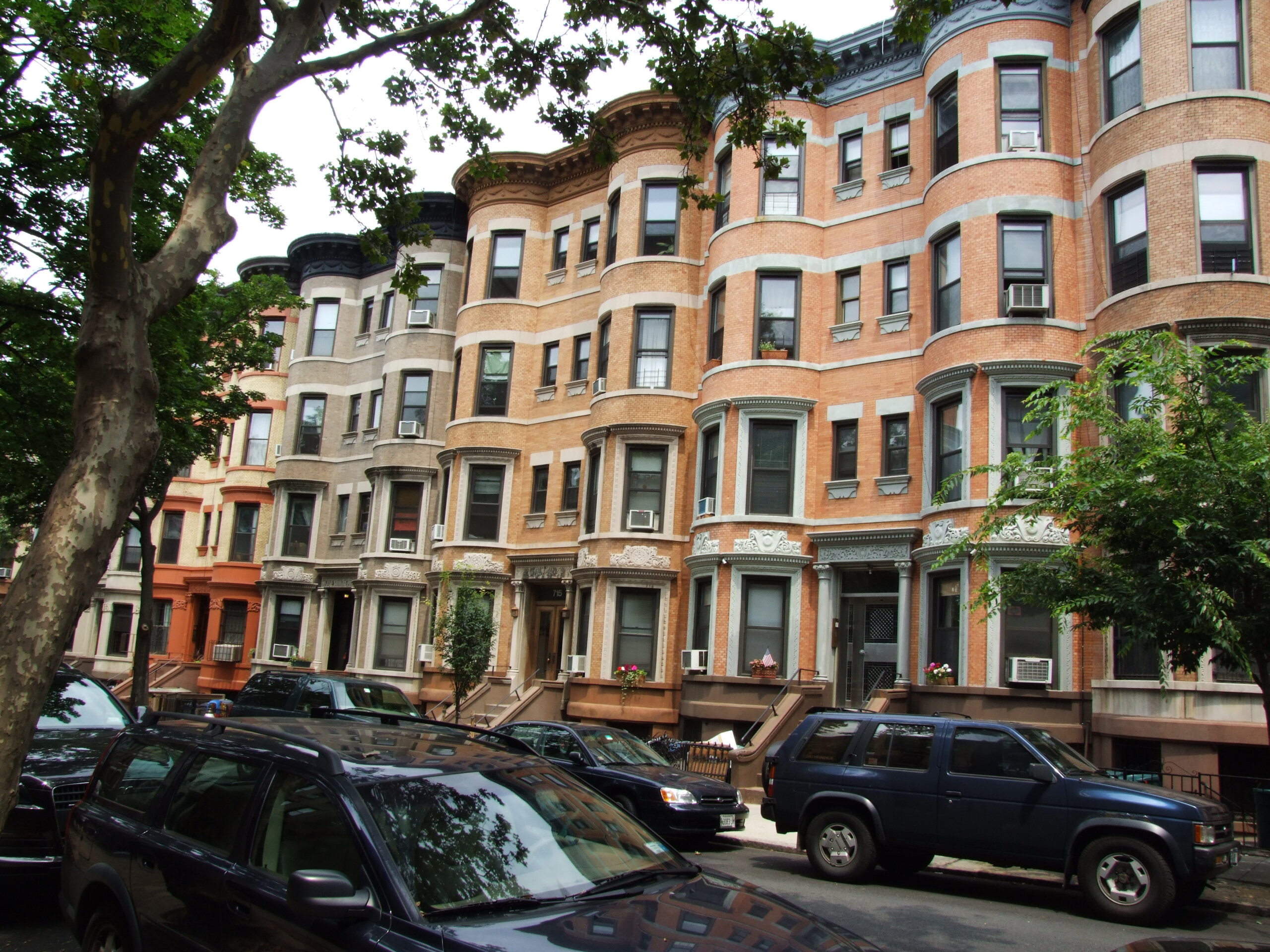
MacDonough Street in Bed Stuy. Photo by Suzanne Spellen
This is the third piece in a series about the development of multi-unit housing in Brooklyn. The French Flat was marketed to the growing middle classes.
In 1885, a writer commenting on the state of housing in Manhattan wrote: NY is a city without homes. 2/3 of the population lives in tenements, and the remainder either occupy palatial but cheerless brownstone fronts, or board.
The rich and poor are increasing, while the great middle class of thrifty and intelligent people are being crowded into the suburbs.
Because of improvements in mass transportation, including the building of the Brooklyn Bridge, railroad and trolley lines, the middle class was encouraged to move to the far reaches of Harlem, or Brooklyn, where single family ownership of a modest row house was still possible.
But even in Brooklyn, there still was not enough housing for people who were well off enough to avoid the tenements, but not rich enough to buy a large single family house.
The obvious answer was a multi-family building, better in every way than a tenement, and affordable to the wide range of incomes making up the middle class. The apartment, or flats building was born, but it was not an easy sell.
The word apartment had been in use in England and France since the 1700’s, where it only referred to a set of rooms, not necessarily shared with other people.
The term flats originated in Edinburgh and London in the beginning of the 19th c. in reference to a group of rooms on one floor of a building.
In NY, by the mid 19th c, the term referred to units in row houses that had been altered and subdivided, and by 1874, the phrase French Flats was officially entered into the DOB books, as a multiple-unit dwelling, and fell under the rules and laws that governed tenements.
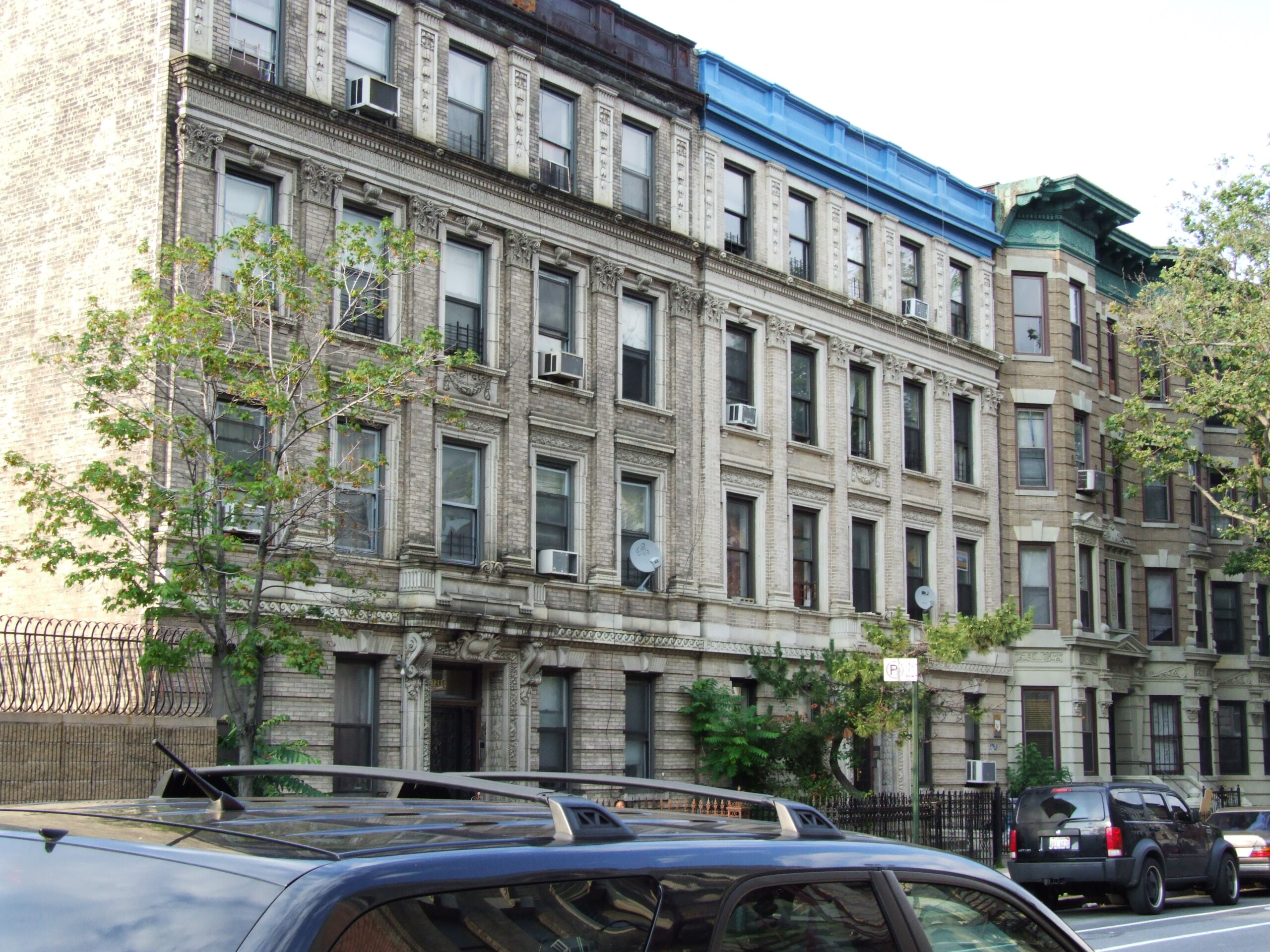
The biggest difference between a high end tenement and a low end flat was that each flat was equipped with sanitary facilities inside each unit. Many low end flats buildings are indistinguishable from tenement buildings from the outside, and often from the inside, too.
Those building for the bourgeoning middle class had their work cut out for them. Most people of decent means did not want to live in a building with strangers, or in a building that could be mistaken for a tenement.
So developers looked to the Parisian apartment house as the standard of perfection. Calling the buildings French Flats evoked the romance, allure and sophistication of Paris in an attempt to draw in customers.
Some of the most influential architects of the time built 4 story, 8 unit buildings with charm and sophistication, using materials and ornament similar to the single family row houses and mansions of the day, which they also designed.
They often named the buildings with women’s names, or posh British and European sounding names in an attempt to give them more class and élan.
These buildings, as well as larger apartment buildings, were built in the same developing middle class neighborhoods that were drawing people in growing numbers; Brooklyn Heights, Clinton Hill, Bedford, St. Mark’s, Park Slope, Cobble Hill, Fort Greene, and more.
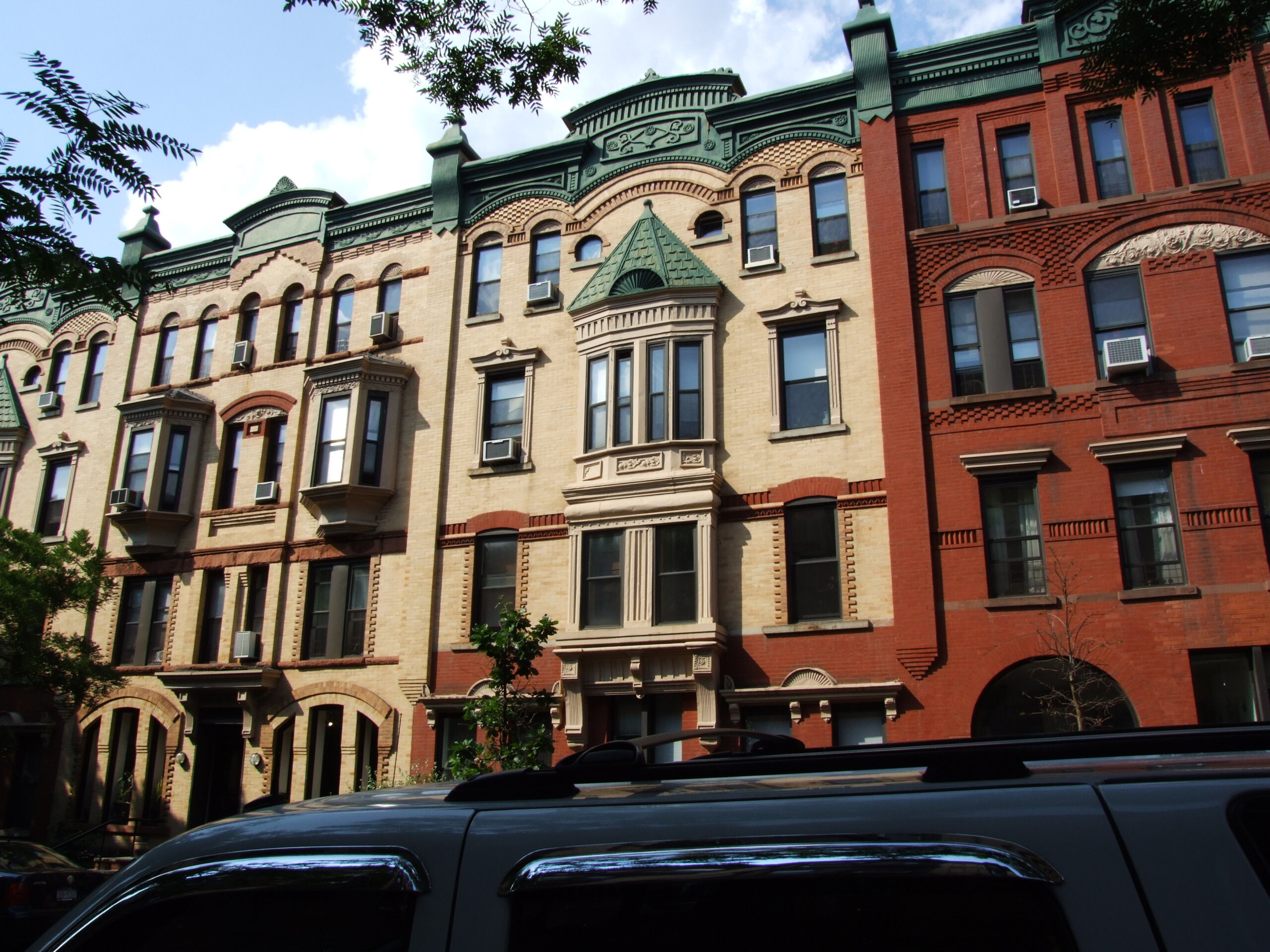
The average higher end, 8 unit flat building had two apartments per floor, one on either side of a center stair. The front door opened to a parlor facing the street, often with a smaller library area. A hallway ran down the length of the apartment with bedrooms and bathroom along its length, ending in a dining room, kitchen, and maid’s room.
The invention of the passenger elevator in the 1880’s enabled builders to build higher than four stories, more amenities and innovations in modern living were added, and slowly, very slowly, the flat grew in popularity, as the need for housing in the city overwhelmed many of the objections people had towards multiple-unit dwellings.
That’s not to say there weren’t plenty of critics, and plenty to criticize. On Sept. 24, 1899, the NY Times stated, “To call the things actually provided for tenants of this class ‘French Flats’ is to insult a friendly nation . . . The ‘court’ has been shrunk by the speculative builder to what he calls a ‘light shaft’ and what is in fact a flue, a conduit, not for light and air, but for sounds and smells.”
At the bottom and middle end of the price spectrum, there were plenty of complaints about the thinness of walls and floors, and being able to hear the personal business of strangers.
More practically, many of these flats were small, having only 4 to 5 rooms, often in the same room configuration as the tenements, making family room tight.
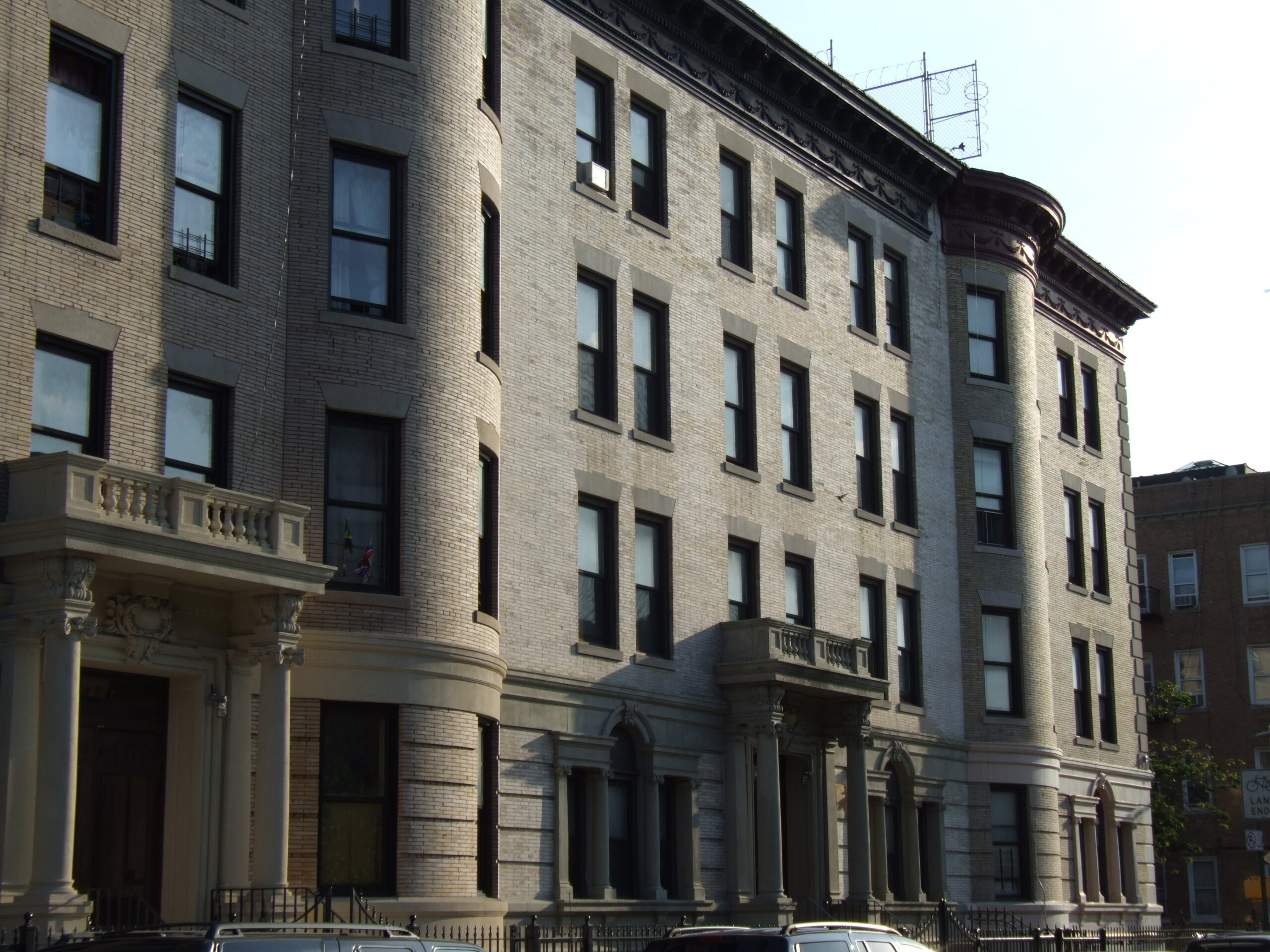
There weren’t enough closets, and often, not enough light or air coming in inadequately sized light shafts. Socially, the risque charm of Parisian flat living was seen by many as dangerously decadent Euoropean behavior, promoting promiscuity and the destruction of family life, none of which should appeal to good American families.
For many years, and for many people, living in a flat continued to be associated with young childless couples, bachelors and working women, and widows and widowers, or as one wit put it, the newly-wed and the nearly dead. Doesn’t this all have a ring of familiarity? My Flickr page has some classic facades.
Information for this article gleaned from LPC reports, NYT archives, and 3 fascinating books: Building the Dream: a social history of housing in America, by Gwendolyn Wright, A History of Housing in New York City, by Richard Plunz, and Alone Together: a history of NY’s early apartments, by Elizabeth Collins Cromley.
[Photos by Suzanne Spellen]
Next time: the wealthy have to live somewhere, too the luxury apartment building.
Very interesting, Montrose! I also live in a Park Slope building — in a row rather similar to the Carroll Street buildings pictures — that I guess was also part of this boom. The row of four-story buildings on my block originally had two apartments per floor, but most of the buildings have now been converted into co-ops or condos and — unlike Wonton’s building, where the apartments were cut in half — they now have one apartment per floor (with the exception of one building in the row, which still has eight apartments).
On my block, however, the apartments aren’t on either side of a center stair. Rather, the stairway is along the side, in classic brownstone fashion, which means that one apartment must have been in the front and one in the back. There are inner windows looking out on a narrow air shaft between the buildings, which I always supposed were installed to be consistent with the old tenement window rules; it never occured to me, however, that this was actually middle class housing. The buildings are 85 feet deep on 100 feet lots, so longer than the typical brownstone (but with a smaller back garden as a result).
As for closets, it’s quite possible there weren’t any originally. The developer who turned my building into condos about 10 years ago had to build some out from the wall in the bedrooms out of sheetrock. But then, most true French flats don’t have closets, either, hence the lovely armoires that many French homes have.
very interesting read. thanks!
arkady- and think about the style of clothing in the 1890’s- all those huge leg-o-mutton sleeves and trumpet skirts. And cleaning? they had to pick apart the dresses, wash the fabric and resew. No wonder o many of the Victorian costumes we see were never washed!
Damn, MM. What the hell do you do with your camera that makes the hood look so renaissance?
***Bid half off peak comps***
Fascinating stuff. But isn’t it true that most dwellings didn’t have closets? My grandparents’ house in DC was new when they bought it in 1893 & they had to add closets in the early 1900s. People didn’t have as many clothes & mainly used hooks or folded everything to put into dressers.
This is fascinating. I live in a Park Slope building that was constructed during the boom of “French Flats” that you write about. Originally it had 8 apartments, two on each of four floors. In the early 1980s it was renovated, and the apartments were cut in half to make a 16 unit building.
The other day I found out that the whole row of buildings on my street, including the one in which I live, is on the list of the Park Slope Civic Council, which is trying to expand the landmarked area (my block currently is un-protected).
My building, it seems, was built by the architect/builder Louis Bonert, who constructed so many of these middle class flats in Park Slope.
The blog of the Civic Council has some great stuff! The background on my street is here:
http://tinyurl.com/qu5g9d
great read. and alol @ builders sticking on a stone babyface or flower on a tenement and calling it a “french flat”. sorta like the concept of taking a french shower!
i think tenements are charming though.
*rob*