
Construction on Flatbush Avenue Redesign Restarts
The effort includes center-running bus lanes, concrete boarding islands, and new pedestrian space between Livingston and Grand Army Plaza.

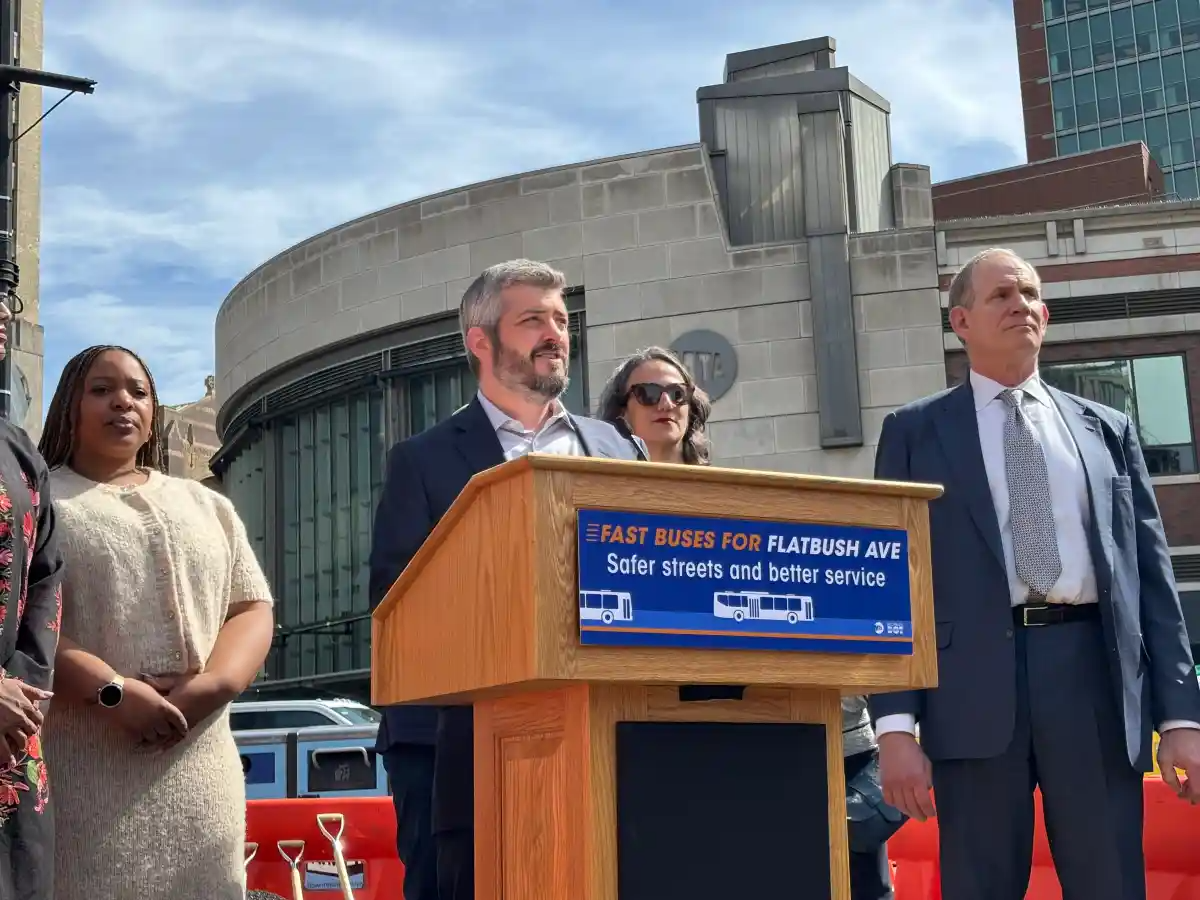
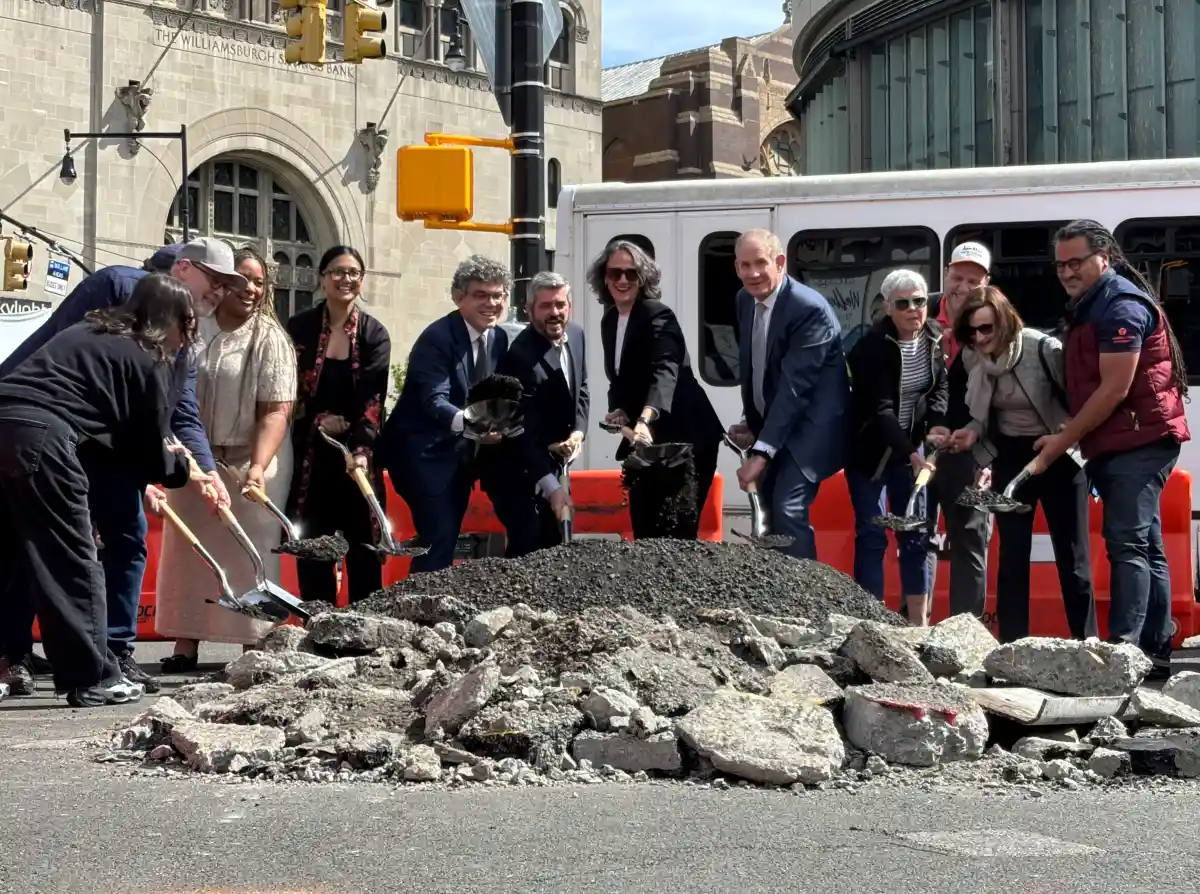
Officials and advocates break ground on the resumption of construction on the city’s Flatbush Avenue redesign on Tuesday, April 28, 2026. Photo by Ethan Stark-Miller
by Ethan Stark-Miller, amNY
The Mamdani administration said on Tuesday that it is beginning the physical work of delivering on the mayor’s campaign pledge to make buses faster by resuming construction on the redesign of Brooklyn’s Flatbush Avenue.
City Department of Transportation Commissioner Mike Flynn stood with MTA Chair and CEO Janno Lieber and a cadre of transit advocates to mark the continuation of the Flatbush Avenue project, which the city began late last year under former Mayor Eric Adams.
“Our crews will be here on Flatbush Avenue undertaking a large reconstruction of the corridor, from Flatbush Avenue in Downtown Brooklyn to Grand Army Plaza,” Flynn said during the event. “Now that the weather is warmed and the construction season is here, the real work starts today.”
The effort involves the city building center-running bus lanes, several concrete boarding islands, and 29,000 feet of new pedestrian space along the thoroughfare between Livingston Street and Grand Army Plaza.
While construction on the project will last through the fall, Flynn played down how much it will disrupt commutes down the corridor over the coming months. The construction will be conducted on one side of the street at a time to allow for the flow of traffic, while the city will optimize traffic signals to keep vehicles “moving as smoothly as possible.”
The project is designed to make travel faster on several bus lines that use the portion of Flatbush Avenue — the B67, B69, B63, B45, and B103, which serve a combined 132,000 daily riders. It aims to do so by providing dedicated lanes where buses are less likely to contend with private vehicles.
Under the street’s current design, buses can move as slowly as four miles per hour.
“This design will separate out bus lanes from general traffic lanes,” Flynn said. “That means riders will no longer suffer behind double-parked cars and commuters won’t lose time as buses that weave in and out of the curb lane for pickup and drop-off slow everything down.”
Although the administration has pledged to boost bus speeds by 20 percent across several corridors, Flynn would not commit to that specific target for Flatbush Avenue when asked during the event. Instead, he pointed to the center-running bus lane design as being particularly effective at increasing speeds.
“They have a huge impact, and we see that in places where we have done center-running bus lanes or otherwise separated bus lanes, and we’re expecting a similar benefit here,” he said.
Lieber lauded the Mamdani administration for making a “long-overdue commitment” to install infrastructure designed to make buses faster. That includes bus lanes, busways, and bus-mounted cameras that enforce against drivers obstructing those areas — under the MTA’s Automated Camera Enforcement (ACE) program.
“We haven’t always had this partnership; it’s not a secret,” Lieber said, in an apparent reference to Adams’ administration shelving or watering down many of its own bus lane projects.
“That made MTA’s mission to speed up service very, very difficult,” he continued. “After all, buses can only move as fast as the traffic and the speed configuration allows.”
Senior Riders Alliance Organizer Jolyse Race said the advocacy group, which pushed for the redesign, was seeing the “fruits of our labor” with Tuesday’s announcement. But she said there is still more work to be done along Flatbush Avenue south of Grand Army Plaza.
“Riders are ready to see the next significant projects that extend all the way to Kings Plaza,” Race said, referring to the Kings Plaza Mall, which sits at the southern end of Flatbush Avenue.
However, when asked by amNewYork what plans the administration has for the remainder of Flatbush, Flynn said it is “looking at potential ideas” without going into specifics. He pointed to the recently announced plan to close the southern portion of Grand Army Plaza to vehicle traffic and integrate that with the Flatbush Avenue redesign.
“We’re really excited about the idea of continuing to move buses faster all the way down Flatbush,” Flynn said. “That’s something we’ll definitely want to look at in the coming months.”
Editor’s note: A version of this story originally ran in amNY. Click here to see the original story.
Related Stories
- Work to Resume on Flatbush Avenue Center Bus Lanes
- Rollout of Center Bus Lanes on Flatbush Avenue to Start Soon, Wrap in 2026
- Street Safety Group Calls for Lower Speed Limit After Brownsville Hit-and-Run
Email tips@brownstoner.com with further comments, questions or tips. Follow Brownstoner on X and Instagram, and like us on Facebook.
What's Your Take? Leave a Comment