
WSJ Bullish on The Fulton Mall
The Wall Street Journal has a lengthy, and rather optimistic, article about the renaissance of the Fulton Mall today. It’s behind the paywall but has been liberated by a reader and posted below. Chains Set Up Shop on Fulton; Merchants, Developers Are Cleaning Up a Brooklyn Strip in Hopes of a Rebirth By Anthony Klan…

The Wall Street Journal has a lengthy, and rather optimistic, article about the renaissance of the Fulton Mall today. It’s behind the paywall but has been liberated by a reader and posted below.
Chains Set Up Shop on Fulton; Merchants, Developers Are Cleaning Up a Brooklyn Strip in Hopes of a Rebirth
By Anthony Klan
25 October 2010
The Wall Street Journal (Online and Print)
With upscale housing developments sprouting in downtown Brooklyn, some developers and retailers are betting big bucks that the Fulton Street Mall is poised for a rebirth.
National retailers like Filene’s Basement and SYMS, H&M and Aéropostale have recently announced they are setting up shop along the strip which was one of the grand shopping districts of Brooklyn before its department stores were replaced by stores selling such goods as cheap jewelry, knickknacks and electronics. Developers are spending millions on upgrading other properties in hopes of attracting other chains.
The renaissance of Fulton—which stretches between Boerum Place and Flatbush Avenue—has been predicted before with little actual change. But local business owners say it’s different this time because of 5,000 new condos and rental apartments that have been added in the downtown Brooklyn area in the past three years.
“The area is attracting the Manhattan type of resident,” says developer Albert Laboz, who leased 30,000 square feet to H&M at his store at 497 Fulton St. “These are those younger people that would otherwise have bought in Manhattan but have been priced out of that market.”
Skeptics have a blunter message: Don’t hold your breath. “They are redesigning the strip, making it look better,” says Prudential Douglas Elliman retail leasing chairman Faith Hope Consolo. “But it’s been the street of 99-cent stores and I don’t see it changing dramatically.”
Fulton Street in its halcyon days was home to four departments owned by such companies as May Department Stores and E.J. Korvette and Abraham & Straus. As downtown Brooklyn deteriorated in the 1970s and 1980s, they closed one-by-one, with the exception of the A&S, which was converted to a Macy’s in the mid-1990s. Under pressure from local merchants, the city converted the strip into an open air mall with traffic limited to buses.
But the hoped-for revitalization never happened. Today paint is peeling from buildings, several stores are boarded up and many shop signs are missing letters.
“They try and pretend to make it upscale but I don’t think there is any possibility of that at all because the customer base is not there,” Ms. Consolo says.
Merchants and developers are optimistic that this time will be different because housing and pedestrian traffic patterns are changing. Many of the new upscale apartment towers—such as the 650-unit Avalon Fort Greene rental building and Toren, a condo—are a few blocks to the north on Flatbush Avenue, a new area for this kind of residential development. While condo sales have been slow and developers have had to cut prices, there’s been a healthy demand for rental units priced at about $2,000 a month for a one-bedroom.
There’s also a greater circulation of affluent shoppers as residents of these buildings make their way over to the upscale restaurants and stores in Cobble Hill. New stores to show up in that area include a Barneys Co-Op, which just opened on Atlantic Avenue next to a popular Trader Joe’s.
Clearly some retailers and developers are banking on the area changing further. In the summer, developers Eli Gindi and Stanley Chera’s Crown Acquisitions acquired the five-story building at 490 Fulton St. and since then have leased 40,000 square feet to Filene’s Basement and SYMS and last week singed an 18,000 square foot deal with Planet Fitness.
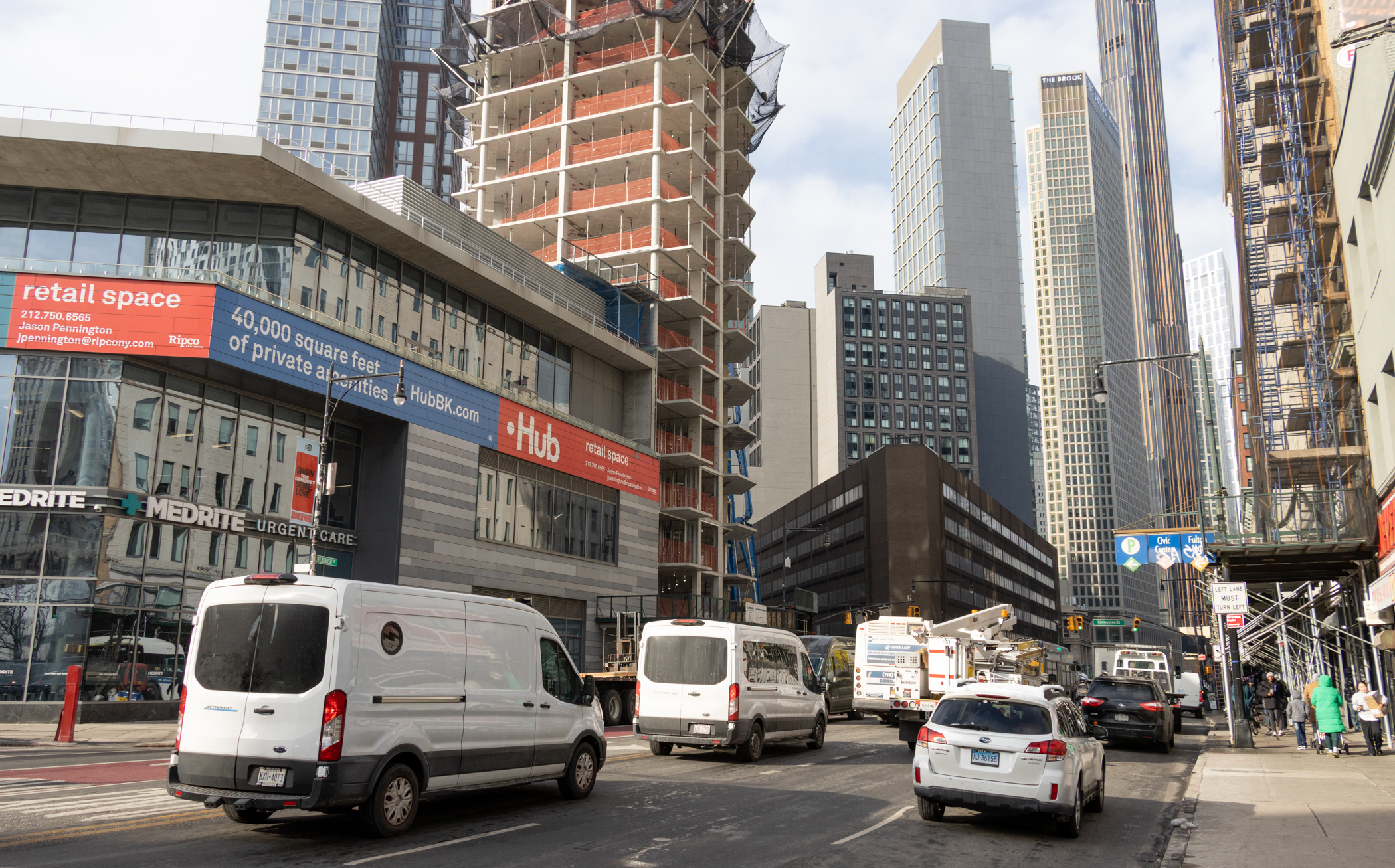
Arcadia Realty Trust this fall broke ground on the first new building to be developed on the mall for years: the beginning of a mixed use complex named City Point. The first 50,000-square- foot phase is scheduled to be completed in early 2012. Eventually it will cover an entire block with some 1.5 million square feet of retail and residential space.
The New York City Economic Development Corporation and the Downtown Brooklyn Partnership comprising local developers, retailers and other stakeholders—are spending $15 million cleaning up the grungy strip, improving landscaping, installing new street lighting and some additional public spaces.
Michael Glimcher of retail giant Glimcher Realty Trust— which has no current development interests in Downtown Brooklyn—says his group is “absolutely” interested in running a ruler over the area.
“We want to be where the people are and more and more people are flocking to urban areas,” Mr. Glimcher says. “You can’t beat density, you can’t beat masses of people”.
Mr. Glimcher says there’s certainly a precedent for areas being transformed. “Third Street Promenade at Santa Monica used to be a small hippy beach community and now it’s made the full swing, it’s anchored by a luxury mall with the likes of Tiffanies and Bloomingdales,” says Mr. Glimcher.
But he warns such moves are often far from smooth sailing: “It’s always difficult to make a new first impression when areas have been out of favor for such a long time.”
Even some boosters of downtown Brooklyn agree that a transformation of Fulton Mall will take time. “If you want to find the Rip Van Winkle place to come back to in 10 years, this would be it,” says Fred Harris, a senior vice president of development for AvalonBay, the developer of the rental tower, Avalon Fort Greene.
Please leave Fulton Mall how it is.
Novanglus,
I agree with your “let’s not pretend” sentiment although I see it slightly differently.
Corporate media is not writing articles about Jimmy James (sp?) or the businesses there now. They’re not sexy of current in the media’s eyes.
“Grungy strip”? It is not grungy there.
I dunno. We lived around this area for 9 years, and what we would notice are all of the discount stores with merchandise on the street (including gold chains), big banners hanging, and hucksters trying to sell people cell phones.
But it would be unfair to describe it as an economically downscale place–there were, as MM noted, a number of standard national and local chains whose clientele were predominantly middle income folks.
Let’s also not pretend that a lot of this talk isn’t really about making Fulton street’s clientele whiter as well as more affluent.
“Not the nose in the air Brooklyn Heights demographic.”
Minard?
This is the part that really gets me:Fulton Street has been economically successful for over 40 years. But it catered to the working and lower middle class customer, and the working poor. Not the nose in the air Brooklyn Heights demographic. I shopped there all the time when I lived in the Heights and I was often the only white face around. I found great bargains all the time. Everyone was nice- it just wasn’t the aesthetic of the wealthy. Now they’ve “discovered” it and want to fix it. Fine- but I hate the rewriting of reality. Like MM said- it was no wasteland.
The 99 cent shops are actually over on Livingston (as is Goodwill). I did see that a thrift/vintage store opened upstairs on Fulton (somewhere near Macy’s).
“And Target at Christmas had many completely empty aisles.”
Christmas? Try any other time of the year and they look like that. It’s their own fault too because Target refuses to adjust their inventory purchase schedule to accommodate the amount of store traffic they get in Brooklyn. From someone who worked at Target they said they only order merchandise about every 3 or 6 months. They pretty much run that place the same as they do a store in Boise Idaho. That’s why whenever you go they’re always out of stuff and the place looks ransacked.
“…It’s behind the paywall but has been liberated …”
is that the same as stealing? why the euphemism?
“It’s always difficult to make a new first impression when areas have been out of favor for such a long time.”
I can’t stand this attitude. It’s like the Europeans landing wherever in North America and declaring the land empty and ready for colonization. Oh, what people here already? I didn’t see them…
Fulton Mall has been IN FAVOR for the last 30-odd years since all of the higher end stores hit the highway, except for Macy’s. The empty spaces were filled by merchants who are paying damn high rent, yet are succeeding. There are actually zero $.99 cent shops on Fulton Street. Yeah, there are bargain shops, local chains like VIM, and a few electronics shops, but it is largely national chains like Lane Bryant, Ashley Stewart, Strawberry, Foot Locker, Children’s Store, CVS, Duane Reade, Baker’s Shoes and plenty more. Now that may not be the kind of stores that the people who read the Wall St. Journal want, but it’s hardly a wasteland.
I see no problem with H&M, etc coming in. They are going to coin money. More upscale shops may do well, too, especially if they have goods that people of all incomes are interested in. Fulton St will change, but these efforts to shove the old out for the monied new really anger me. The old Fulton Street, in its heyday had a mixture of expensive and bargain. You could buy a fur coat, china, furniture and jewels, as well as bargain goods, toys and everday goods. High and low, and a healthy middle. That’s what works the best, and makes for a sustainable and desireable retail hub.