
Iconic Brooklyn Heights Mid Century Modern House Seeks Rooftop Addition
The new owner of the townhouse designed by Joseph and Mary Merz as their home plans a visible rooftop addition that would alter the facade’s geometry.

The townhouse at 48 Willow Place undergoing repair and with a mockup on the roof in September. Photo by Susan De Vries
At least one local objects to a rooftop addition proposed for an iconic Brooklyn Heights mid century modern townhouse on Willow Place.
An application to the Landmarks Preservation Commission to build a terrace and rooftop addition on top of 48 Willow Place was on the agenda to be discussed at the Tuesday, November 5 meeting of Community Board 2. An LPC hearing is scheduled for Tuesday, November 25.
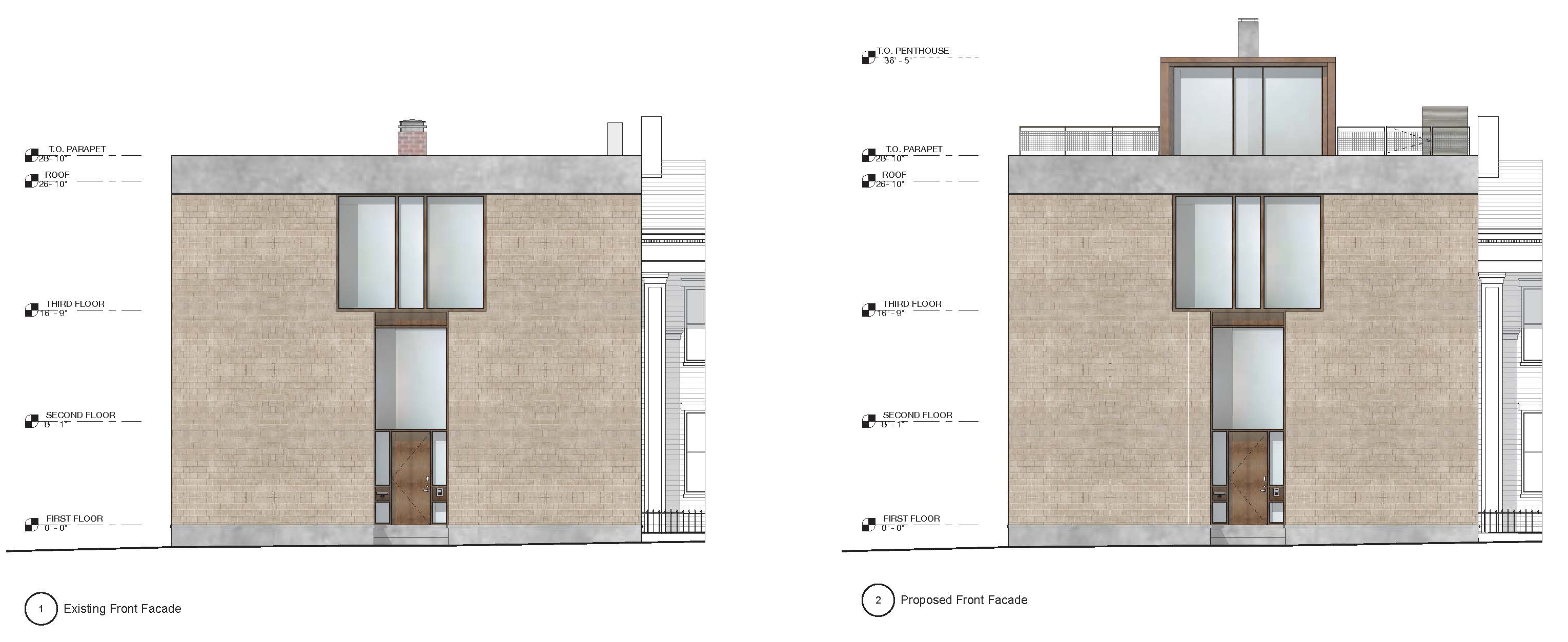
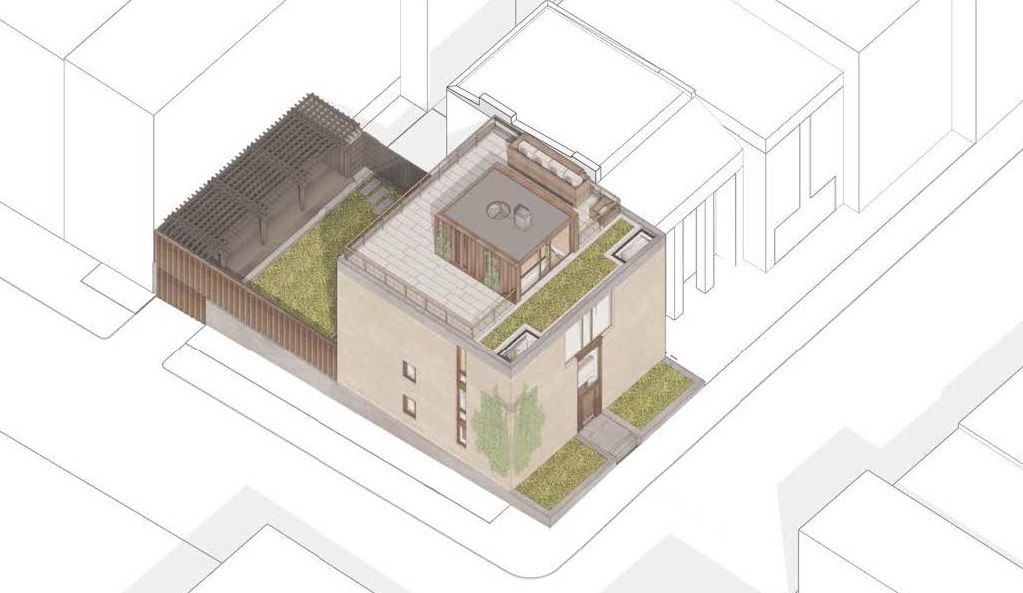
The mid century modern townhouse is one of three in the Brooklyn Heights Historic District designed and developed by architects Joseph and Mary Merz. After the couple passed away, their home at No. 48 changed hands twice, most recently in 2024 after a sympathetic alteration by prominent architect Ian Starling intended to update the house for modern living while preserving its spirit.
The proposed addition will be visible from the street, and alter the carefully composed modern and abstract composition of its facade, application materials show. Although each is slightly different, the facades of all three Merz-designed townhouses reference traditional townhouse elements, and center and vertically stack three openings. Perhaps the column-like arrangement of the openings is a nod to the columns of the houses of the colonnade row the new townhouses replaced.
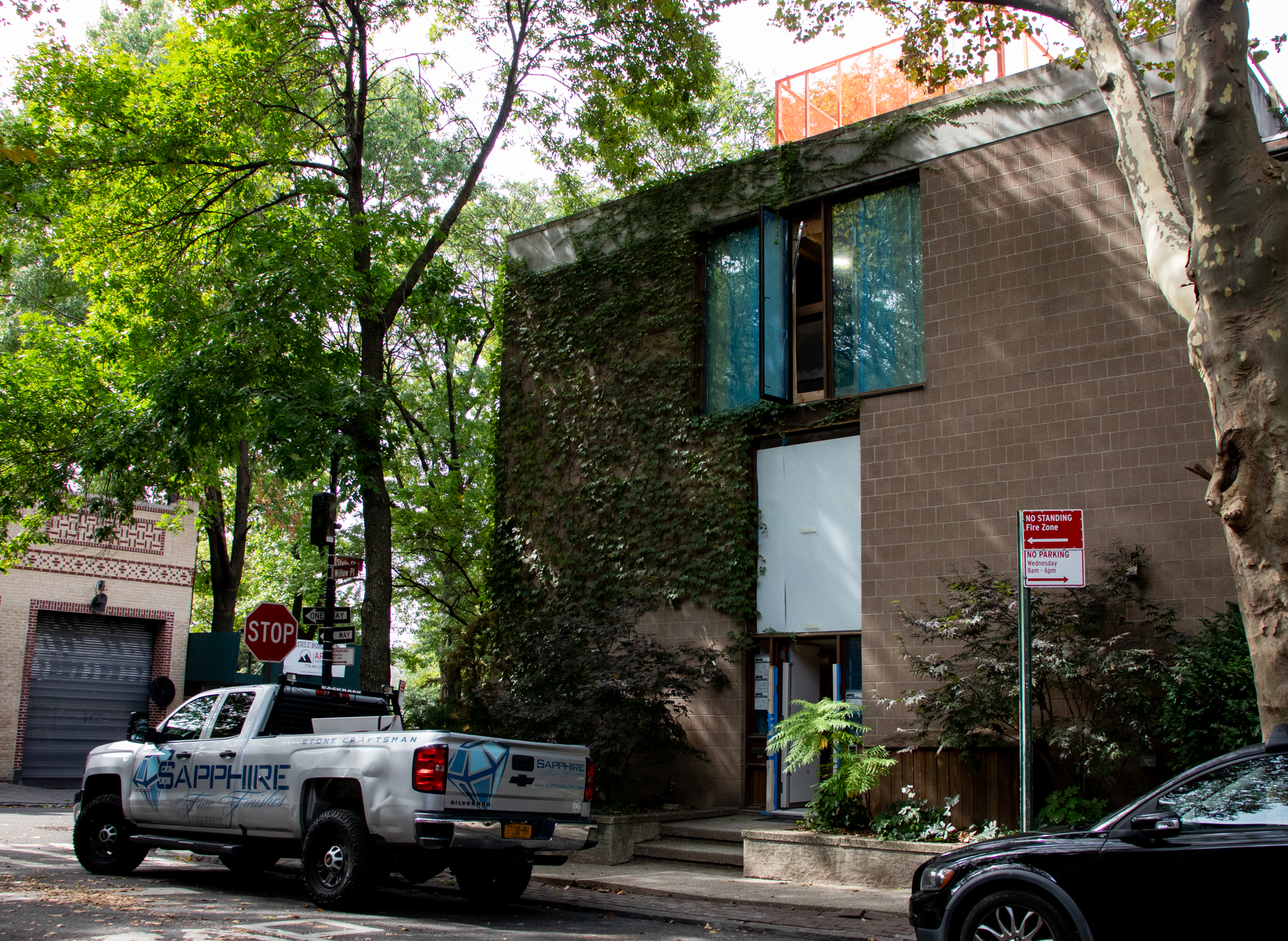
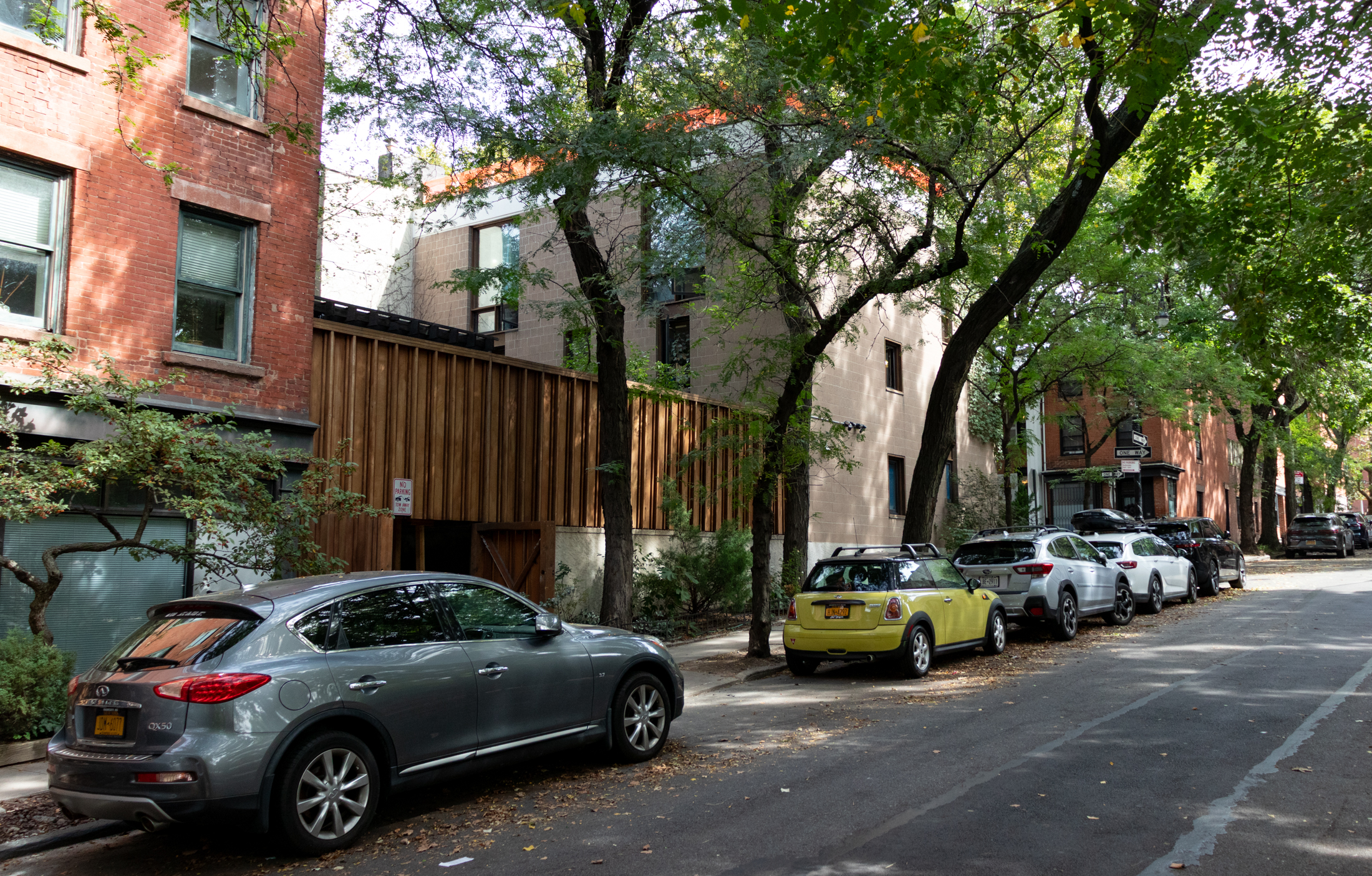
At the architects’ own residence, the front door has sidelights that echo Greek Revival entrances, and the shapes of the openings and panes recall vertical townhouse windows. A petite chimney above the front parapet in the “before” renderings does not appear to be visible from the street. Likewise, a rooftop structure depicted atop No. 40 in the renderings does not appear to be visible from the street.
More than 20 years ago, the owner of one of the other Merz-designed townhouses, 40 Willow Place, applied for a similar rooftop addition, also visible from the street, but the LPC ruled the addition must not be visible, according to written testimony submitted to Community Board 2 concerning the application for No. 48.
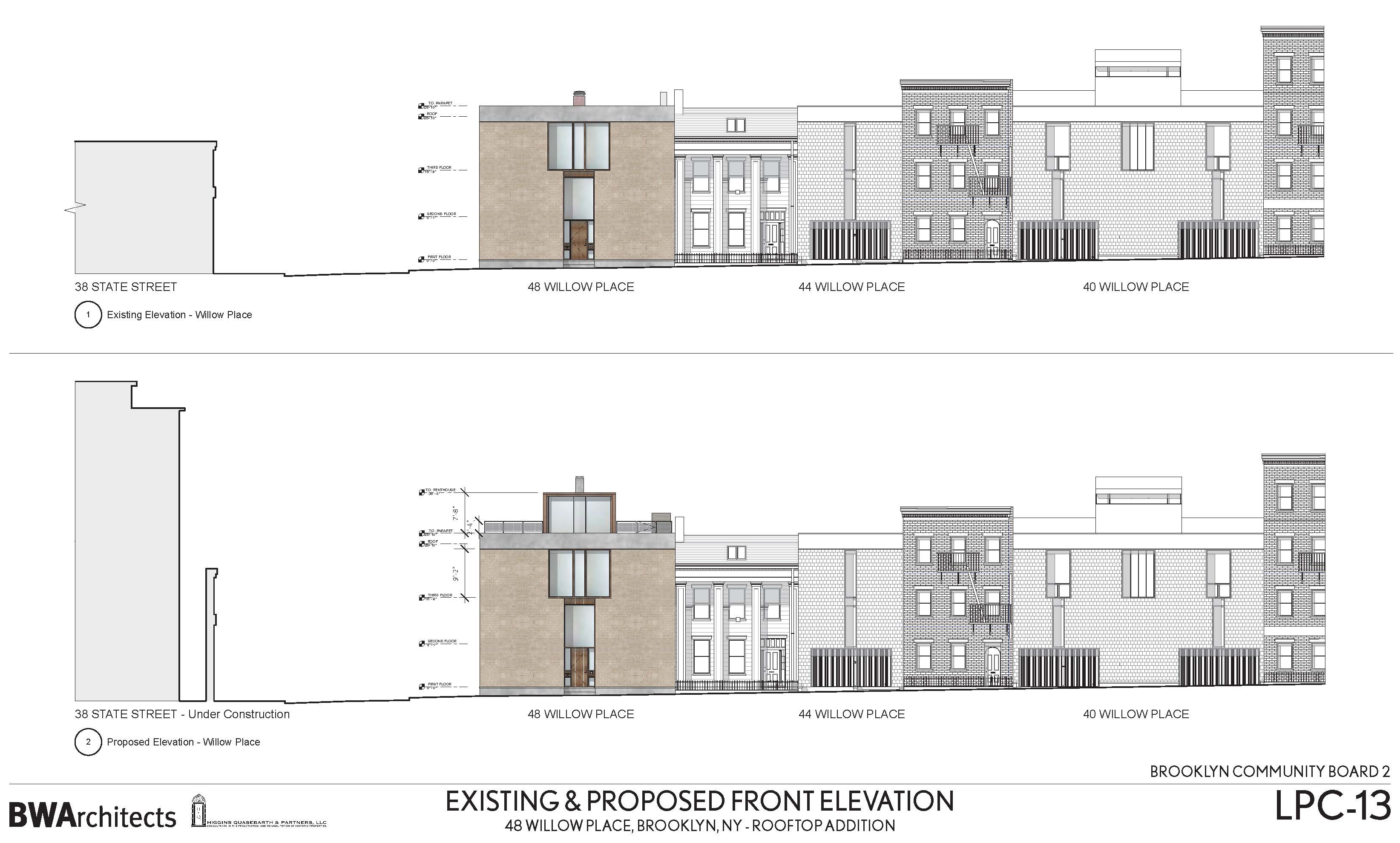

“The Commission found that the unique sculptural design of these buildings would be severely compromised by a visible “pillbox” roof addition. The same reasoning applies here,” said the letter writer, who called on the LPC to “reject any visible rooftop addition that would alter the integrity of this unique modernist ensemble.”
Earlier this year, the new owner of 48 Willow Place received DOB permits and LPC permission to reframe the roof and add skylights to the upper story, as Brownstoner reported.
The chairs and secretary of Community Board 2 did not reply to a Brownstoner request for comment.
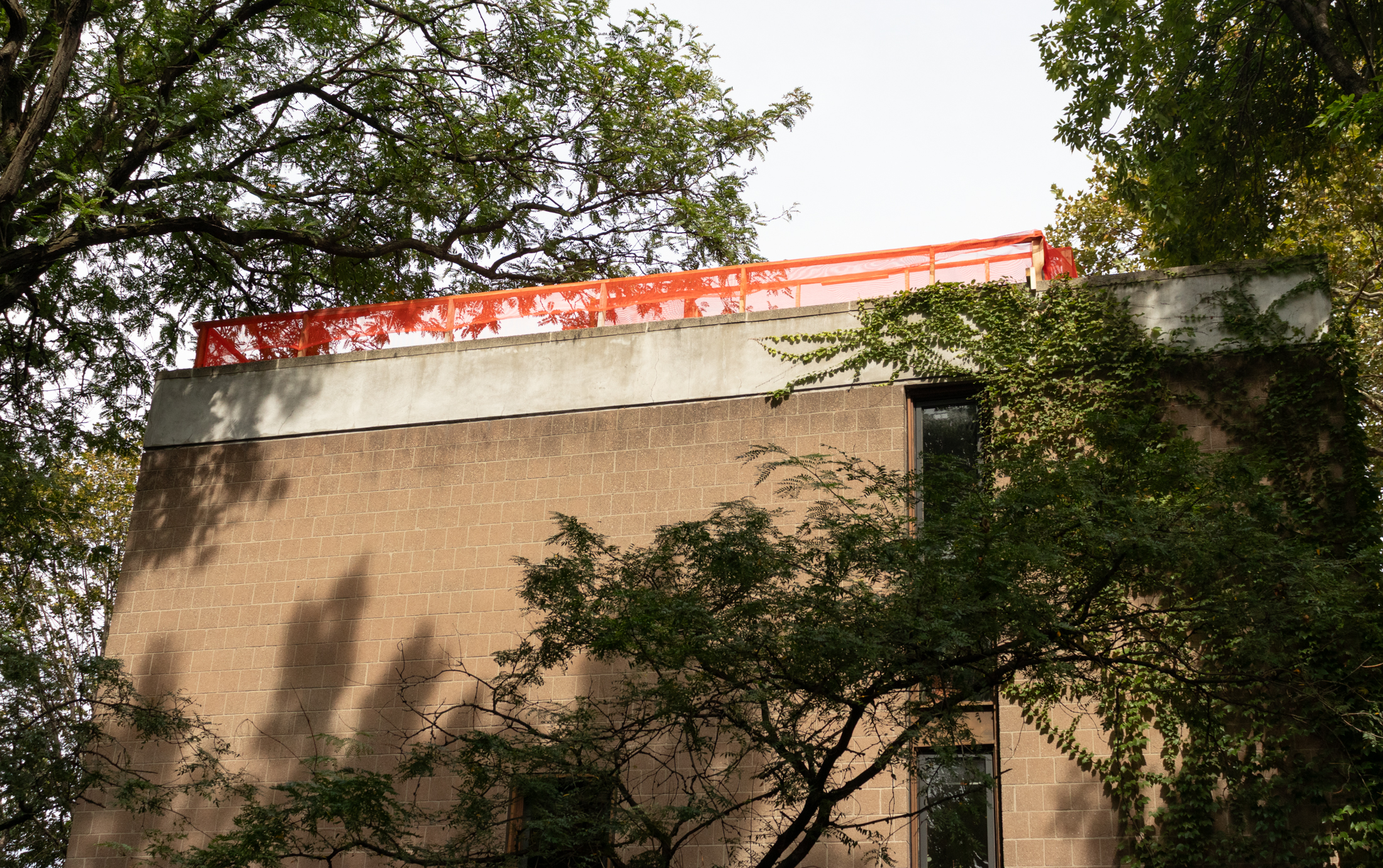
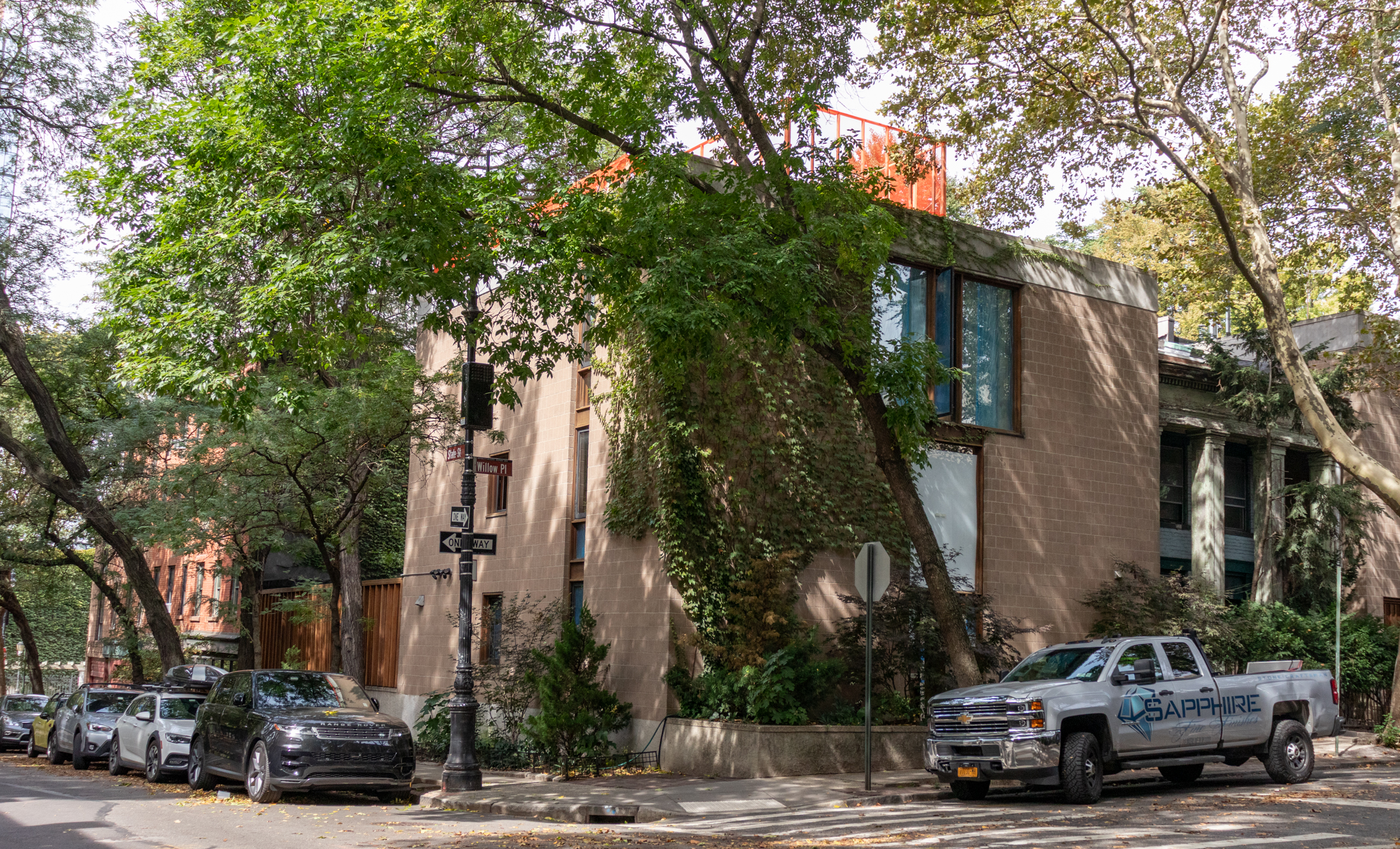
[Photos by Susan De Vries | Renderings by BWArchitects via CB2]
Related Stories
- No Gut Reno for Iconic Brooklyn Heights Mid Century Modern Townhouse
- Notable Heights Mid Century Modern Townhouse With Carport, Garden Asks $6.95 Million
- Condo Design for Heights Powerhouse Turned Garage Stirs Debate at LPC
Email tips@brownstoner.com with further comments, questions or tips. Follow Brownstoner on X and Instagram, and like us on Facebook.
First, to reiterate and strengthen my sister Katie Merz’s point: the “existing chimney” shown in the architectural rendering does not exist in reality and was not part of the original design. Second, if you look to the right on the roof in the “existing” drawing, you’ll see another shaded “mass”—also non-existent. These fabrications are plainly intended to mislead Landmarks into believing there were prior breaks in the original symmetry and intent of the structure, thereby implying that the proposed addition merely “continues” what is already there. It does not. These elements are fictional.
Why invent them? Because once an addition is placed on the roof, the actual chimney—which in the Merz design sits at the center of the roof and is the same height as the parapet—will, by NYC code (Title 27, Subchapter 15), be required to extend at least three feet above the new roofline. In other words, their unlawful “birthday-cake” addition forces the chimney to sprout an additional three-foot extension, turning it into a literal candle on top of their construction. So they have drawn a fake chimney to distract from this violation and its aesthetic absurdity.
Likewise, the shaded mass on the right side is an invention—an attempt to fabricate a visual “continuity” to justify whatever mechanicals or bulk they hope to slip in. It has no basis in the built reality.
My parents designed these houses—48, 44, and 40—on three vacant lots before the Landmarks Law even existed. They could have built higher, bulkier, more aggressively modern structures. They did not. They chose restraint: harmony, balance, proportion, and a sensitive dialogue with the surrounding historic fabric. Every plane, setback, roofline, and geometric mass was intentional. The integrity of the design is the composition itself.
I came home from the hospital two weeks after these houses were built. Throughout my entire life—at ages 6, 13, 19, and as an adult with my own children—students from Columbia, Pratt, Yale, NYU Urban Design, and beyond came to study these homes as exemplary modernist infill. Up to my father’s death at 92, he could be found on the stoop or walking a group through the design, explaining the vision he and my mother achieved: a holistic, sensitive modernism that integrates with, rather than bulldozes over, its historic neighbors.
Whether one likes the houses or not is irrelevant. They do not overwhelm; they compose a deliberate symmetry, this house in question (48) on its own and down through 44 and 40—the bookend of a deliberately unified trio set amid two older houses. The integrity of the whole role and composition and their intent to both set a precedent of excellent “infill” architecture is at stake.
And let me be absolutely clear: this is not a “modern” house in the sense of contemporary stylistic trends. It is a modernist house—of a specific period, at the height of modernist architectural expression. It deserves the protection afforded to any significant work of its era.
Finally, this is not merely a question of taste or preference. There is precedent. In 1978, the owners of 44 Willow Place—another of the trio my parents designed—attempted to build a roof addition. Otis Pratt Pearsall himself—the man who wrote the NYC Landmarks Law and who stopped Robert Moses’s BQE plan from destroying Brooklyn Heights—wrote a three-page letter forcefully declaring that any alteration to the façade, roofline, or visible massing of these houses would be a direct violation of what Landmarks exists to protect. He went on at length praising the architectural importance and integrity of these structures. Landmarks summarily rejected the proposal, and the owner of 44 refused to speak to my parents for the rest of his life.
I am not an antagonist of wealth or yoga rooms on roofs. But in a 3,200-square-foot house with one of the largest backyards in Brooklyn Heights and a two-car garage, this proposal is nothing short of an outrageous assault on a nationally recognized AIA-honored design. For what, exactly? To satisfy the whims of a pair of $13-million buyers who simply want more?
Years of students learning here, years of careful Landmarks protection, decades of architectural integrity—all cast aside for what? A preference? A want? A fleeting indulgence dressed up as necessity?
This should not, and must not, be allowed to happen.
The incorrect chimney that Katie Merz points out is problematic. It is easy to confirm that it doesn’t exist- just check the house out on Google Earth. Whether this error is due to sloppiness or to deceive Landmarks into thinking there is a precedent for protrusions on the roof cannot be determined, but it doesn’t speak well for the competence or intensions of the architects.
I would like to make a correction to the architects ” existing building ” drawing. There is no chimney or protrusion that extends above the parapet. There has never been a chimney that extends past the site-line of the cube. That rendering is not true to reality. My parents would NEVER have made a small chimney extend past the line of the roof. And to repeat – that depiction of the existing structure is not correct.
This house, plus the other structures the Merzs did nearby, are probably the finest examples of Modern domestic architecture in Brooklyn. The beautifully composed facades are so minimal that any addition would destroy their impact. This is a gem that should be left in its original state.
Please submit feedback here https://www.nyc.gov/site/lpc/about/submit-public-hearing-meeting-comments.page. This action violates LPCs long standing Rule § 2-15(c)(2)(i) but was approved by LPC’s CB2 committee without the benefit of a sightline study, without mentioning that 40 Willow Place is not visible from the street, and without showing the assemblage of buildings. These are significant buildings and street level sightlines should be preserved.
Just to clarify, neither Community Board 2 nor its land use committee are part of LPC. They review LPC proposals and make recommendations.
I should have said that 40 Willow Place’s rooftop addition is not visible from the street. That was a requirement from LPC voiced formally or informally before the review. These buildings are modernist gems. Joe AND Mary were incredibly talented and these buildings are in textbooks. Sightlines need to be preserved.
Thank You Marty !
Thanks for acknowledging them. They were pretty generous people. Visionaries.