
The Alden: Brooklyn Heights’ First Luxury Apartment Building
Appointments designed to attract wealthy residents included light and air, a doorman, built-in iceboxes, and a separate servants’ entrance.

The Alden on Remsen Street in Brooklyn Heights. Photo by Susan De Vries
During the latter quarter of the 19th century, wealthy Americans began traveling the world, giving rise to a nation of tourists. While a sojourn could go anywhere, Egypt and the Middle East were very popular for the adventurists, but for most people their “grand tours” were to Europe, and included extended stays in Paris, London, Rome, and other Western European countries and capitals. The Americans were impressed by many aspects of European urban life — the history, art, food, and architecture. One of the biggest revelations to upwardly mobile New York City dwellers concerned how people lived.
Perhaps it is a by-product of that vaunted “frontier spirit,” or the idea that a man’s home is his castle, but the American middle classes and those above firmly believed that a successful man and his family should live in their own one-family home. Hence our row house neighborhoods, whether they are wood frame, brick, or stone, not to mention freestanding houses and mansions.
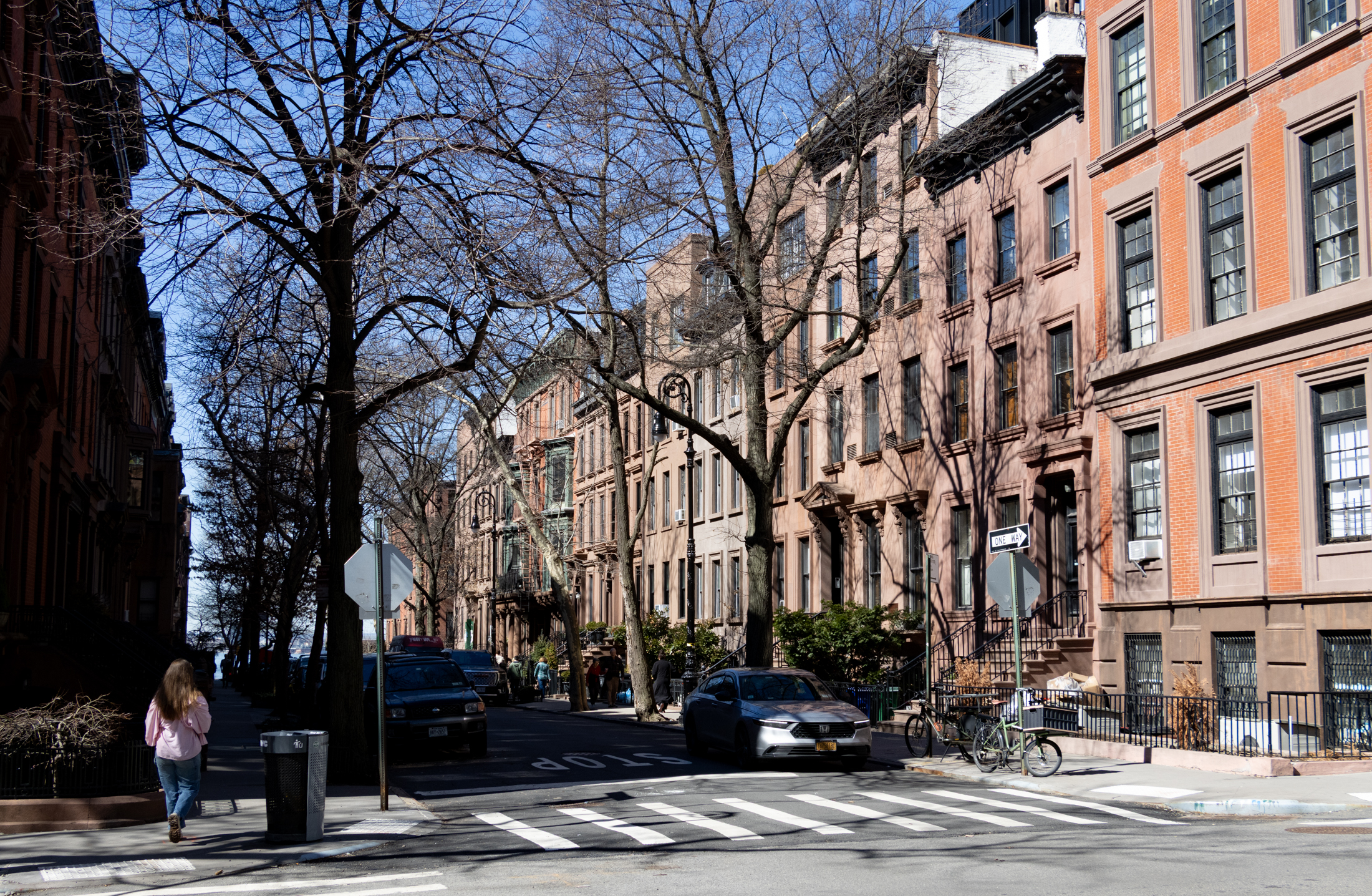
But many of the wealthy people who lived in the city of Paris, for example, didn’t live in individual homes. These sophisticated urban French lived in large apartment flats, one apartment on top of another in a beautiful building with a common staircase opening into a courtyard and windows that opened onto the courtyard and the street. How chic, an almost decadent way to live in a city!
However, multiple-unit buildings had another name in New York – they were called tenements.
The word tenement has been in use in Scotland and Great Britain since the Middle Ages and simply meant “tenant houses.” But as the definition evolved through the centuries, it went from being value neutral to defining run-down, overcrowded buildings in poor neighborhoods filled with very poor people living in unimaginably horrible conditions.
A tenement is legally defined in New York by the Tenement House Act of 1867 as “Any house, building, or portion thereof, which is rented, leased, let, or hired out to be occupied or is occupied as the home or residence of more than three families living independently of one another and doing their own cooking upon the premises, or by more than two families upon a floor, so living and cooking and having a common right in the halls, stairways, yards, water-closets, or privies, or some of them.”
New York and Brooklyn had a lot of those tenements, so many that one cannot escape seeing them somewhere. But as time went on, it soon became clear that land was a finite commodity. As more people of all incomes flocked to cities, multi-unit dwellings became a necessity for all income levels.
The hard part for late 19th century property developers was not the difficulty of building them, even in upscale neighborhoods like Brooklyn Heights, but convincing the middle and upper classes that living in one of these buildings was as socially acceptable and as aesthetically pleasing as living in a single-family townhouse. It would require special architectural features and some aggressive marketing.
Today we call any multi-story, multi-unit dwelling an apartment building, but that wasn’t the generic name in the years following the Civil War. All multi-family buildings that fit the legal definition were technically “tenements.” That was the name used on building permits and in official documents of the day, and it is still used by architectural historians and professionals when describing these buildings. Among the first such buildings designed to woo the middle classes were the eight-family buildings that were marketed as “flats.”
The typical flats building was four stories tall with a center stairway and two apartments on each floor, one on either side of the stairs. The apartments generally took up the entire length of the building. The height and window placement of these buildings were designed to blend in seamlessly with extant and future row housing, and they were often designed by the same architects who designed the surrounding one-family homes.
These buildings start to appear in the mid-1870s and became extremely popular in the developing new neighborhoods in Brooklyn well into the years leading up to World War I. They needed to be wider than the average 18 to 20 foot wide lot; generally they are around 40 feet wide, or two single lots, resulting in most of them appearing in the “new” neighborhoods that were heavily developed in the 1880s and ‘90s, like Bedford and Park Slope. Lot lines could be adjusted and these went up at the same time that the surrounding houses did. But they also appear in our older neighborhoods too. One of the earliest was 43-45 Cheever Place in Cobble Hill, built in 1873.
In wealthy Brooklyn Heights, one of its more influential residents decided to invest in the new “flats” construction on two 25 foot wide lots at 41-43 Remsen Street, between Hicks and Henry Streets. Like many of Brooklyn Heights’ wealthy merchants, Edwin Packard was a transplanted New Englander, born in Massachusetts in 1840, a direct descendant of the Mayflower’s John Alden. By the time his building was constructed, he was serving as the first president of the Franklin Trust Company, one of Brooklyn’s most successful banks. During his long career he was president of the New York Guaranty and Indemnity Company. He was also a director of the Franklin Safe Deposit Company, the American Writing Paper Company, the Fajardo Sugar Company, and the Brooklyn YMCA, and a member of the New York Chamber of Commerce.
Packard was very instrumental in the establishment and success of Brooklyn’s new YMCA, which once stood on Bond Street with an entrance on Fulton Street in the shopping district. He was a generous giver to charity and was also very involved with Brooklyn’s Republican Party. He was a strong supporter of his friend and fellow Heights’ resident Seth Low in his bid to become the two-term mayor of Brooklyn, and then the mayor of the newly formed City of New York in 1902. When Packard died at the age of 81 in 1921, he was remembered in the Brooklyn Eagle as “a fine type of what used to be called the ‘Merchant Prince’ in civic life and the broader field of American politics.”
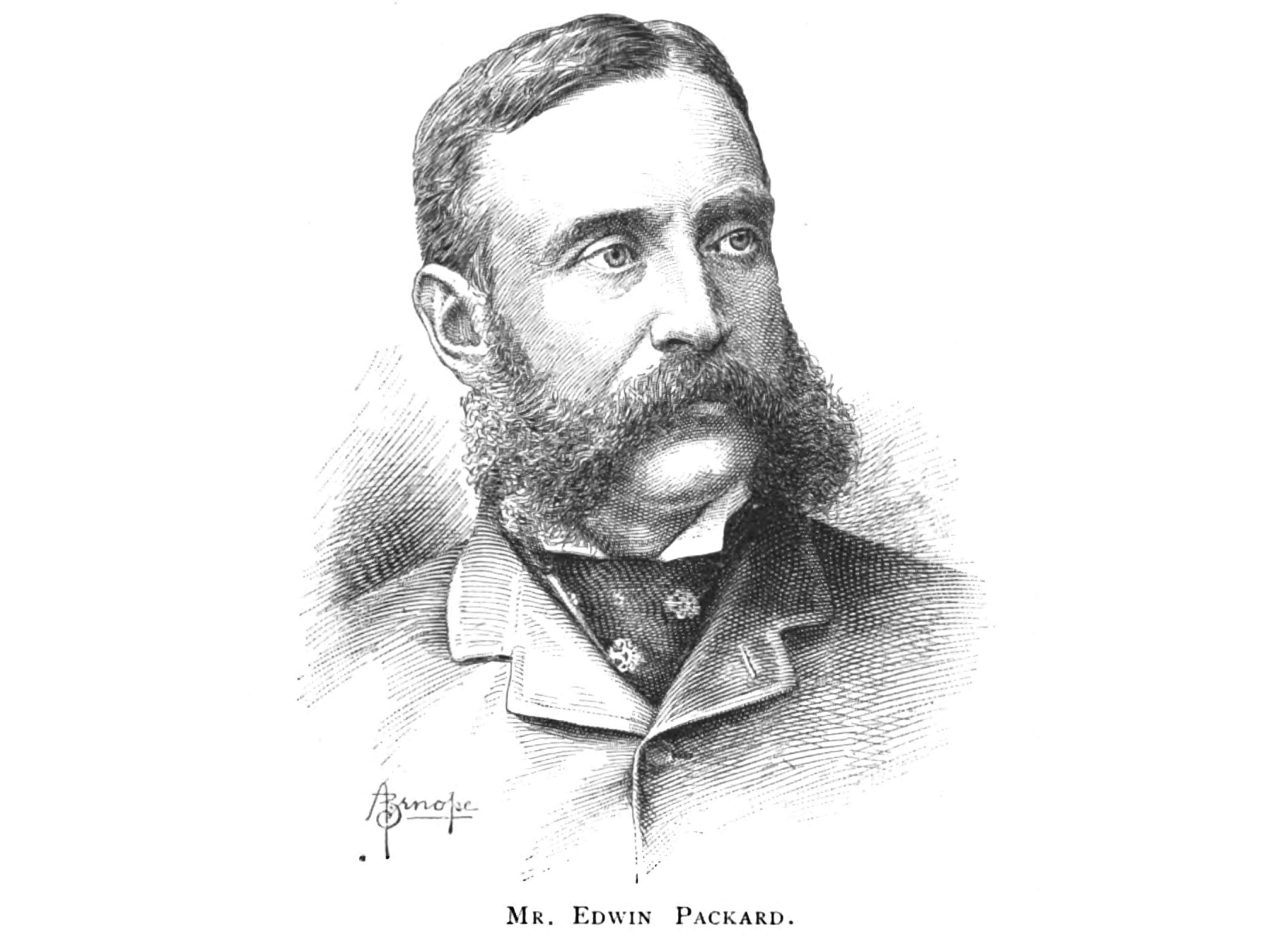
Like many wealthy men in an ever-expanding city, he was also a very active figure in local Brooklyn real estate development. The lot at 41-43 Remsen Street was not his first foray into developing, or his last, but it was one of his most experimental. He was going to build flats that would be marketed to rich people. He was taking a big risk – this was 1877, not 1897. Manhattan’s Dakota apartments would not be completed until 1884. Would wealthy people want to live in his flats?
Building the Alden Apartments
Packard needed a well-known and regarded architect for his project. He chose George L. Morse, who by 1877 had gained the reputation of being one of Brooklyn’s finest architects. Morse came from Maine and a family of builders. His father designed, drafted, and built mills and factories across New England. Young Morse inherited his father’s talents and was drafting for him while still in school in Bangor, Maine.
He moved to New York City to apprentice under British architect Jervase Wheeler, who offered him a partnership after only a short time. But before it became official, Wheeler returned to England to take care of urgent family business and decided to stay. Morse took his practice to Brooklyn and opened his shop in 1860. He was 22. Before being hired by Packard, he already had a wide portfolio of buildings to his name, both residential and commercial.
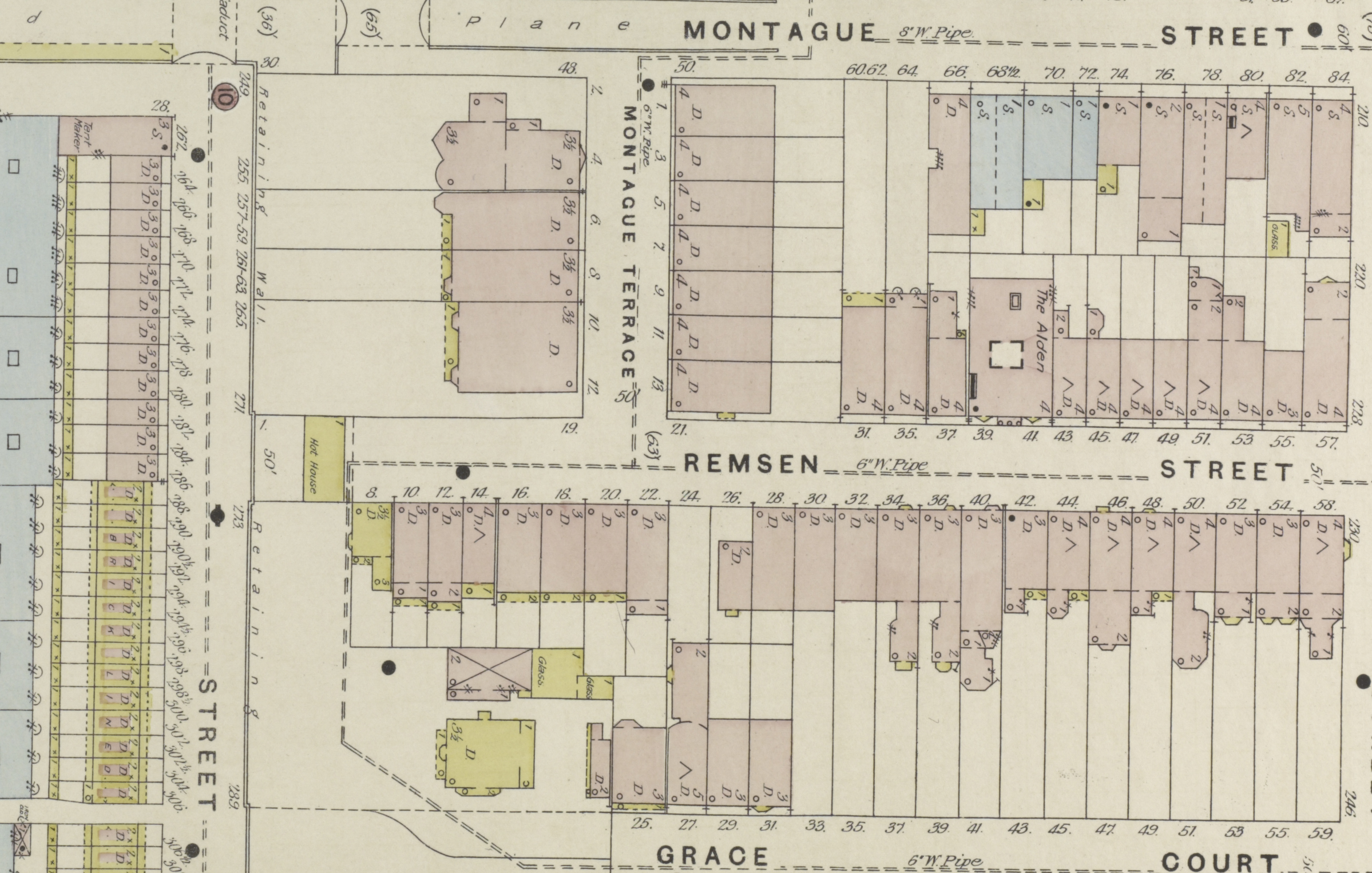
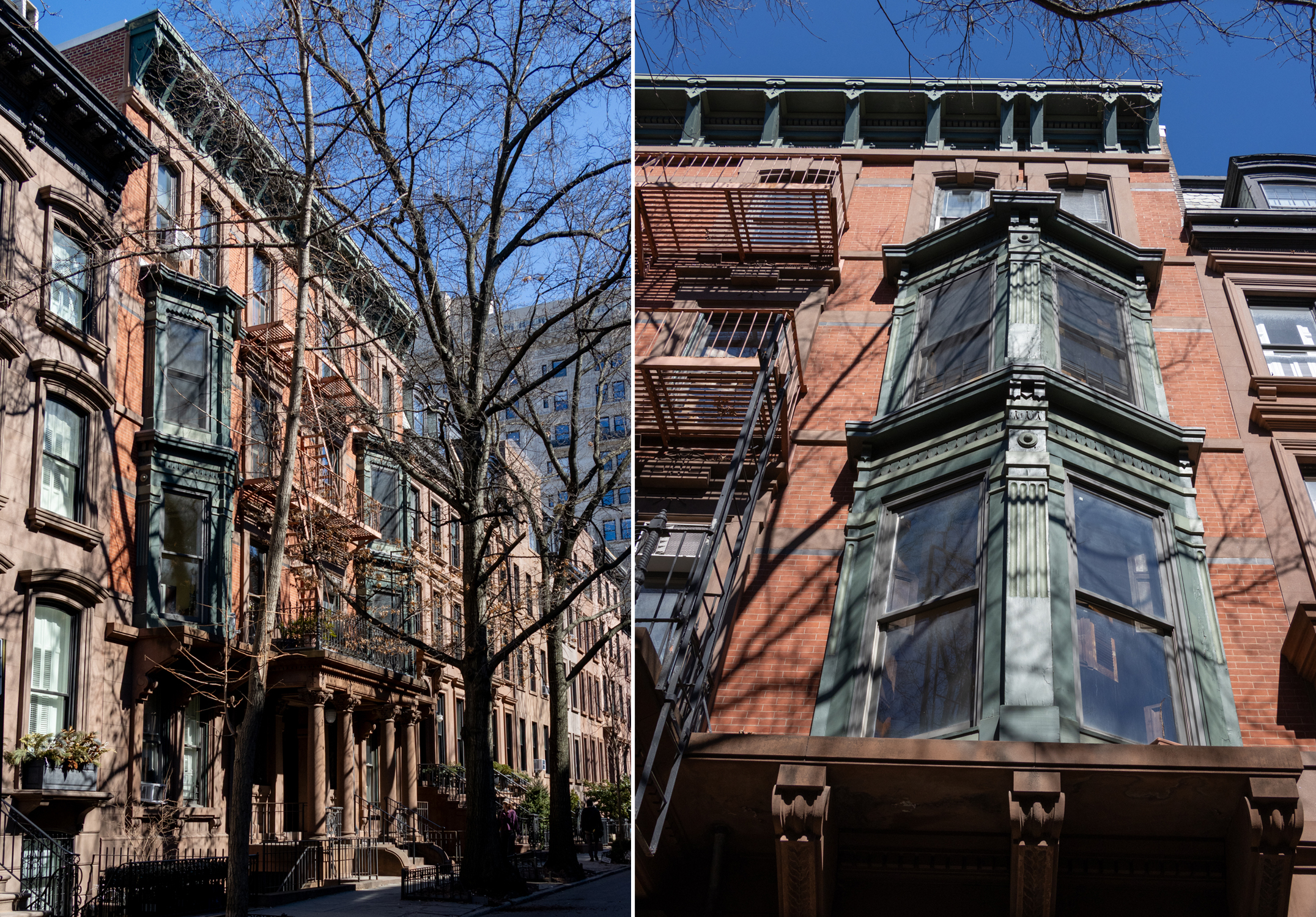
Both men knew the stakes were high here. Morse’s design had to be attractive as well as functional and needed to fit into this neighborhood of established upscale homes. Most of the houses on either side and across the street were tall Second Empire single-family houses comprising four stories over a basement. They were basically Italianate in style, with mansard roofs, giving the houses another floor of living space. Since these were speculative homes for upper middle-class people, the top floor was generally home to servants’ rooms and storage space. Some may even have been ballrooms.
Morse’s building was described in the Brooklyn Eagle as Neo-Grec in style, but had elements of several different styles, unique to this block. Characteristics of the Neo-Grec are evidenced in the etched ornamentation of sills and the fleur-de-lis etched patterns on the entablature above the columns, the elegant wooden cornice, and the triangular oriels.
But Morse seems to have anticipated the architectural style that came into vogue only a few years later called Queen Anne, which borrowed elements from many different styles and influences. The building facade incorporates details taken from other buildings in the Heights, including mansions on Pierrepont Place, and houses further up Remsen and on Henry.
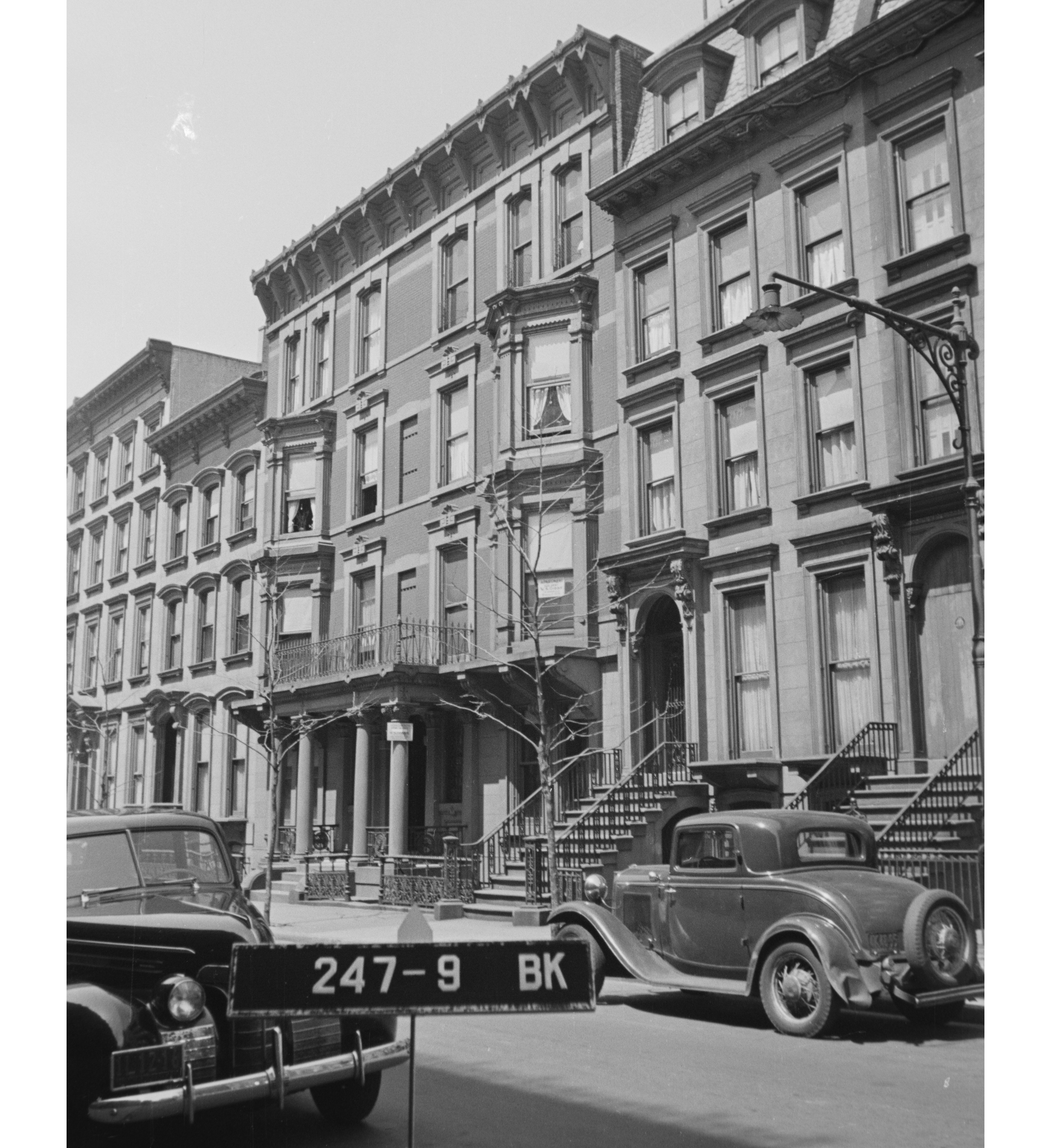
The building, dubbed the “Alden Apartments,” was marketed to the rich. The apartments were called “French flats,” to remind people of the large and opulent apartments in Paris. Even before the building was completed, the marketing campaign was in operation. The Brooklyn Union published a lengthy article in 1877 about the building entitled “Palatial Flats: A Tenement House for Wealthy People.” The introduction to the article called the building a “practical adoption of a Parisian idea in Brooklyn,” and went on to describe it as an extraordinary building. Edwin Packard would go on to say that he was inspired by the apartments his friends had in Paris and Berlin, where they lived in comfort and elegance.
The construction and details of this new building were indeed splendid. There were only two apartments per floor. Each apartment (a word so new to the housing vocabulary that the author felt obligated to define it as a “set of rooms”) had eight rooms. A large parlor looked out over Remsen Street, followed by bedrooms and a bathroom, with the dining room towards the back next to the kitchen, behind which were servant’s rooms. An important feature of the building was that it was designed with a small courtyard in the center, which allowed every room to open to fresh air. Architect Morse considered the light shafts employed in the tenements for the poor to be conductors of fire, disease, noise, and smell. That would not happen here. Morse was correct, but it would take another 30 years for laws to be written to eliminate those narrow shafts in other tenement construction.
One objection to multiple family dwellings by those better off were the sounds of the people above walking across rooms, with loud voices and cooking odors. Where was one’s privacy and peace and quiet? These concerns were met here by building double flooring separated by layers of felt as well as fireproof materials between the beams that also deadened sound.
One entered the building into a spacious hall, like a reception room, which contained a grand staircase, all faced in hardwoods. Each apartment parlor had plate glass mirrors over the fireplaces. The dining rooms had similar mirrors and were finished in the popular Eastlake style, which included decorative parquet floors. The kitchens were all equipped with stationary refrigerators (these would have been ice cooled, not electric) and chutes for garbage disposal. The entire building was steam heated, with the building owner paying for heat and light in the common spaces. Another amenity was a platform with a sturdy iron railing on the building’s roof, so tenants and guests could promenade. The entrance to the roof was accessible from the main stairway.
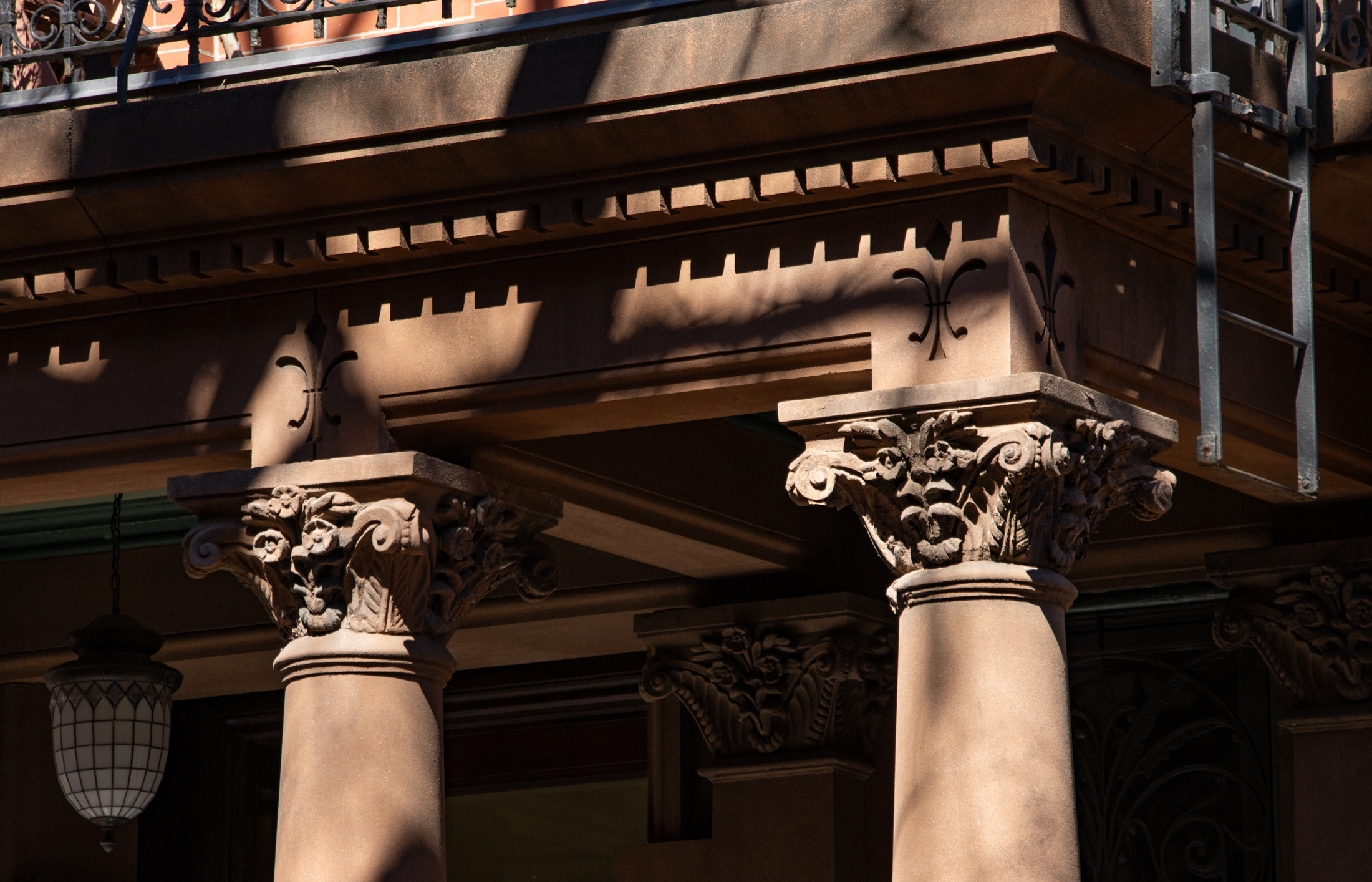
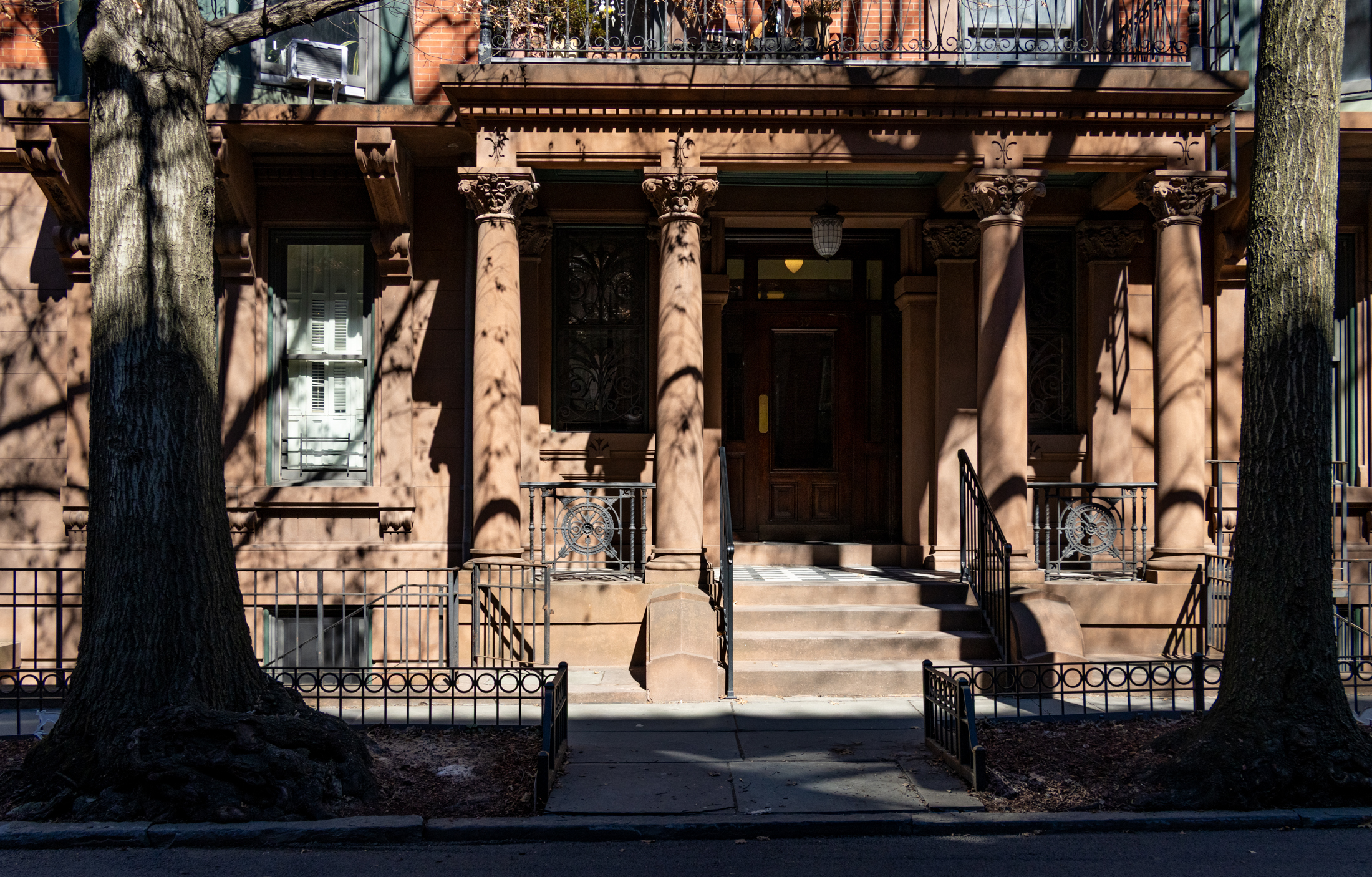
Finally, to compensate for the lack of proper servants’ spaces that an upscale townhouse would have had, the service areas were well thought out. Since you couldn’t have the servants using the same stairs to enter and leave the property, a separate entrance and stairway for them was in the back of the building, along with a servants’ hall where the building’s help could take their meals and perform tasks for their employers. The room was equipped with a series of electric bells connected to bells in each apartment, which would summon them when needed.
The basement level was home to the building’s janitor and in use by the collective help. All deliveries were accepted in the rear, and the janitor would send the items upstairs via a dumbwaiter and a steam elevator for larger deliveries. A laundry and drying closet were also in the basement, for use by the servants. Each apartment also had a “washing apparatus” and a drying closet, as well. Finally, the building employed a doorman in livery who would ring a bell up to the apartments, notifying them of visitors. Most townhouses didn’t have THAT, although the wealthiest probably did, if the “Gilded Age” is accurate.
After the building was completed in 1878, a writer for the Manufacturer and Builder, a trade periodical, visited to write about some of the interesting infrastructure in this new-style building. He wrote that the Alden was the finest flats building in Brooklyn and compared favorably with the best dwellings of its class. He was especially impressed with the ventilation and plumbing aspects of the project. He praised the light and air flowing into the building via the courtyard. He noted that the creation of the servants’ stairs and the elevator and dumbwaiter lifts necessitated large ventilating shafts opening onto a covered shelter on the roof that also allowed fresh air to flow into the building and carry away cooking odors. He was also pleased with ventilating flues within each apartment that also carried off vapors. All in all, the writer concluded, it was a commendable building in both design and execution.
Life at the Alden
So, how successful was Mr. Packard’s French flats building? His rent wasn’t cheap, by the standards of the day. But Packard was confident his experiment would work and he’d make a tidy profit. Rent for each of the two apartments on the first floor was $100 a month, $125 for the second, $110 for the third, and $80 for the fourth floor. (Legs of steel!) The same year, rent for a four story and basement row house on nearby Columbia Place was $1,000 a year. The second floor at the Alden would be $1,500 per annum. The rent for a more middle class three-story brownstone in the growing neighborhood of Park Slope (on 5th Street between 6th and 7th Avenue) was only $360 to $400 per year.
The rental roll for the building was full before it was completed. It seems that the stigma of living in a flats building was overcome by a desire for something new. Flats were slowly becoming more popular with newly married couples and empty nesters. They were also appropriate for widows and young single gentlemen, but single women, not so much. Social critics of the day railed against apartments because they were modeled on decadent urban European living, the horrors of which they could only imagine. Worst of all, apartments encouraged unsupervised living by single women and were thought to be dens of prostitution in waiting.
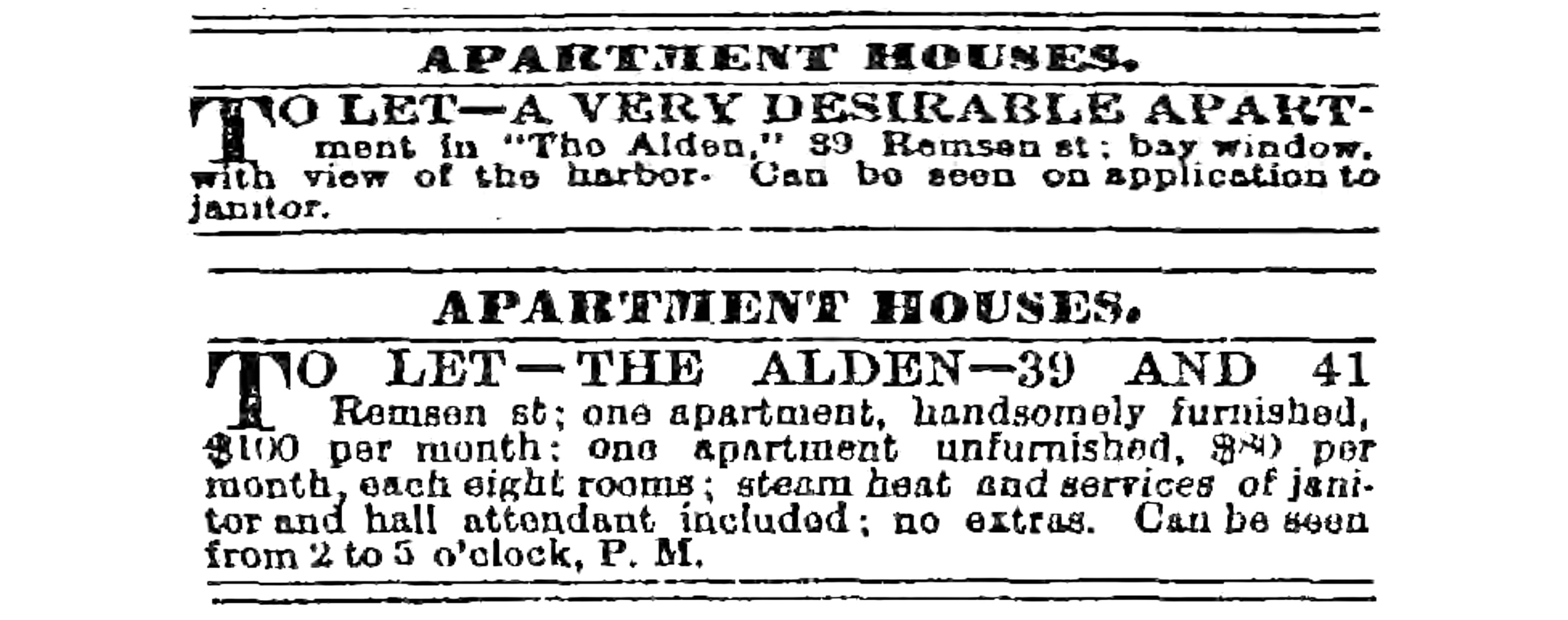
The 1880 census shows apartments rented by families headed by a carpet importer, a clergyman, a wholesale clerk, a broker, a commandant, a rubber manufacturer, and the janitor. More than half had a live-in cook, and one family with small children had a live-in maid and two nurses. Another had a cook, a nurse, and a waitress.
Over the years, more lawyers, manufacturers, merchants, brokers, and widows with their own incomes populated the building. Some families had children, others did not.
One of Commodore Vanderbilt’s nephews, Franklin Allen, lived here in 1889 when his mother’s will was being probated. She left him a tidy sum. Reverand Henry Jackson Van Dyke, the well-known pastor of the Second Presbyterian Church only a block away, passed away here in 1891. His family was listed in the 1880 census. He was a man of many accomplishments and was highly respected by the community. And, tragically, a 70-year-old widow named Caroline Lynds died here when a lit match broke off as she was lighting a lamp and her dress caught fire. Despite aid from her maid and two others who rapidly put out the flames, it was too late and she died shortly afterward.
In 1909, Mark Twain’s former secretary of many years, Isabelle Lyon, was being sued by Twain’s daughter, Clara Clemens. She claimed Lyon had taken advantage of the aging writer and had tricked him into giving her gifts and real estate that Clara did not think were appropriate. Lyon left his employment and was now married to Ralph Ashcroft, Twain’s agent and business partner. Ashcroft’s brother Herbert was representing her, and he lived here at the Alden, as did Ralph, temporarily. The case went on for about a year before being settled to both parties’ satisfaction, according to the papers.
In 1912, another prominent clergyman died here at the Alden. He was the Reverend Dr. A. Lewis Parks, retired rector of Calvary Protestant Episcopal Church and a lecturer at the General Theological Seminary in Manhattan. Parks was very ahead of his time and his peers. He was a supporter of allowing divorced people to remarry, favored baseball playing on Sundays, and established a benefit store for the poor. His brother, Reverend Leighton Parks, conducted the funeral service at St. Bartholomew’s in midtown Manhattan, where he was pastor.
That same year, the building’s janitor, George Vaughen, discovered a baby at the entrance to the building. The child was a boy and about two months old, with blue eyes and brown hair. He was well dressed, wrapped in a fine white blanket with satin trim, around which was a woman’s skirt. No one knew who he was or where he came from, or who the mother was, and the City Nurse was called to take charge of the child. The newspapers did not follow up on the story.
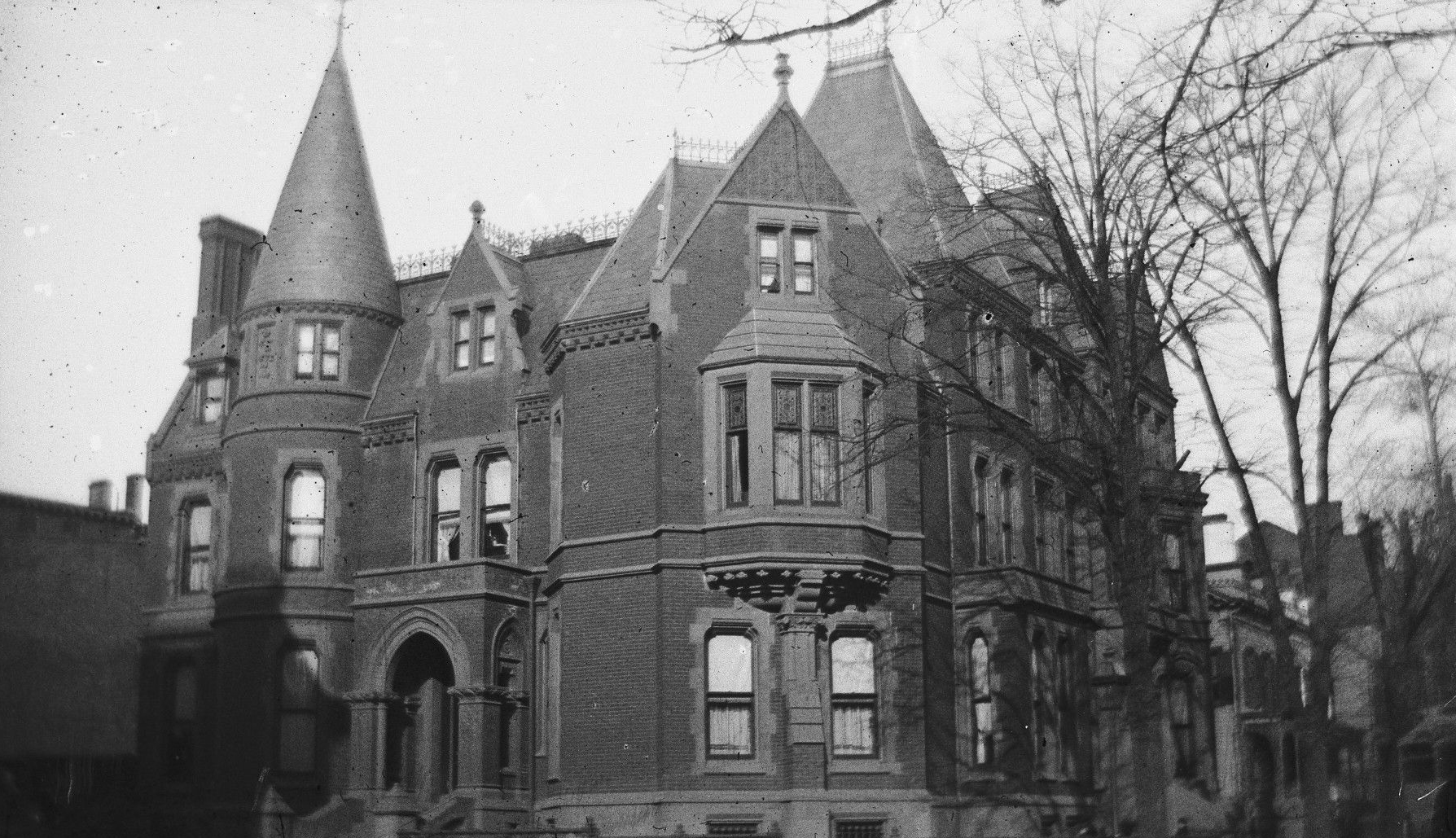
What of Edwin Packard, the forward thinking creator of the first luxury French flats building in Brooklyn Heights? Two years after completing this building, he and fellow affluent businessman L.A. Fish commissioned George Morse to design two large townhouses, one on the corner of Joralemon and Henry streets and the other next door. The buildings were scheduled to be completed in 1881, and would be family residences to each. A 1950s apartment building now stands on the site of Packard’s house, whose address was 241 Henry Street.
Packard must have been quite taken with George Morse’s work, as Morse designed one of his best buildings, the Franklin Trust building, on the northern corner of Court and Montague streets, where Packard was president. The Franklin Trust building is a limestone-clad mixed-use office building constructed in 1891 in the Renaissance Revival style of architecture. (It’s now residential.) Morse designed several other large commercial buildings in the area, now all demolished except for his Temple Bar Building at 44 Court Street, a corner Beaux-Arts office building with three distinctive copper-clad mansard towers, built in 1901. It is considered by many to be the most beautiful office building in Brooklyn and the architect’s finest work.
Morse was a founder and first president of the Brooklyn Institute of Art and Science’s architectural board, established in 1889, and a founder of the Brooklyn branch of the American Institute of Architects (AIA). Most of Brooklyn’s leading architects belonged to one or both organizations. Although he hated design competitions, Morse also sat on the committee to judge the winner of the contest for the Institute’s new building on Eastern Parkway. The committee chose McKim, Mead & White to design what is now the Brooklyn Museum.
The Alden soon became one of the smaller apartment buildings in the Heights. As the century concluded, it faced competition from a growing number of large luxury residential hotels. By the end of the 1920s, new elevator buildings replaced many of the mansions of the 19th century. Ahead of the trend, the tenants of the Alden formed a corporation called the Remsen Realty Company and purchased the building in 1920, making history again as one of the Heights’ first co-ops.
Related Stories
- The Fougera: The Lost Apartment Building of Brooklyn Heights
- Parlez-Vous French Flat?
- From Mansions to Housing for Navy Yard Workers: The Clinton Hill Co-ops Story
Email tips@brownstoner.com with further comments, questions or tips. Follow Brownstoner on X and Instagram, and like us on Facebook.
What's Your Take? Leave a Comment