The Outsider: Oversized Roof Terrace in Williamsburg
THIS EDITION of The Outsider, Brownstoner’s Sunday garden column, is the last to be written and produced by journalist/blogger Cara Greenberg. It’s been fun… now get growing!
This post is sponsored by James Stephenson's Artist Garden.
James Stephenson brings 20 years of experience in high level hardscape design and all aspects of garden installation from planting to irrigation and lighting.
THERE’S REALLY NOTHING you can’t grow in containers, provided the container is big enough — trees, shrubs, grasses, bulbs, perennials, annuals. On a 4,000-square-foot bi-level roof terrace atop a converted factory building in Williamsburg, garden designer Rebecca Cole has done just that, creating an urban woodland for her client, with elements of prairie meadow, too.
The view is a triple whammy, with the East River, Manhattan skyline, and monumental latticework of the Manhattan Bridge all seen in close-up. It cried out for equally dramatic landscaping. The client, who is in real estate, hired Cole to turn the vast 11th floor terrace into something a couple could enjoy without feeling lost in space.
Cole, a well-known TV personality and author, created the look of natural landscaping, with metal cubes containing birch trees and grasses, ‘carpets’ of sedum, and lots of annual color. She carefully planned the placement of containers to break up the space into functional areas. “You can literally wander as you would through the woods,” she says, “taking different paths around birches and evergreens, coming upon places to sit, noticing pretty little ground covers.”
More after the jump.
Photos: Courtesy Rebecca Cole
The Insider: Small & Stylish in Carroll Gardens
A FOND FAREWELL to Brownstoner readers from Cara Greenberg, whose final installment of The Insider this is. Stay tuned for an announcement of continuing coverage of interior design and renovation in the greatest borough of them all.
ROBERT FARRELL is an interior designer with eclectic style, at ease in high-end showrooms yet not above rescuing a deserving chair from the street. With interests ranging from antiquity to modern art, he lives stylishly on the ground floor of an 1863 row house, unfazed by the fact that the apartment measures just 600 square feet. “Small spaces make you think about how and what you need to live,” he says. “They’re an opportunity to edit down and live only with the things you really want.”
His key decision upon moving into the place in the mid-1990s: what color to paint the walls. “The reason I’m here is for the garden,” says Farrell, whose floor-through is attached to an impressively landscaped backyard, featured recently in The Outsider. He chose a pale gray-green celadon (Benjamin Moore #465) for the main walls “as a way of connecting inside and outside,” he says. “It goes with everything.” To further brighten the space and “capture a feeling of being in the woods, with filtered, dappled light,” Farrell incorporated natural woods and used accents of yellow, red, white, and chrome in his decor.
Since the apartment is essentially two rooms, each serves many purposes. At the front of the building is a living room that quadruples as a bedroom, guest room, and library; there’s a dining room at the rear with a galley kitchen along one wall and a home office tucked into a corner. The space is divided by a pair of original parallel walls a few feet apart, which Farrell has dressed with floor-to-ceiling linen curtains “to make the interior softer and create a sense of depth from front to back.”
Read on and see more after the jump.
Photos: Brian Riley
Above: Farrell’s dining area displays his trademark balance between antique and modern. A contemporary Spanish table with a cast aluminum base sits on a contemporary kilim. White 1950s ant chairs and a mid-20th century light fixture brighten an old wood pantry cabinet from France, a carved antique mirror, and wood Venetian blinds. “You can’t do contemporary on the left and antiquity on the right,” says Farrell. “It all has to be considered simultaneously.”
The Outsider: Shady Terrace in Brooklyn Heights
WELCOME TO The Outsider, Brownstoner’s weekly series exploring the various creative ways Brooklyn residents deal with their outdoor spaces. Written and produced by Cara Greenberg, you’ll find it here Sundays at 8AM.
This post is sponsored by James Stephenson's Artist Garden.
James Stephenson brings 20 years of experience in high level hardscape design and all aspects of garden installation from planting to irrigation and lighting.
A TRUE GARDENER like Elke Kuhn, whose outdoor space is a 15′x25′ terrace behind her second-floor apartment on Atlantic Avenue, doesn’t let a few obstacles get in the way. Hardly any direct sun? So be it. Kuhn makes the most of every ray that manages to penetrate the ailanthus canopy around her north-facing terrace: a single hour in the morning and a couple more at midday. By choosing the right plants and coddling them — even shifting them around from time to time to give each its place in the limited sun — she has wrought a lush miracle.
No car? No worries. She does her plant-shopping on foot at the Borough Hall Greenmarket and local stores like GRDN on Hoyt Street, takes the bus to Gowanus Nursery in Red Hook, and relies on Bruno’s Housewares on Court Street to deliver pots, soil, and other heavy supplies. (The cast iron urns are from Restoration Hardware.)
Among Kuhn’s shade-lovers: vines and climbers like moonflower and morning glory, hibiscus, ferns, caladiums, coleus, hostas, spotted begonias, passionflower. No ordinary impatiens here. Kuhn, an artist, goes in for exotic foliage and unusual color combinations. Her favorite combo: gray/silver (dusty miller, for example) with chartreuse and/or burgundy (sweet potato vine) —plus splashes of color from “as many flowers as I can get.”
As important as the plants are the pots. Her collection started in the 1970s with handmade English pots from Smith & Hawken. Others range from expensive pots by Campo di Fiori to a few picked up on the street. About half of Kuhn’s plant material comes indoors for the winter. Hardier perennials stay outside, moved close to the wall of the house. “I put them into cardboard boxes, and I may throw a blanket or sheet of plastic over them,” she says.
More, including Kuhn’s tips for container gardening, after the jump.
Photos: Cara Greenberg
The Insider: All the Details in Boerum Hill
WELCOME to The Insider, Brownstoner’s weekly exploration of creative approaches to interior design and renovation, written and produced by journalist/blogger Cara Greenberg. Find it here Thursdays at 11:30.
TALK ABOUT SNAP DECISIONS. The 1870s brick row house Nancy Blechman bought in 1987 was the very first one she looked at. “I fell in love with my neighbor’s magnolia, which has since died,” says Blechman, who retired recently after a career as a senior financial officer in the not-for-profit world. “Under pressure from my family, I did look at some other houses, but I turned right back around and bought this one.”
The house had plenty to recommend it besides the tree next door, including such coveted details as a gilded pier mirror between long four-over-four parlor windows, a black marble mantel in Eastlake style, original pocket doors with etched glass, and hefty plasterwork in the back parlor/dining room.
Blechman raised her now-grown daughter in the lower duplex, and rents out the two upper floors. She did no major renovation until this past year, when she finally updated a dreary galley kitchen at the back of the parlor floor, replacing it with a warm, inviting new one that reflects the antique look of her decorating — a look that harks generally back to the Arts and Crafts era. She also splurged on some new furniture. Blechman spends a lot of time in Amsterdam, and there’s something of a European feel about the place, with its mix of found and inherited pieces, exotic items picked up in her travels, and a collection of paintings by David Fisch, a close friend who died in 1993.
Much more after the jump.
Photos: Cara Greenberg
The Outsider: Private Woodland in Carroll Gardens
WELCOME TO The Outsider, Brownstoner’s weekly exploration of the many different approaches Brooklynites take to their outdoor spaces. It’s written and produced by Cara Greenberg, who blogs at casaCARA: Old Houses for Fun and Profit. Find The Outsider here Sundays at 8AM.
A FEW SHORT YEARS AGO, Robert Farrell’s backyard consisted mainly of multi-colored impatiens and a patch of grass. It was pretty, yes, but labor-intensive. Farrell couldn’t go away for more than a day or two in high summer without worrying about watering. Today, it’s a densely planted woodland, with a few small trees and a variety of shade-tolerant perennial plants, from hydrangeas and astilbes to ferns and foxgloves.
What brought about the shift? “Coming to terms with the fact that my north-facing garden was getting shadier,” says Farrell, an interior designer who’s been renting the garden floor of a row house since the 1990s, with exclusive use of the backyard. “The grass wasn’t doing well, and I was tired of mowing. I wanted a garden that would come back every year and that I wouldn’t have to put a lot of effort into, or spend hundreds of dollars each year re-installing.”
Farrell made no changes to the existing hardscaping. There’s a central rectangular bed with a path around it, and concrete patios at either end of the garden. Along the rear property line, he built a three-sided pavilion with a metal roof and white corrugated plastic walls. “The pavilion extends my living space throughout the year,” says Farrell, providing seating for outdoor entertaining and cover from the rain.
More about Farrell’s private woodland after the jump.
Photos: Robert Farrell
The Insider: Designer’s Townhouse in Cobble Hill
WELCOME TO THE INSIDER, Brownstoner’s weekly exploration of the creative ways Brooklynites renovate and decorate their homes. It’s written and produced by journalist/blogger Cara Greenberg. Find it here Thursdays at 11:30AM.
This post is sponsored by Open Air Modern.
Open Air Modern offers authentic mid-century furniture along with out-of-print design, photography, and art books.
1850s HOUSE, 1950s FURNISHINGS — it’s amazing how well and often that combination seems to work. Evidence: the home of interior designer Julia Mack and her husband John, an architect, which they renovated from the ground up and furnished mostly with mid-20th century design classics.
It was in Italy that Mack first realized how brilliantly modern furnishings can be integrated into antique structures. “There’s a longstanding precedent in Europe, where the homes can be older than our Brooklyn townhouses by several hundred years, but the focus is on keeping the decor fresh from generation to generation,” she says. “You see it in old Italian villas and urban townhouses in Amsterdam and London. They often have extremely contemporary kitchen appliances, bath fixtures, and lighting — all cutting-edge modern, within the envelope of a 400-year-old house. I realized that was an idea I wanted to work with in my own home.”
The Macks bought this Baltic Street house as a ‘neglected dump’ in 2002 and spent a year upgrading the mechanicals. The 20′x40′ four-story building had been used as floor-through rental apartments; the first order of business was pulling out four nasty kitchens and four baths. Happily, the house’s original moldings, panel doors, wide-plank floors, and turned stair balusters were intact, along with a spectacular carved marble mantel in the front parlor.
When it finally came time for decorating, clean white walls formed the backdrop for their collection of mid-century modern furniture. Some is vintage, handed down by Julia’s parents and grandparents; other items are re-issues, many from Herman Miller and budget-friendly sources like Bo Concept, Room & Board, and Modernica.
Read on and see more photos, plus a source list, after the jump.
Photos: Brett Beyer
The Outsider: Lush Rooftop in Park Slope
WELCOME TO THE OUTSIDER, Brownstoner’s weekly look at the ways Brooklynites design and utilize their outdoor living spaces. Written and produced by Cara Greenberg, you’ll find it here Sundays at 8AM.
FOR A CLIENT who wanted a Mediterranean feel on her apartment building’s rooftop, Glenn Smith of Glenn Smith Design, Inc., built a deck and shade structure reached by an elevated ‘bridge’ over an 8-foot-wide pond. Then he surrounded them with an eclectic assortment of grasses, succulents, and conifers.
The building is new construction, so weight bearing was not a significant issue, says Smith, who works mainly in Brooklyn and on the east end of Long Island. The surface of the 400-square-foot garden is covered with pea gravel, and there’s a walk made of round red concrete paving stones 12″ in diameter — the kind “you would find in a suburban backyard,” Smith says. “It’s supposed to be fun, casual, and comfortable.”
The budget? Approximately $25,000, including construction, plants, and Smith’s design fee.
Details and photos of the roof’s 2-year transformation after the jump.
Photos: Glenn Smith
The Insider: Creative Layout in Bed Stuy
WELCOME TO THE INSIDER, Brownstoner’s weekly look at the wide-ranging ways Brooklynites renovate and decorate their living spaces. Written by Cara Greenberg, you’ll find it here Thursdays at 11:30.
PETER HASSLER is not most people. Certainly not in the way he’s set up his 1892 bay-windowed brownstone. “Most people,” he says, “put the kitchen on the parlor floor, and I understand the reasons. But I wanted to stay as true as possible to the original layout of the house, and keep the kitchen where it was originally,” at the rear of the garden floor. “That allowed me to have two massive rooms on the parlor floor that you could have a ballroom dance in.”
A web designer recently embarked on a partnership with Design Vidal, an LA-based company expanding their interior design and renovation services into the New York area, Hassler bought the 18-foot-wide house some nine years ago. He accomplished most of the reno in a year-long push, including stripping and refinishing all the luscious woodwork and parquet floors, rewiring and replumbing the entire house, and putting in new heating and water systems.
He decorated mostly with modern pieces. “I wanted to let the best of the house shine through, while creating a bright, airy space,” Hassler says, “using clean lines, geometric shapes, and solid whites and blacks to contrast with the original detail.”
Hassler shares the lower duplex with Dahn Hiuni, a visual artist, and rents out the two floors above. He worked with an architect on finalizing drawings and filing them, then hired a crew and oversaw the construction himself. Besides the two huge bedrooms on the parlor floor, there’s a new half-bath in what used to be a closet. On the garden level, the living room sits between the kitchen at the rear, with a full bath in an extension next to it, and the dining room at the front of the house.
See and read more after the jump.
Photos: Patrick Mulcahy
The Outsider: Rooftop Meadowscape in Park Slope
WELCOME TO THE OUTSIDER, Brownstoner’s weekly column about the ways Brooklynites use their outdoor spaces, from backyard to roof and in between. Written and produced by Cara Greenberg, you can find it here every Sunday at 8AM.
‘LANDSCAPE URBANISM’ is the specialty of Future Green Studio, according to the Gowanus-based firm’s website. Meaning what, exactly? Principal David Seiter explains: “Typically, landscape architecture looked at parks and gardens, but as we’ve moved into denser urban environments, we’ve started to consider under-utilized spaces as landscape — streets, roofs, spaces between buildings, vacant lots, waterfronts, all sorts of post-industrial areas.” Landscape urbanism deals with “emerging landscape typologies,” like rainwater catchment systems and the overlooked potential of wild urban plants (otherwise known as weeds), “looking not just through an aesthetic but a productive or performative lens.”
That doesn’t mean it can’t be pretty. This 25′x50′ townhouse rooftop was conceived, says Seiter, as a “desert meadowscape of grays, pinks, and purples” — grown in 6-8″ of soil to limit weight load. The primary plants are grasses, flowering sedum, and groundcovers, planted in a random mix. Because the client had a strong interest in botanical diversity, “We packed in a lot of different plants,” Seiter says. As opposed to a monoculture, or using four or five plants repeated in various places, “Everything is a specimen.” And extremely drought-tolerant; there’s an irrigation system, but it’s used only two or three times a season.
The roof’s architecture was designed by N Architects in DUMBO. Future Green designed the plantings around areas carved out for decking, a shower, stepping stones, and an HVAC system. The green roof section, Seiter says, cost approximately $25/square foot, including drainage materials, substrate materials, soil, and plants.
More photos and a plant list after the jump.
Photos: Future Green Studio
The Insider: Eye-Popping Duplex in Williamsburg
WELCOME TO THE INSIDER, Brownstoner’s weekly look at the creative and wide-ranging ways Brooklynites renovate and decorate their living spaces, written and produced by CaraGreenberg. Find it here every Thursday at 11:30AM.
AND NOW FOR SOMETHING completely different. Interior designer Christopher Coleman, whose office is in DUMBO, rocks vivid color and a playful mix of shapes and materials in his own 1,250-square-foot home in a Williamsburg loft building. He considers his New York base “a laboratory for design.” The use of color and pattern is so emphatic, from a yellow patent leather wall to a sliding red barn door separating the living area from the sole bedroom, not to mention checkerboards, plaids, and stripes — that you almost don’t notice that most of the wall area is actually white.
When Coleman and his partner moved into the nearly new building 3-1/2 years ago, they made a few minor changes: opening up the bedroom wall and substituting the barn door, adding a pantry and storage area in the kitchen, installing black low-pile broadloom carpeting over what Coleman calls the “gymnasium floors.” He likes the carpet for soundproofing, and for the way sensuous shaped furnishings are silhouetted against the black. Coleman is not big on square and rectangular furniture lined up against walls, he says. “It’s much sexier and more appealing to have shaped pieces of furniture floating in a room.”
Half of Coleman’s work is in Miami where, he says, “People are open to color and a little more daring. They want something fun and adventurous.” Coleman is clearly the man to deliver. “It bores me to tears when you open a magazine and everything’s from Holly Hunt,” he says. “Anyone can do that.”
See more of Coleman’s apartment after the jump.
Photos: Dana Meilijson, except as noted
The Outsider: Beauty and Bounty in Park Slope
WELCOME to The Outsider, Brownstoner’s weekly garden column, written and produced by Cara Greenberg. Find it here every Sunday at 8AM.
ATOP a block-through garage, next to a one-family townhouse, 1,500 square feet of horticultural wonders lurk. Once a barren rooftop, the space now provides its owners with areas to rest, sunbathe, dine, and entertain — as well as grow both edible and ornamental plants, including many which are both.
Brooklyn-based garden designer Cynthia Gillis conceived a ‘zig-zag’ plan based primarily on triangular shapes. “It makes the spaces more interesting than having a rectangle, and gave us a way to have a longer path, rather than a straight line,” she says. Raised beds with retaining walls of stacked bluestone are connected by paths made of leftover scraps of ipe wood. Underneath the growing areas are three layers: ordinary roofing material, a root barrier layer, and a water-retention layer (a plastic grid that holds water and allows it to be slowly absorbed into the soil).
The separate triangles have different kinds of soil for different types of plant material: acid soil for blueberries, lingonberries, heathers, and pines; rich, deep compost in a sunny area outside the kitchen for perennial herbs like rosemary and sage, fragrant lavender, and a Concord grape on an arbor. There are creeping raspberries trailing over stone walls, mint and strawberries used as groundcover, and other edibles mixing freely with flowers, ornamental grasses, and evergreen shrubs.
Find out more after the jump.
The Insider: Do-It-Herself Reno in Cobble Hill
WELCOME to The Insider, Brownstoner’s weekly in-depth look at the creative ways Brooklynites renovate and decorate their homes. Written and produced by Cara Greenberg, you can find it right here every Thursday at 11:30AM.
FOR MOST OF THE PAST 18 YEARS, Lula Blackwell-Hafner has lived in her grand parlor floor co-op, with its 12-and-a-half-foot ceilings, in a state of what might be called Bohemian splendor. Peeling plaster walls and cracked crown moldings served as atmospheric backdrop to her eclectic accumulation of vintage furnishings. The kitchen was a Danish modern disaster in the center of the apartment, bearing no relation to the building’s Italianate detail.
Recently, Blackwell-Hafner, a landscape architectural designer by profession, undertook to restore the plasterwork, refinish the tall mahogany doors and moldings, and install a brand new kitchen. Because her budget is limited but her handywoman skills prodigious, she did much of the work herself, with the assistance of Dave Cunningham, a Brooklyn-based plaster craftsman, and Colin Rice, a carpenter.
They repaired the heavy crown moldings decorated with what Blackwell-Hafner calls her ‘Shakespearean troupe’ of faces; replaced sections of ceiling with QuietRock, a drywall product designed for soundproofing; skim-coated all the walls; and painted them with Farrow & Ball ‘Modern Emulsion’ colors, washable and low-VOC, with a slight sheen. Blackwell-Hafner sanded and waxed the mahogany entry doors by hand to the point of bandaged fingers, and upgraded the new cherry kitchen cabinets, bought online, with wavy glass from old windows, which she cut and installed herself.
So far, Blackwell-Hafner has spent about $25K on this phase of the reno. What remains to be done: paving and a railing for the small deck off the rear parlor (presently a rooftop on the downstairs extension) and restoring tall windows there, and replacing plaster ceiling medallions and some of the worn-away faces in the crown molding.
See and read lots more after the jump.
Photos: Cara Greenberg
The Outsider: Reader’s Garden in Clinton Hill
WELCOME to The Outsider, Brownstoner’s weekend column exploring how Brooklynites design and use their outdoor spaces. Written and produced by Cara Greenberg, you’ll find it here every Sunday at 8AM.
A BRAVE BROWNSTONER READER has come forth with inspiring photos of his own backyard, a swath of greenery wrested from the overgrown weed patch he and his wife found when they bought their townhouse in 2008. Thank you, Sam Erickson (you know him as ‘wasder’) and Rachel Smith!
With two young kids, they wanted romping room — “a biggish expanse of grass, possible because we get a lot of light in our south-facing garden,” Erickson says. They spent $2,000 (of a total outlay of about $5,000) for the delivery and installation of sod, including grading and proper drainage, by Dragonetti Bros. They salvaged pieces of bluestone “from all over the neighborhood” to make a patio at the rear.
With the help of some day labor and friends, they built long raised planting boxes along either side of the garden out of 4″x4″ railroad ties. In the beds on the shadier side of the yard, they planted azaleas, rhododendrons, and hydrangeas; on the sunny side, lilies, roses, and herbs. Toward the rear of the garden, they put in a single weeping cherry.
“You don’t have to hire a high-end designer,” Erickson says. “We don’t have gardening backgrounds, but we are enthusiasts. We’ve learned as we’ve gone along. My wife decides what to plant, and I enjoy watering, mowing, and pruning. It’s a nice stress release.”
More after the jump.
Photos: Sam Erickson
The Insider: Warmth and Color in Brooklyn Heights
WELCOME to The Insider, Brownstoner’s weekly look at the multitudinous ways Brooklyn residents decorate and renovate their homes. Written and produced by Cara Greenberg, you’ll find it here every Thursday at 11:30AM.
This post is sponsored by Open Air Modern.
Open Air Modern offers authentic mid-century furniture along with out-of-print design, photography, and art books.
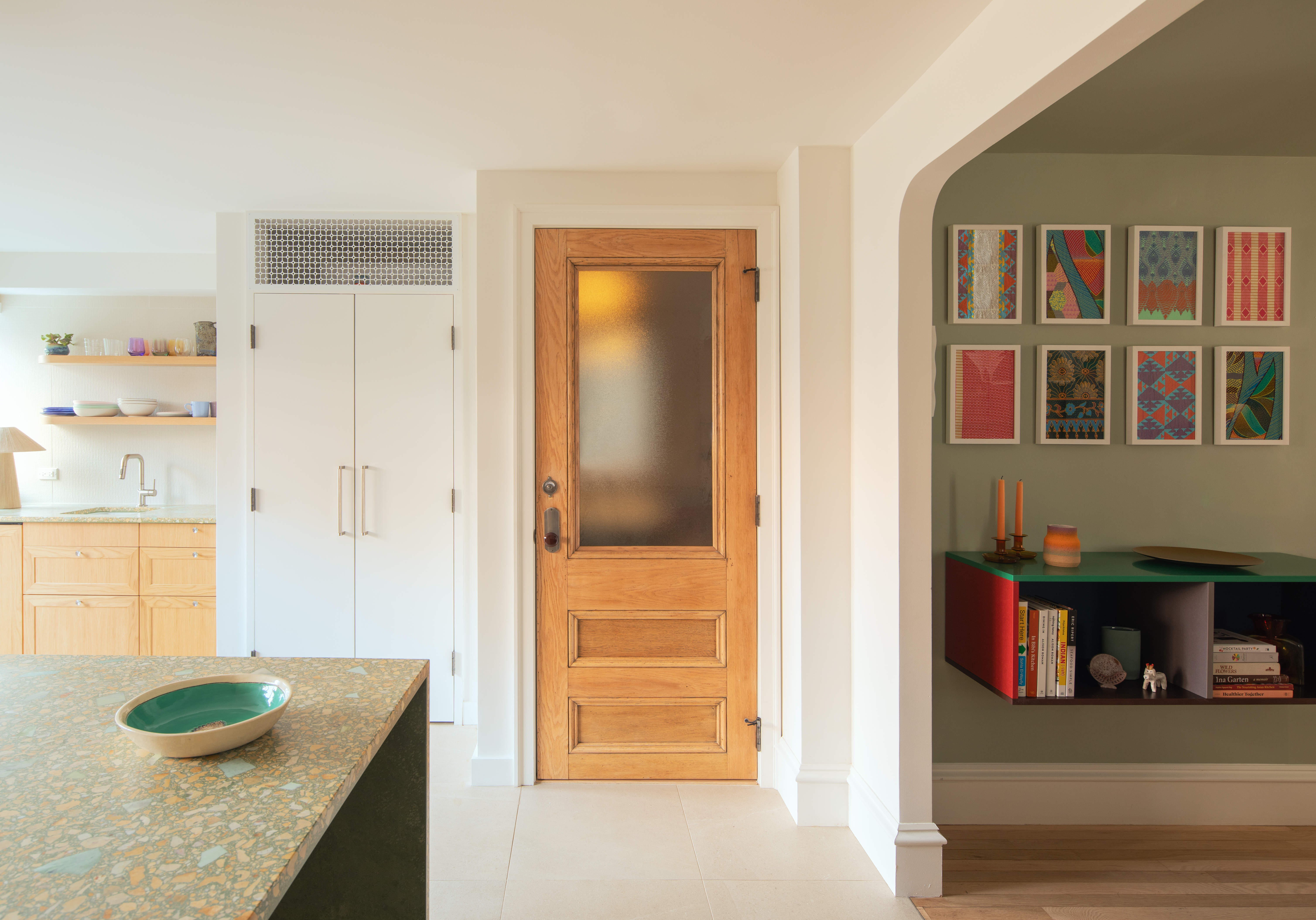
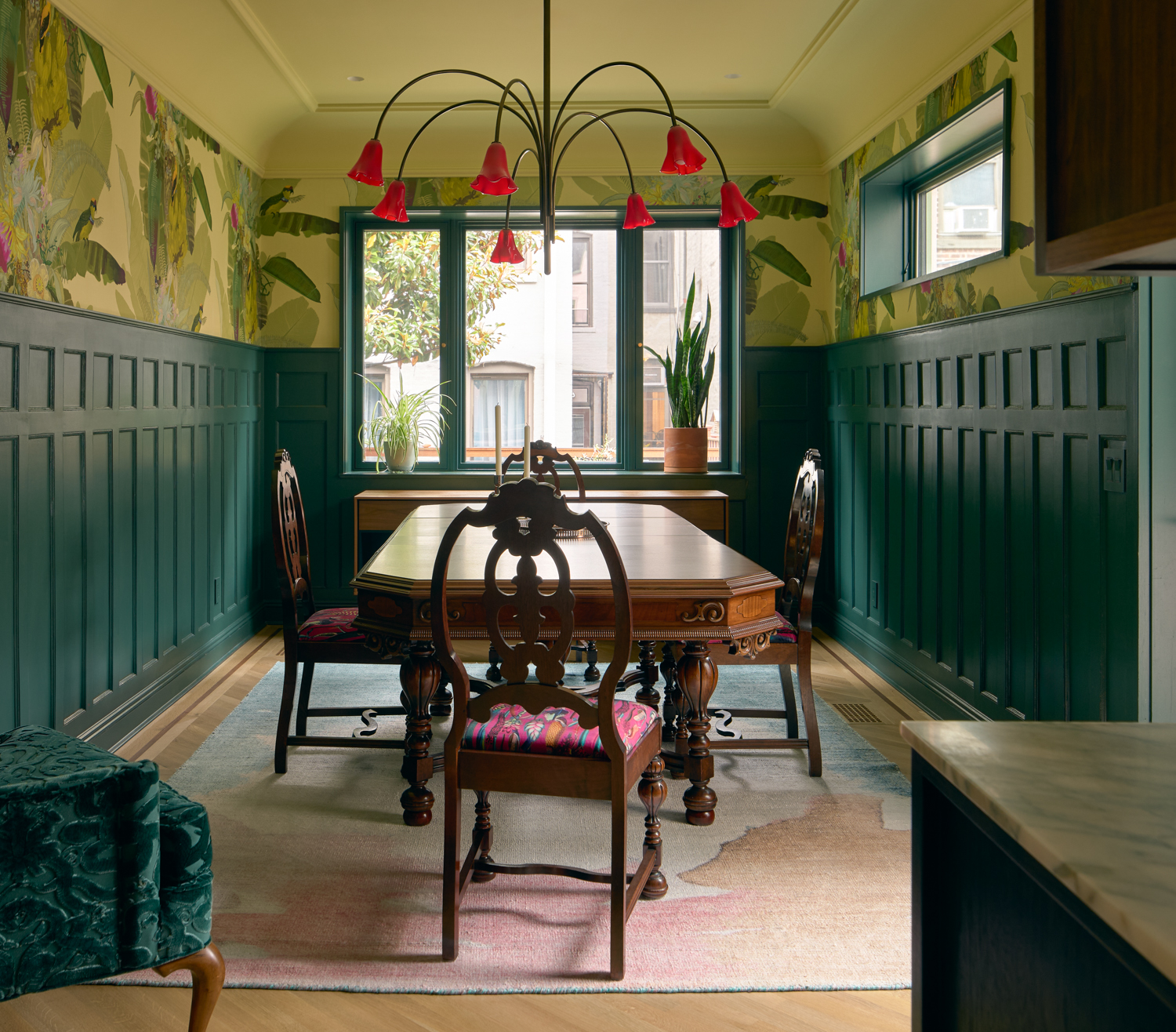
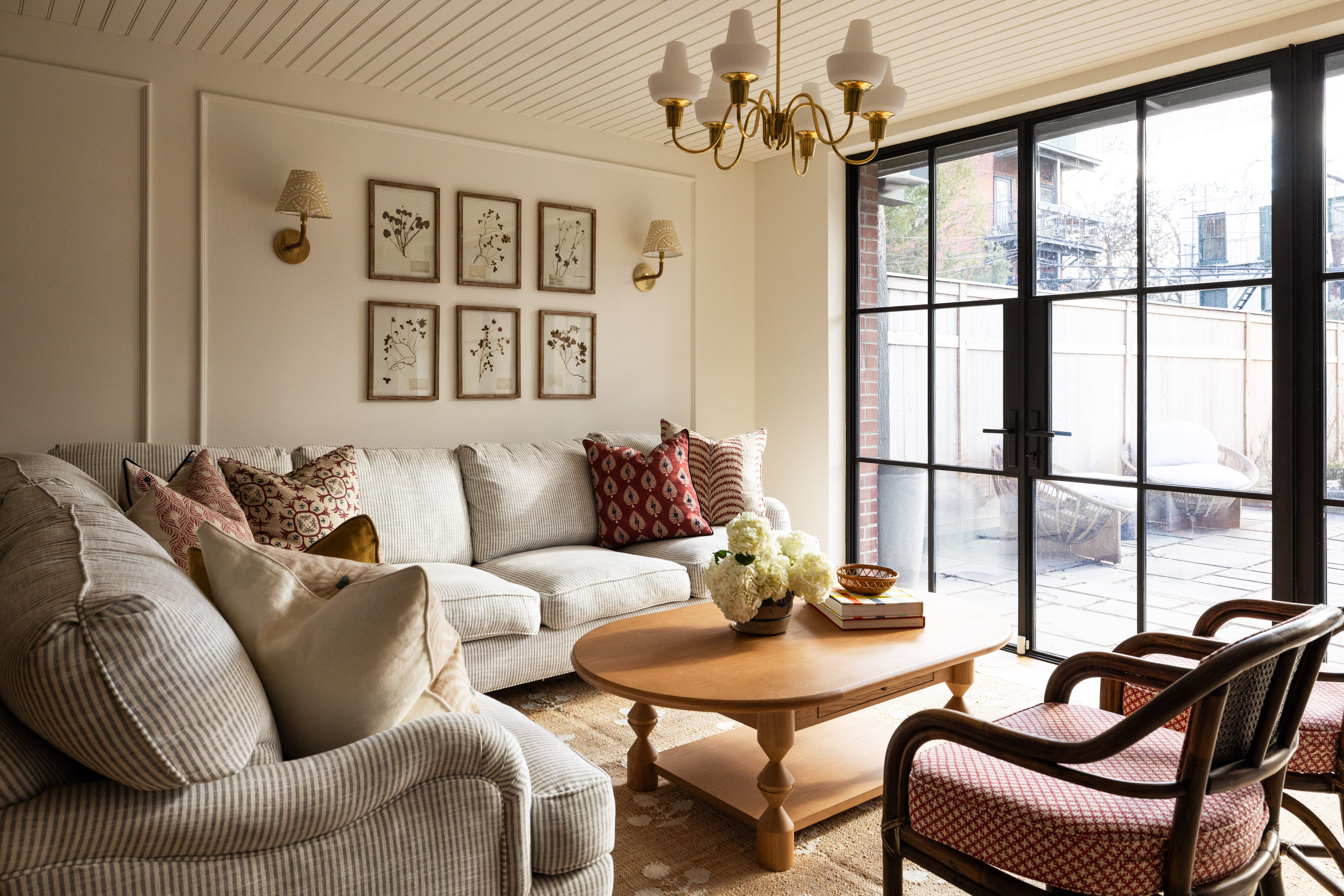
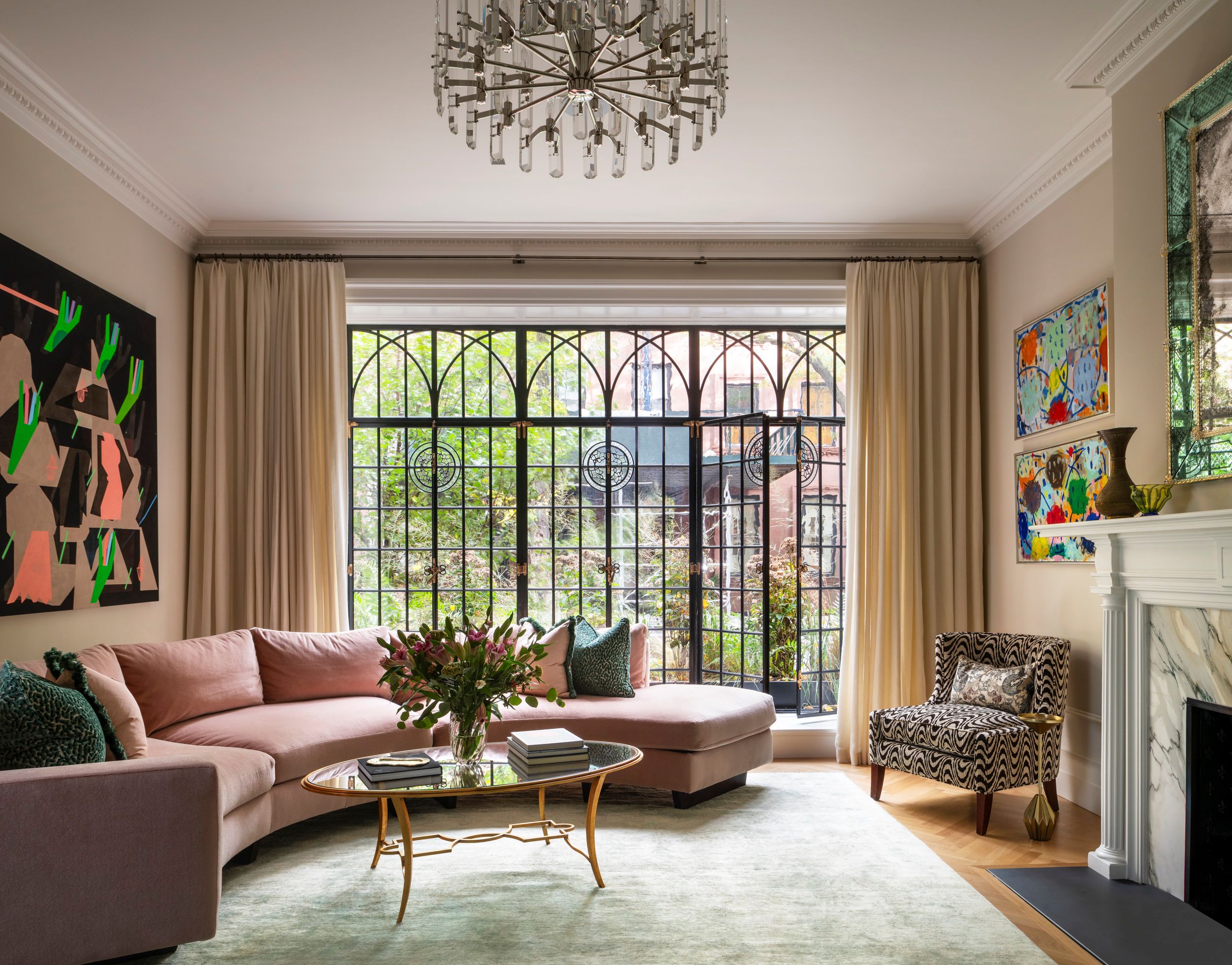
THE CLIENTS’ WISH LIST was not unusual: they wanted a home for themselves and their three young children that was “warm and comfortable, with a lot of play spaces,” says Kiki Dennis, the Brooklyn-based designer hired to pull together furnishings, paint colors, and final details upon completion of a top-to-bottom renovation.
A 19th century townhouse whose five floors had been broken up into apartments, it was re-designed by architect James Ramsay as a homeowners’ 5-bedroom, 4.5 bath quadruplex totaling about 5,500 square feet, plus a garden rental. The project was well under way when the current owners bought the building in mid-reno. There were few original details remaining except for stair balusters and some mantels. “Other architectural moves were more contemporary, almost minimalist,” Dennis says. Her clients were concerned that the house “not be too stark, but have elements of color and warmth.”
Dennis loved the steel-framed windows at the back of the parlor floor and the use of reclaimed teak in various areas. “We took cues from those materials, used a lot of neutrals, and added fun pops of color to bring the house to life,” she says. She also worked with the clients to buy art, an important factor in adding color to the space.
If this home looks familiar, it was one of several on the recent Brooklyn Heights House Tour.
Photos: Brett Beyer
The Outsider: Low-Cost Veggie Garden in Vinegar Hill
WELCOME to The Outsider, Brownstoner’s weekly exploration of the many and varied ways Brooklynites approach their green spaces. Written and produced by Cara Greenberg, you can find it here every Sunday at 8AM.
A 2,000-SQUARE-FOOT BACKYARD, shared by three buildings, was overgrown and mostly neglected space until Andrea Solk, a LEED-certified architect and recent West Coast transplant, spent the better part of this spring working to reclaim it. Solk, a renter in one of the buildings, is trying, with the owners’ permission, to “transform it without any intention beyond growing vegetables and making a nice space for everyone to hang out in.”
She’s had the help of assorted folks who’ve pitched in at weekend work parties, and the benefit of advice from Andrea Parker, Julia Price, and Maggie Hansen, all practicing Brooklyn-based landscape architects who consulted on such matters as how to deal with existing contaminated soil.
One of the initial tasks was removing dirt from buried pieces of slate and flagstone to uncover a patio area. In order to grow edible food, they built raised beds out of wood and salvaged brick, filling them with fresh soil and compost. Two cubic yards of imported topsoil at $35/yard has been the main expense to date, along with some Greenmarket veggie starters and a few bags of compost. “It’s incredibly low-budget,” Solk says.
Clusters of clay pots, plastic buckets, and “anything we could find” are filled with broccoli, sprouts, cabbage, tomatoes, eggplants, and herbs. At the rear of the lot, where there’s daylong sun, Solk plans to put more wooden beds with tomatoes, cukes, squash, melons, and other summer veggies that need a lot of sunlight. There are flowers as well, including bachelors buttons and foxgloves, along with rose bushes that have been there all along. Right now, watering is done by hose and watering can, but Solk hopes to put in a drip irrigation system.
The photos in this post were taken in late April. “It was very undefined space,” says Solk. “Now it’s starting to look like a cared-for garden.”
Photos: Andrea Solk
The Insider: Flying Colors in Fort Greene
WELCOME to The Insider, Brownstoner’s weekly interiors column by design writer/blogger Cara Greenberg. Find it here every Thursday at 11:30AM. And be sure to catch The Outsider, our new garden column, Sundays at 8AM.
DK HOLLAND’S PRE-CIVIL WAR HOUSE is a favorite of passersby, often evoking cries of “I can’t believe this is New York City!” The inside of the former hayloft and tack house — all three stories and 1,800 square feet of it — is no different, with bold color on walls, stairwells, and in the country-style furniture.
As a longtime graphic designer and former principal in Pushpin Studios, the firm founded by Milton Glaser and Seymour Chwast, DK’s sure hand with color reflects her interest in children’s book illustration (Chwast helped choose colors for the exterior — tan with blue window frames, in keeping with Landmarks requirements). “There are no bad colors,” DK says. “All colors go together in nature.”
DK did a top-to-bottom renovation between 2002-4, during which she added a kitchen in a new side extension, built the front porch, opened up the second floor as a loft-like bedroom/study, and put in new bathrooms and closets. The reno exposed original brick, ceiling beams, and mid-19th century wainscoting.
Todd Johnson was the architect for the exterior; he helped with the interior as well. Burda Construction was the contractor.
More of DK’s charming house after the jump.
Photos: Cara Greenberg
The Outsider: Country Feel in Greenpoint
This is The Outsider, Brownstoner’s weekly garden series by Cara Greenberg. Find it here every Sunday at 8AM.
“A WILD, LEAFY LOOK” was the starting point for this 21′x48′ row-house garden belonging to a single man. “He wanted a country-type feel,” says garden designer Alexandra Abuza, who was hired to help achieve the goal. It was one of Abuza’s first projects in New York City after arriving from Maine four years ago, where she had worked on perennial flower gardens for summer estates. (Her portfolio now includes terraces, roofs, and brownstone gardens “with a slight Japanese influence.” She also does floral design.)
This backyard, with no tall buildings around, is blessed with an unusual amount of sunlight for a city garden. The client “had just put up a wood fence and hated it,” Abuza recalls. “He wanted to cover it with vines, but I told him it can’t happen immediately.” They did plant thickly, though, after digging down to remove old construction debris, broken glass, and wires, and bringing in new soil, compost, and other amendments.
“The soil was junk,” Abuza says. Getting fresh soil in was one of the most difficult aspects of the job. “We had a delivery of five yards of soil, plus bag after bag of amendment, and two pallets of fieldstone. All this had to be moved from the street, quickly, then up a ramp we built for the wheelbarrows, and down a very long, very narrow hallway.”
Abuza, who apprenticed to a stonemason, laid out stone paths and a patio, then chose plant material in a blue/purple palette. Shrubs and small trees include buddleia (butterfly bush), a crabapple, a Japanese stewartia, and a climbing hydrangea intended to eventually obscure the fence. Hosta, heuchera, and Russian sage are among the perennials, and there are planter boxes for annuals on the small patio near the house.
With soaker hoses laid out to aid in the watering, the job was complete in a few weeks. “It looked pretty good the second year, one year after planting,” Abuza says, “and even better the third.”
More photos and info after the jump.
Photos: Alexandra Abuza
The Insider: New-Construction Townhouse in Boerum Hill
WELCOME to The Insider, a weekly interior design/renovation series by Cara Greenberg. Find it on Brownstoner every Thursday at 11:30; and don’t forget The Outsider, our new garden series, every Sunday morning at 8.
This post is sponsored by Open Air Modern.
Open Air Modern offers authentic mid-century furniture along with out-of-print design, photography, and art books.
THIS SUPER-MODERN TAKE on the Brooklyn row house archetype is one of eight unique places on the 25th BOERUM HILL HOUSE TOUR, happening this Sunday, June 3, from 1-5PM. On a State Street lot many will remember as the site of a tragic gas explosion that reduced a brownstone to rubble, the lot remained vacant for years until Ben and Christine Hansen, both architects, acquired it in 2009 and designed a replacement.
Outside the boundaries of the Boerum Hill Historic District, the Hansens were free to design a strikingly modernist home for themselves and their two children. With a zinc-clad front bay and large steel-framed windows, the house stands out visually among other townhouses on the block, relating to them with its familiar high stoop and placement of the front door.
All-steel construction allows for flowing spaces inside, with large openings between rooms, 11-foot ceilings, and different-size footprints from floor to floor. On the 20′x40′ garden level, there’s a family/play room, plus guest room and bath. The 20′x50′ parlor level has a living room in front and kitchen/dining in back. On the 20′x40′ second floor are two children’s bedrooms with a bath in between. The master suite is on the 20′x32′ top floor.
Above: Rear view of the townhouse, with its cantilevered kitchen extension.
More photos and details, including a list of major suppliers, after the jump.
Photos: Francis Dzikowski
The Outsider: Outdoor Living Room in Fort Greene
WELCOME to The Outsider, Cara Greenberg‘s Sunday garden column for Brownstoner. KNOW OF ANY BEAUTIFUL BROOKLYN GARDENS? (Sure ya do!) Contact caramia447@gmail.com
THE LONG, NARROW BACKYARD is a challenge garden designers face in Brooklyn more often than not. The owners of this one, 22′ wide and more than three times as long, approached James Stephenson of The Artist Garden with the notion of two patios plus lots of planting space. They were looking for a clean, modern look that would blend with their indoor aesthetic.
Working with oversized pieces of thermal bluestone, Stephenson laid out a plan for a central inner patio that serves as an outdoor family/living room, and another toward the rear of the property that provides overflow entertaining space for larger groups.
A central pergola made of iron and cedar is an architectural element that will also become a shade structure when the wisteria vines planted in each corner climb up and over.
Don Statham, an Upstate NY-based garden designer, collaborated on the plantings, which include what Stephenson calls “epic” columnar oak trees that will eventually create privacy walls on either side of the central patio. Everything is planted in the ground; there are no raised beds or containers.
The south-facing garden, with in-ground drip irrigation, is essentially low-maintenance.
More detail and photos after the jump.
Photos: James Stephenson
The Insider: Attic ‘Cabin’ in Fort Greene
Welcome to The Insider, here every Thursday at 11:30AM. It’s written and produced by Cara Greenberg, as is The Outsider, Brownstoner’s new garden series, every Sunday at 8AM. ALWAYS SEEKING LEADS TO WORTHY INTERIOR DESIGN AND GARDEN PROJECTS!!! Please contact caramia447@gmail.com
THIS MULTI-FUNCTIONAL SPACE at the top of a five-story brownstone was once “a weird scenario,” says Manhattan-based architect Ole Sondresen, who renovated the entire building for a pair of artists with two college-age children — a utilitarian attic, 22′x60′, divided up into “six or seven little storage spaces.” Now it’s a destination for the family, used for movie nights, games, and music-making. “It’s meant to be almost a cabin at the top of the house,” Sondresen says. “A getaway in one’s own space.”
Enhancing the cabin feeling is the unorthodox use of wood, wrapping around the entire ceiling and down the wall to become a bench under the windows. “We saw it as an upside-down space,” the Norwegian-born Sondresen says. “While the rest of the house has wood floors and plaster ceilings, this space has white painted oak floors and the warmth of wood as the ceiling.”
The contractor was William Dorvillier.
More photos and details of the attic loft, as well as the new kitchen on the parlor level, after the jump.
Photos: Ole Sondresen


May 16, 2013 | 09:04 AM