
Mayor Pushes Gravesend Homeless Shelter Forward Despite Local Protest
Renewed activity at the 86th Street site has rattled opponents who have protested the project for more than 600 days.

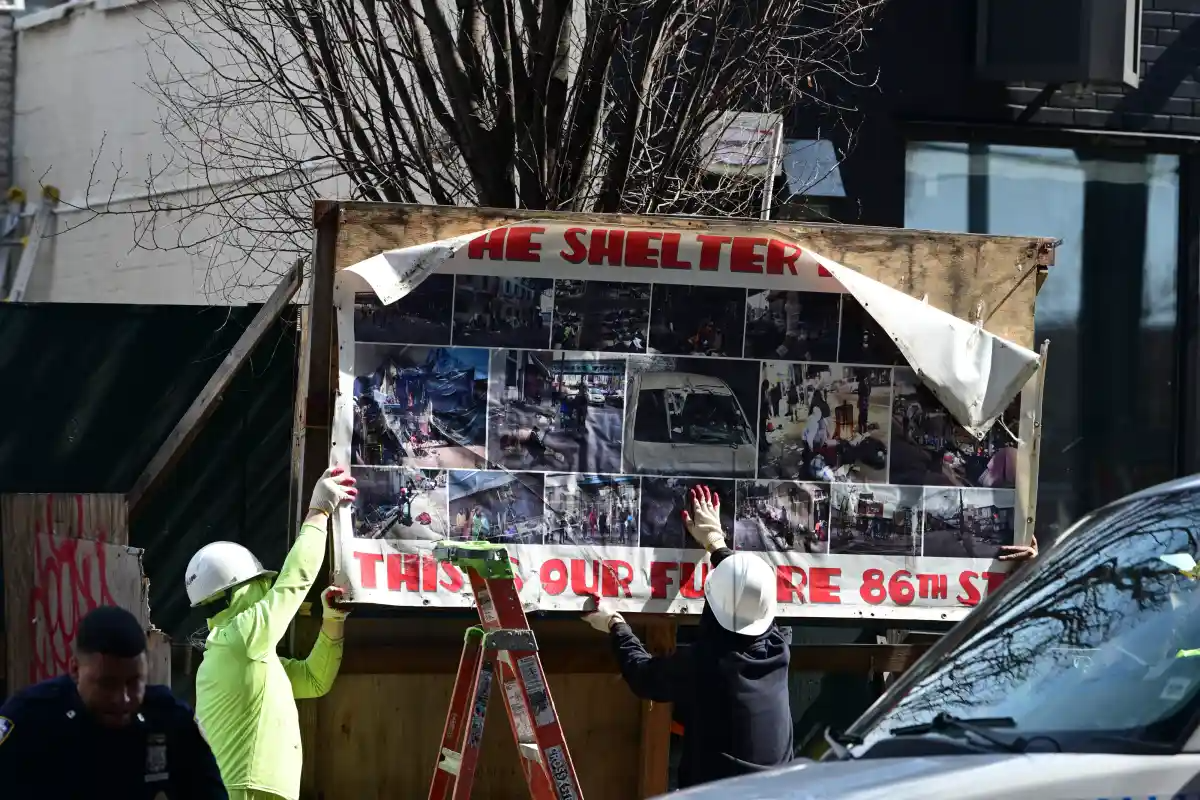
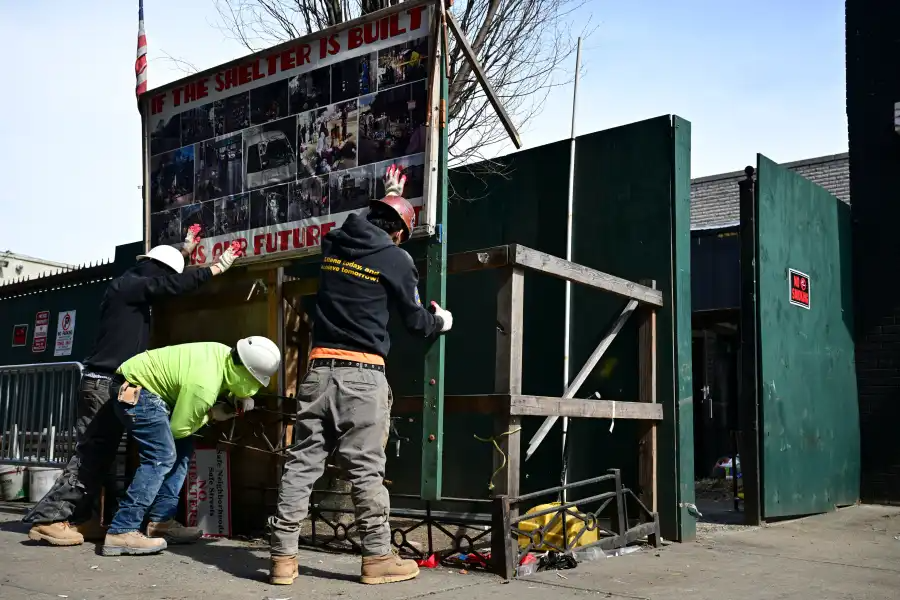
Workers tear down a graphic protest sign outside the proposed Bensonhurst men’s shelter site as construction resumes. Photo by Lloyd Mitchell
by Adam Daly, amNY
A long-running fight over a proposed men’s shelter in Brooklyn has entered a new phase under Mayor Zohran Mamdani, with demolition resuming despite over two years of protests and local officials pressing the new administration to reverse course.
The renewed activity at the site on 86th Street in Gravesend has rattled opponents who have been protesting the project for more than 600 days and had hoped the new mayor would reconsider one of the most contentious shelter fights inherited from the Adams administration.
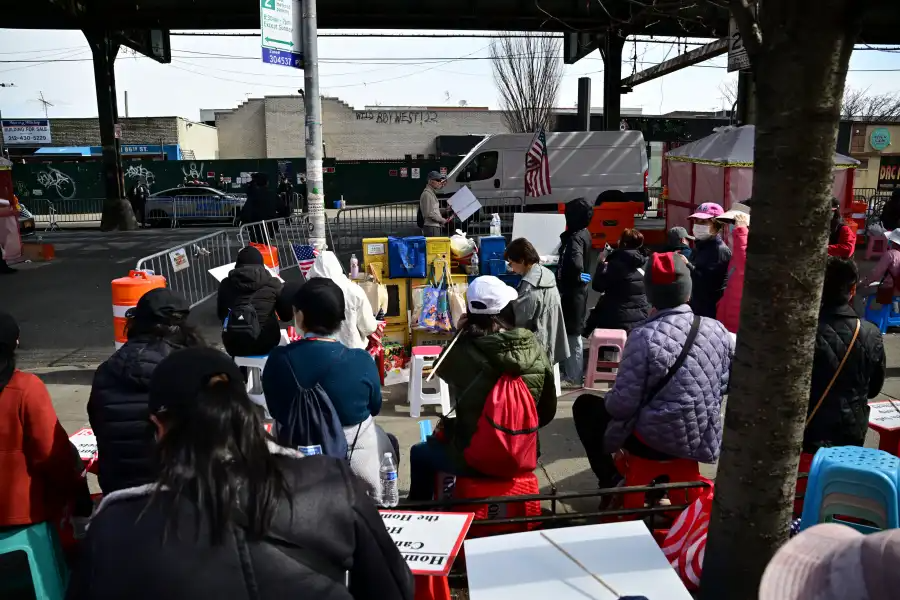
Instead, Mamdani is moving ahead with the project, setting up a clash between local officials who say the site should become affordable housing and homelessness advocates who insist the city cannot meet its obligations without adding more shelter beds.
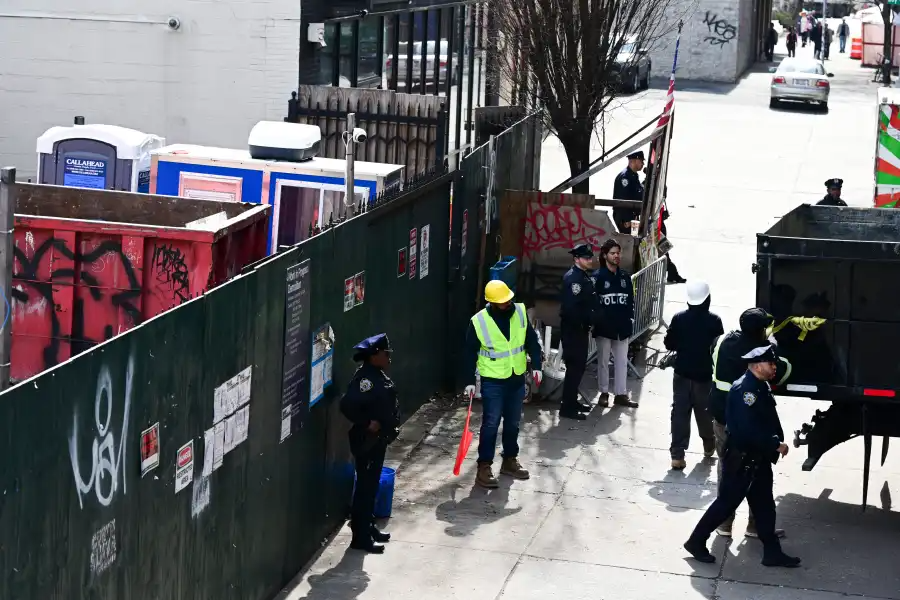
The fight against the shelter intensified after construction resumed at the site Sunday night, with opponents saying work got underway after permitted hours and a 70-year-old woman was injured outside the property during a scuffle.
In a March 31 letter to Mamdani and Department of Buildings Commissioner Ahmed Tigani, local Council Member Susan Zhuang said community members reported active work around 8:30 p.m., heard chainsaws by about 9 p.m., and watched a confrontation spiral into what she called a “deeply disturbing and unacceptable incident.”
A new phase in an old fight
For local elected officials, the latest confrontation was only the newest chapter in a battle that long predates Mamdani’s time at City Hall.
Opponents have been monitoring the site since construction stalled following a July 17, 2024, confrontation between protesters and police that led to the arrests of several southern Brooklyn residents, including Council Member Zhuang, who was charged with assault for biting a police officer during the protest. The charges were later dropped after she took part in a restorative justice session.
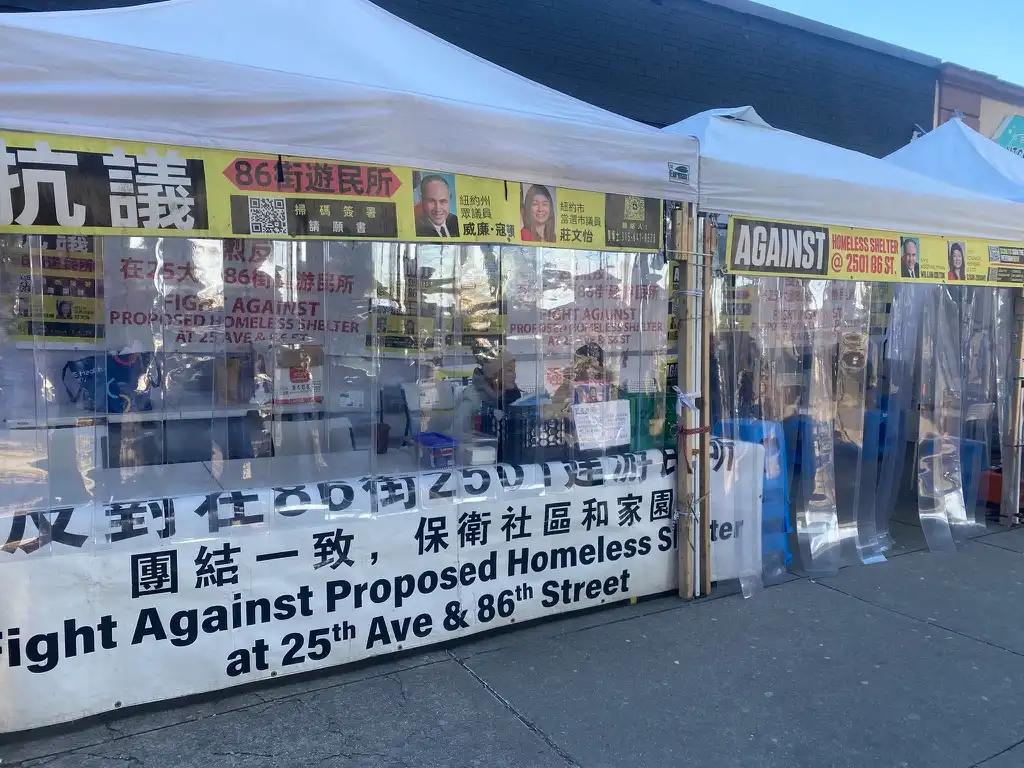
The facility, which is planned to be operated by Bronx-based VIP Community Services, is being developed by 86th Street NY LLC, led by The Sandhu Group, and could house up to 150 single men experiencing homelessness, including some with mental health challenges.
Sandhu purchased the site at 2501 86th Street in February 2023 for $4.8 million and filed permits to build a 32-room hotel on the site in October of that year.
Assembly Member William Colton, one of the project’s most prominent opponents, has accused developers of making a practice of building “so-called hotels in unexpected locations then leasing them to the city.” Colton previously led protests against a now-scrapped homeless shelter on Bath Avenue in 2021, which was set to be built by the same Sandhu Group.
After construction resumed Sunday, he told amNewYork that “we are definitely still fighting. We haven’t given up on it.” He argued that the city’s shelter policy “is not the answer to the problem of homelessness,” calling for them to be eventually phased out, and said permanent affordable housing, vouchers, and supportive housing would do more to help people than new shelters.
Colton also tried to draw a distinction between opposing the project and opposing homeless New Yorkers themselves. “Homeless people are people who need help,” he said. “The government needs to help people, including homeless people.”
Zhuang had already been urging Mamdani to intervene before the weekend clash. In a March 18 letter, she asked the mayor to back “an affordable housing development” at the site instead of a shelter for single men, arguing that District 43 is heavily rent-burdened and falling behind the rest of the city in new housing construction.
“For the last few weeks, I have communicated to your administration that we have an alternative plan for the site, one that the community would be excited about and benefit from – but no one has been willing to work with us,” she wrote.
That letter framed the dispute as a fight over land use and the kind of project that should go on a prime site in a district Zhuang described as underserved by affordable housing, rather than a neighborhood rebellion against homeless New Yorkers — though signs and rhetoric at protests have at times leaned in that direction.
One poster, for example, displayed on a makeshift billboard outside the construction site, warned that the area would fall into disrepair if the shelter were built, showing photos of drug use and crime-ridden streets.
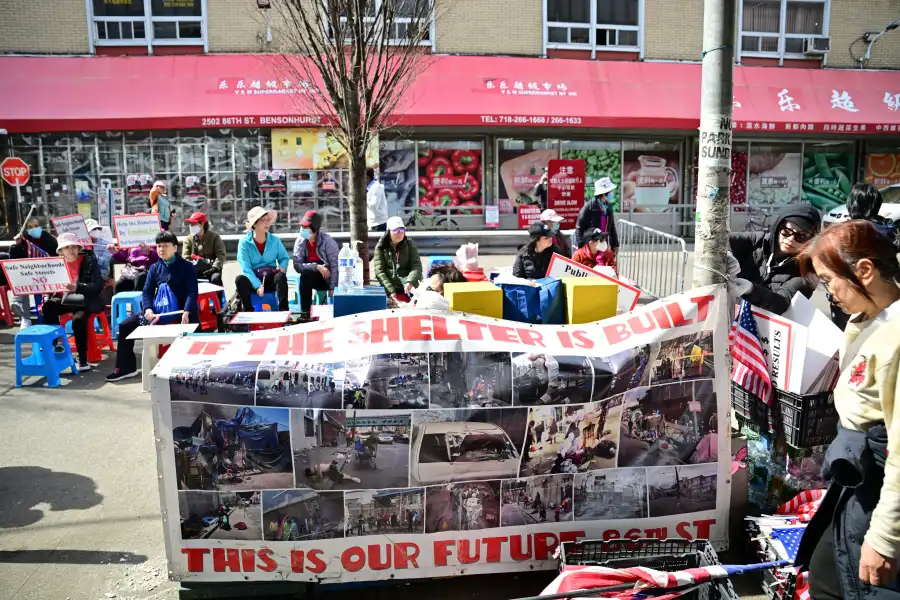
To address local residents’ safety concerns, the city previously said there would be on-site security around the clock, with a minimum of seven security staff per shift and a total of 74 security cameras throughout the building and across the shelter grounds. But that assurance did little to change minds.
In her letter, however, Zhuang told Mamdani there was “an opportunity to fight the true crisis: affordability,” and said the site could instead house “hundreds of people, including children in need.”
Zhuang also stressed to the mayor the confrontation had heightened fears in the largely immigrant neighborhood because of what she described as threats tied to the project.
She told amNewYork that there were reports that individuals connected to the site had threatened concerned residents with law enforcement action, “including implications that ICE could be involved.” She added that community members told her rumors had spread that if protests continued, immigration authorities could be called.
The Sandhu Group did not respond to requests for comment at the time of publication.
The Sunday night confrontation
Local opposition has centered on what critics say has been a lack of consultation between the city and the community.
Back in November 2023, local officials were notified by DSS that construction would begin within 30 days, but Colton and Zhuang have long maintained that having no say in the city’s decision to place a shelter in the middle of a bustling thoroughfare does not amount to meaningful outreach. Now, with the new administration, they say their pleas for open dialogue have gone unanswered.
To add to their frustration, construction crews appeared at the site after sundown on Sunday.
Dr. Larry He, a district leader working with Colton and Zhuang, recalled that he arrived around 8:30 p.m. and initially saw police, construction workers and a relatively small number of residents. He said he was told no work would be done, but then heard generators and chainsaws and saw activity inside. As more people arrived, thanks to the whistles protesters were blowing, the scene became more tense.
He described what followed in cautious terms. “It was very chaotic,” he said when asked exactly how the struggle unfolded. “I could not remember, actually,” he added. “I can’t fabricate things I don’t remember.”
What He did say clearly was that both he and the woman were knocked down. In Zhuang’s March 31 letter, she wrote that He and the 70-year-old woman “were pushed to the ground” in the “ensuing chaos.” The letter said Zhuang called emergency services, that the ambulance arrived about 20 minutes later, and that He accompanied the woman to Coney Island Hospital, where he remained with her until about 4:30 a.m. because she did not speak English.
For Zhuang and her allies, the incident became proof that City Hall was pushing ahead without enough regard for the neighborhood’s concerns. In the March 31 letter, she wrote that the woman’s injury was “a dangerous and entirely preventable situation created by unlawful activity” and called the night’s events “the real, human consequences of reckless and unlawful conduct.”
City Hall says the district must do its part
Though the Adams administration paused construction amid daily protests, Mamdani’s City Hall answer has been blunt and largely in line with the Adams-era pushback against opposition: the project is moving ahead because the city needs shelter beds, and this district has none.
“Homelessness exists in every part of our city, and in order to effectively address this citywide crisis, we must tackle it across the five boroughs,” a City Hall spokesperson said in a statement. “This forthcoming facility will be the first shelter site in this community district and will provide homeless individuals with a wide array of services and supports to help them get back on their feet and build their lives in the city. As part of our equitable siting approach, we are committed to ensuring that every community has adequate safety net resources.”
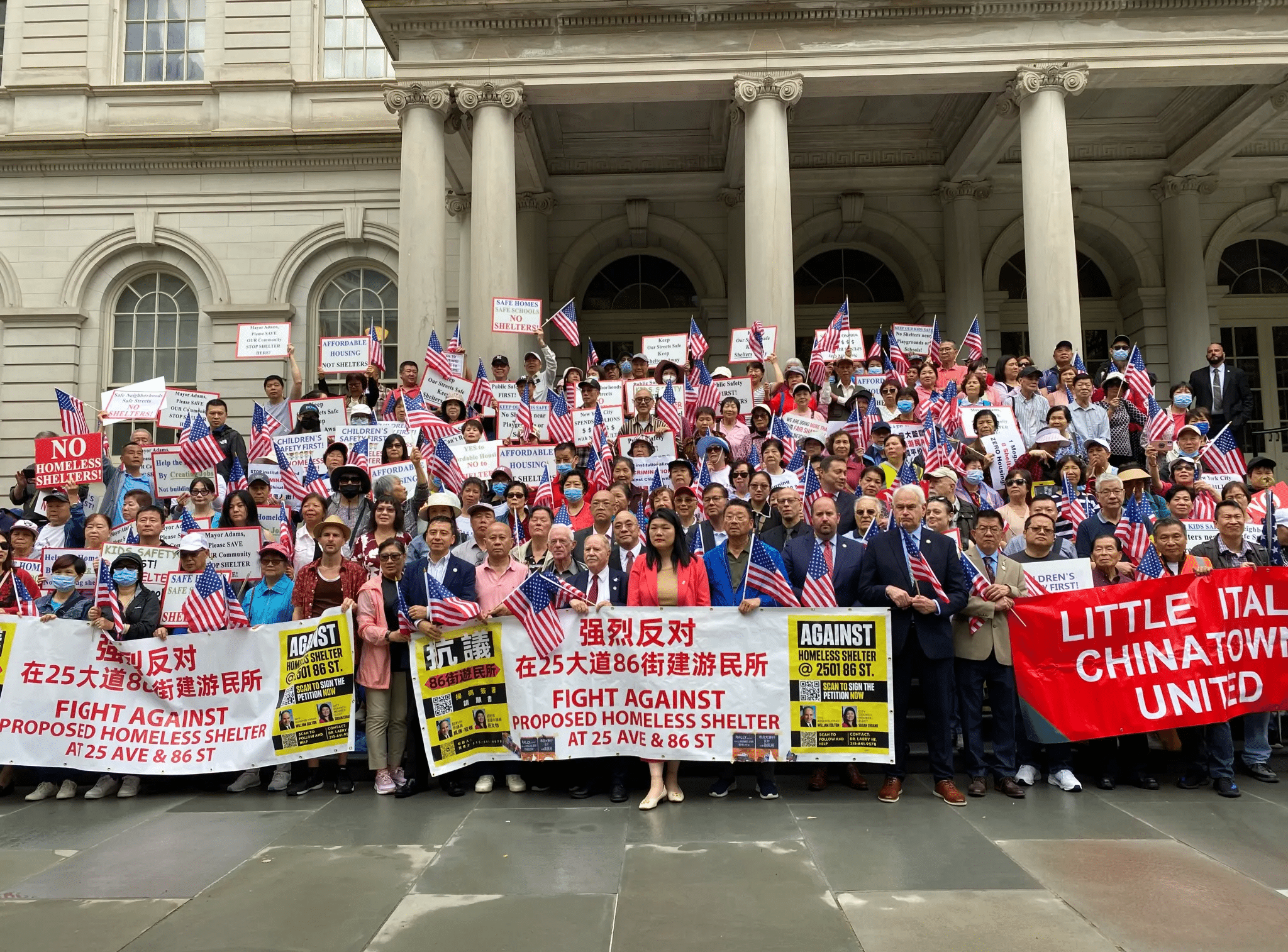
What is happening in Gravesend is also tied to a much bigger shift at City Hall. In February, Mamdani’s administration announced a plan to shut down the city’s last remaining emergency migrant shelter and move people back into the standard DHS system, partly by opening proposed shelters that had been delayed under Adams and redistributing capacity across the system.
The backlash is also not confined to southern Brooklyn. On Staten Island, local officials and residents have also mounted opposition to a new all-male shelter advanced under Mamdani. Public records cited in the New York Post tie that project to the Sandhu Group as well.
The city charter requires services and facilities, such as shelters and libraries, to be equitably distributed across the five boroughs, though audits have shown that some neighborhoods have a high concentration of shelters, while others, including Community District 11, have had very few or none.
An audit by the Comptroller’s Office in 2023 found that 40% of DSS shelters were located in community districts that already had a high concentration of shelter beds relative to the district’s population. The analysis also showed shelters had been consistently overconcentrated in certain communities of color, such as the South Bronx and East Brooklyn.
That argument found support from homelessness advocates like Dave Giffen, executive director of the Coalition for the Homeless, who said the city is meeting a legal obligation by moving ahead with the project.
“The city has a legal obligation to provide a sufficient number of shelter beds for anyone in New York City who’s homeless,” he said, referring to the city’s right-to-shelter law.
“Every neighborhood in New York City contributes to the homelessness crisis, and every neighborhood in New York City needs to be part of the solution,” he added.
According to city figures, more than 84,000 people slept in city shelters on the night of March 31, including more than 18,000 single adult men or boys.
From his experience, Giffen said opposition to new shelters tends to follow a familiar pattern: the residents who show up most forcefully at public meetings are often the ones most hostile to the project, while more supportive neighbors stay quieter. In his view, that early backlash is frequently driven by fear and by the dehumanization of homeless people. But he said those battles often lose steam once a shelter opens.
He was unsparing in his criticism of Colton’s proposals to phase out shelters altogether. “It’s the most ridiculous proposition I’ve ever heard,” Giffen said, arguing that without a functioning shelter system, New York would wind up relegating far more people to sleeping outside.
Giffen did, however, agree that the city “needs to do a much better job of monitoring the operators” in the shelter system and said there is “a real variation in the quality of shelters out there.” The best ones, he said, are “smaller, well-staffed, with a well-trained staff” and help people transition quickly into permanent housing.
He also said outreach matters, even if he doubts it would dissolve hardened opposition like that surrounding the 86th Street shelter. “Who would ever say that the mayor shouldn’t be out there engaging with New Yorkers on topics that are important to them?” he said. But, he added, “the shelters need to go in” because the city has “a moral as well as legal obligation to ensure that nobody is left to sleep unsheltered on the streets.”
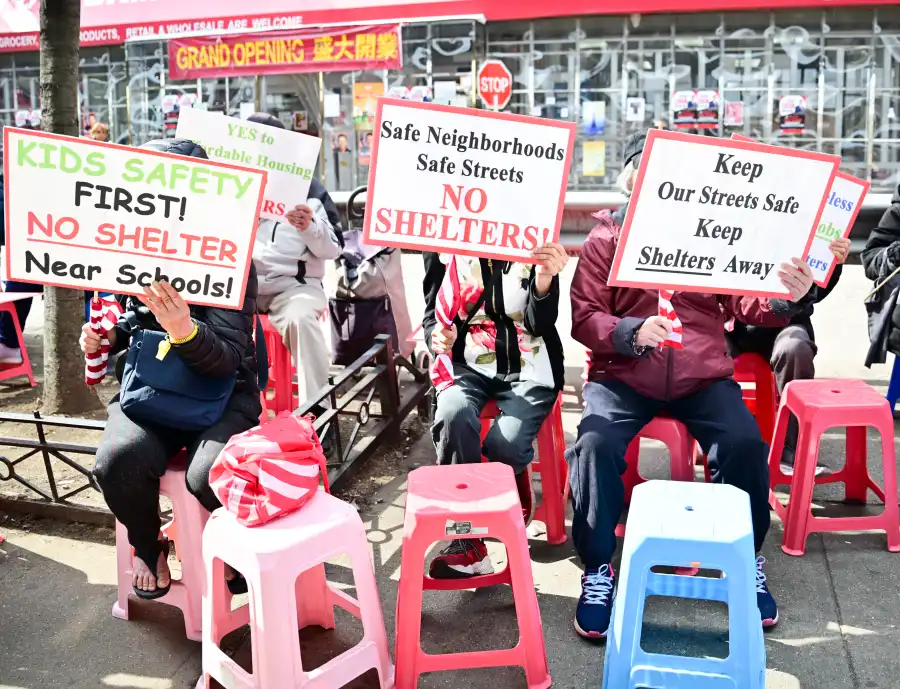
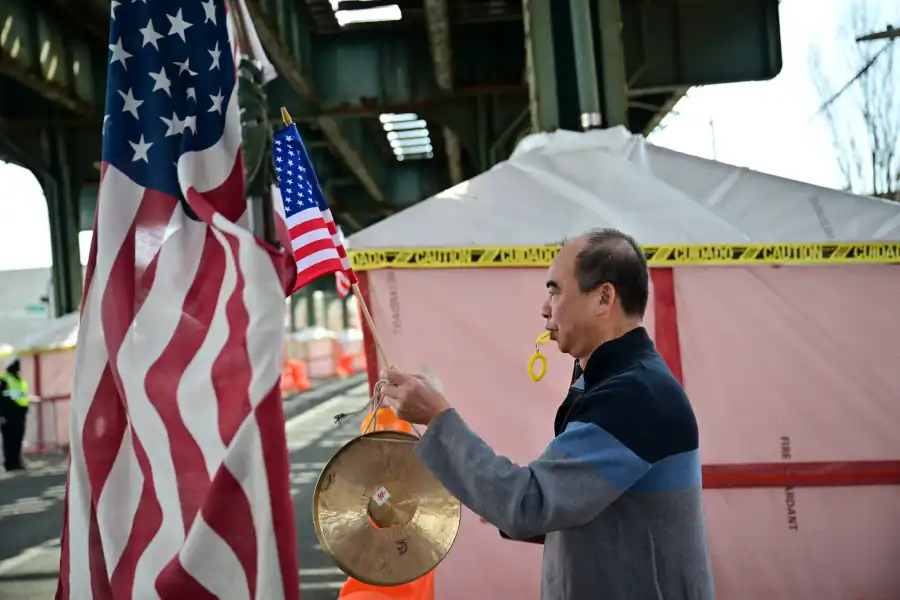
When it comes to Mamdani’s approach to homelessness overall, Giffen did not offer the mayor an unqualified endorsement.
Asked about the mayor’s broader response to homelessness, he said “it still remains to be seen,” and argued that Mamdani had already backed away from two major promises — expanding CityFHEPS and ending encampment sweeps. He also said the mayor’s affordability agenda so far appears too focused on middle- and working-class New Yorkers and “doesn’t seem to be adequately inclusive of lower-income New Yorkers and homeless New Yorkers.”
“It’s time for him to be clear about what his approach is going to be to mass homelessness in New York City,” Giffen said.
Even on shelters, where Giffen said Mamdani is moving in the right direction, he called the mayor’s emergency order to bring the system back into compliance only “a good first step,” saying the shelter system still suffers from inadequate staffing, poor service for people with psychiatric and cognitive disabilities, and other longstanding failures.
The paperwork and compliance fight
As the political fight has escalated, so has the battle over permits, inspections, and agency oversight.
In a separate March 31 letter to DOB Commissioner Tigani, Zhuang demanded a stop-work order and raised a series of concerns about complaint handling, asbestos filings, demolition prerequisites, and permit renewals. She alleged “potential fraud, environmental violations, administrative irregularities, and significant public safety risks” tied to the site.
DOB and DEP, however, pushed back on much of that account.
In a statement, DOB said the site “continues to be in compliance” and that inspectors responding to community complaints this week “observed no unsafe or illegal conditions during our field visits.” The agency also said Zhuang’s claim that more than 100 complaints were closed without action “isn’t true,” explaining that duplicate 311 complaints are often grouped and investigated through a single inspection. DOB further stated that the required demolition documentation had been submitted and that the demolition permit, renewed on Nov. 14, 2025, followed the normal renewal process and included the applicable fees.
DEP, in turn, said a September 2025 ACP-5 asbestos survey was revised after inspectors found materials that might contain asbestos had been left out of the original report. The agency also said the project did not require a separate stormwater permit or determination of non-jurisdiction at the location, though “an application was submitted, certified, and approved for a site connection.”
Assembly Member Colton says the fight will continue. Colton said opponents plan to keep fighting through press conferences, media events, and demonstrations, while trying to expose what they say they have learned about the developer until, in his words, “it will be an embarrassment to support that project.
But for the locals who have remained at the site every day, like Donald Cheung, the sight of NYPD officers guarding the property while construction gets underway has brought a mix of exhaustion and resolve.
“We feel we have lost,” he said on Tuesday, “but we try to hope, we pray, and we will try to do whatever is necessary.”
Editor’s note: A version of this story originally ran in amNY. Click here to see the original story.
Related Stories
- Gravesend Residents Continue Protest Against Planned Homeless Shelter
- Hundreds Protest Planned Gravesend Homeless Shelter
- Sheepshead Bay Residents Step Up Protests of Planned Homeless Shelter
Email tips@brownstoner.com with further comments, questions or tips. Follow Brownstoner on X and Instagram, and like us on Facebook.


What's Your Take? Leave a Comment