
The Good Life: Private Parking in Brooklyn
Off-street parking is rare in brownstone Brooklyn, and an enterprising doctor tried to remedy that in 1920, to the horror of his neighbors.

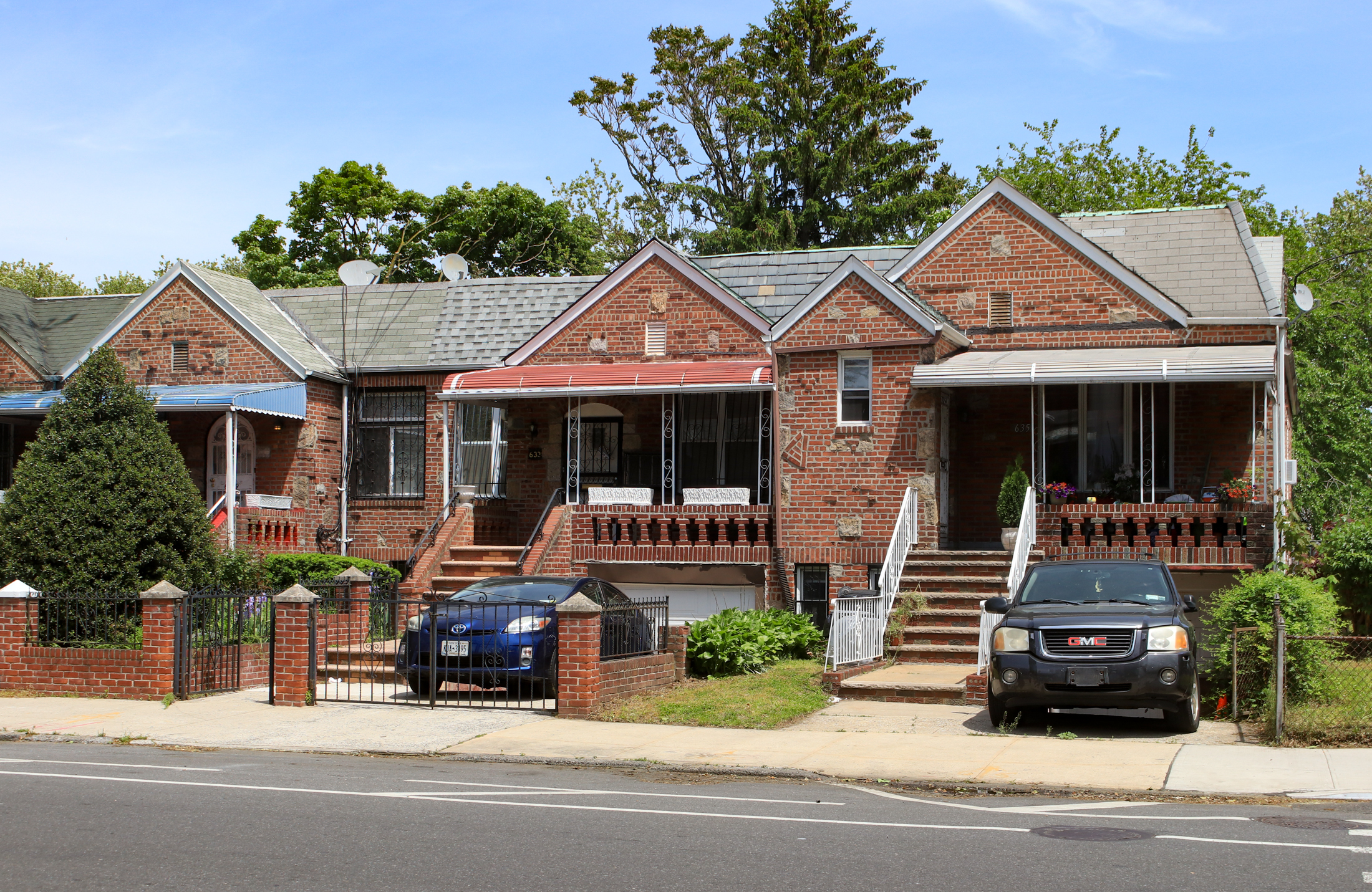
A house in Crown Heights with a driveway and garage in 1940. Photo via New York City Municipal Archives, Department of Records and Information Services
It’s possible to live your entire life in Brooklyn and never own a car. Of course, public transportation routes and stops are not perfect. There are places in the borough that are not served well at all, but for most people in what is called “brownstone Brooklyn,” everyday life doesn’t include car ownership. If it isn’t prudent or possible to walk or bike, then we hop on a bus or the subway, and if necessary, we get a cab or car service – those are someone else’s cars, not our own.
Nonetheless, today there are more cars on the road in Brooklyn than ever in every neighborhood and all these vehicles need somewhere to park. Parking is a huge issue in most urban settings, there is never enough, at least not where you need it to be. Many neighborhoods, such as Brooklyn Heights and Park Slope, have long been notorious for their scarcity of parking, with people circling the blocks of one-way streets over and over, hoping to be the one who snags a space when someone else pulls away from the curb.
A Car in Every Driveway – But How?
The first automobiles began rolling down Brooklyn’s streets at the beginning of the 20th century. In 1900, the first auto show in New York debuted at Madison Square Garden in Manhattan. It was geared more towards the wholesale aspect of the new industry, attracting those who could establish dealerships and place orders for sales to the public. Even so, it proved to be very exciting and popular for all who attended. In the beginning of the automobile age, there were dozens of car manufacturers.
As the first decade progressed, more automobiles appeared on the scene as manufacturing methods improved and competition between automakers grew. In 1908 Henry Ford introduced his Model T, the “affordable” car. His moving assembly line wouldn’t come into being until 1913, but Ford had already pioneered more efficient ways of production. Henry Durant founded General Motors that same year, and would prove to be Ford’s primary competitor, although there were scores of other contenders.
Brooklyn held its first auto show in February 1911 at the 23rd Regiment Armory on the corner of Atlantic and Bedford avenues in today’s Crown Heights North. The event had been almost a year in planning and featured 47 different manufacturers, all eager to introduce their vehicles, not just to dealers, but to the public. The event took place in the armory’s huge drill hall and was a carnival of events aimed at drawing in those who could buy as well as those who could just look and aspire to own.
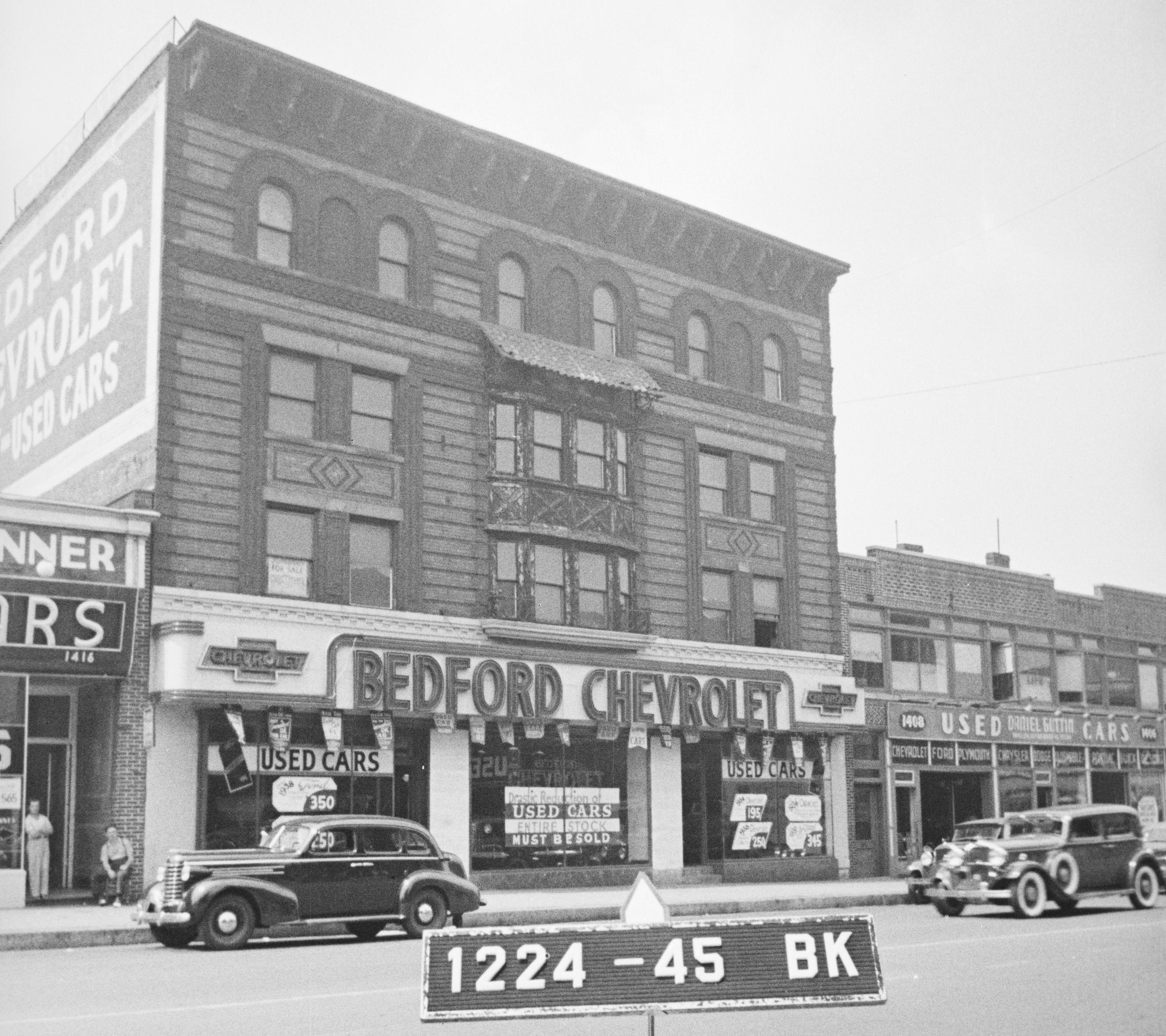
Over the next 20 years, Bedford Avenue grew into “Automobile Row,” with automobile dealerships for the many brands of new and used cars, as well as gas and service stations, parts and outfitters and more. The neighborhood was still experiencing residential growth but already had industrial and commercial areas that developed as large and small automobile service and storage spaces. As the number of automobile owners grew, parking became an issue of public concern.
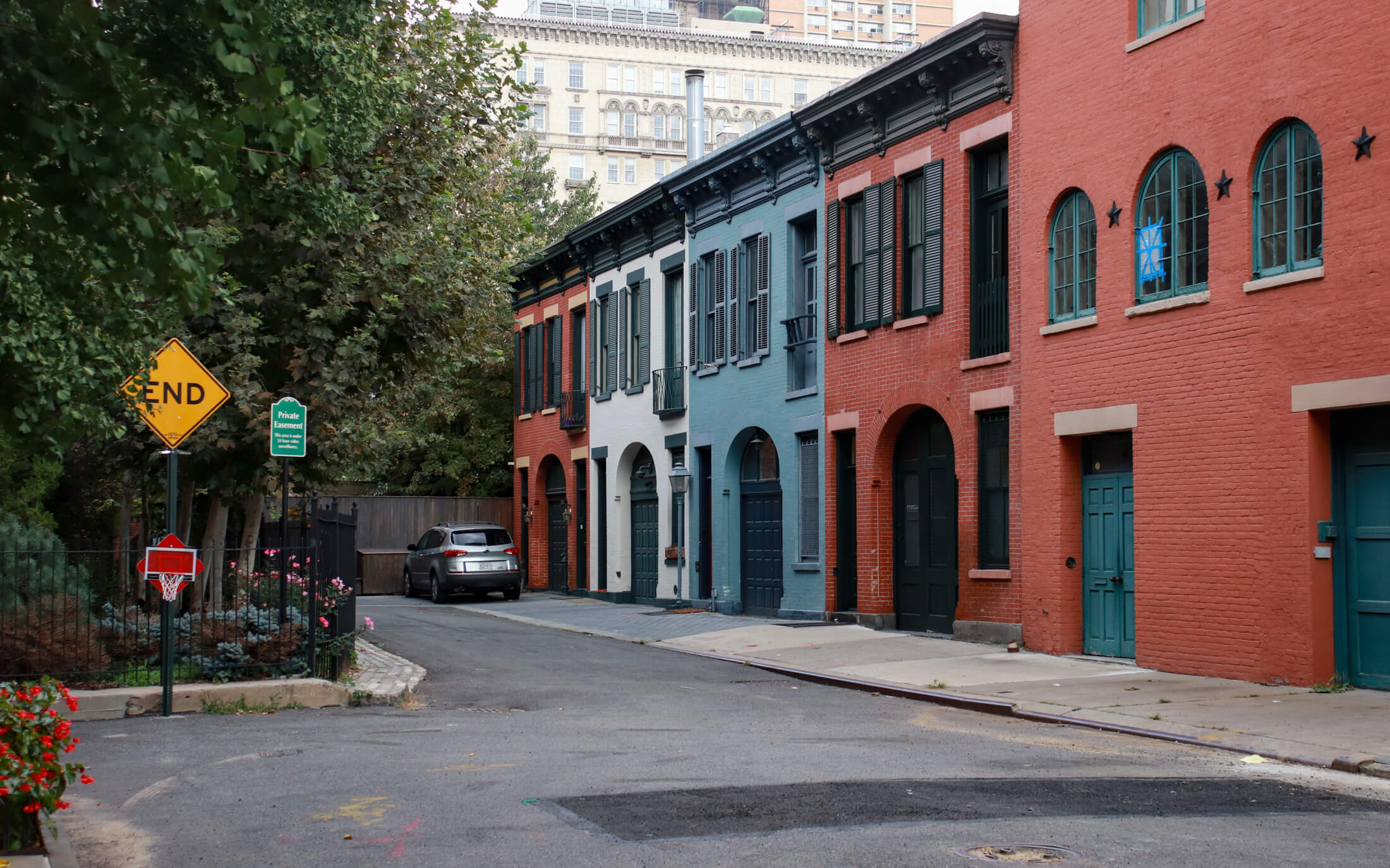
Grace Court Alley and College Place in Brooklyn Heights, two blocks that once held stables and carriage houses were repurposed as automobile garages for their wealthy owners who lived on adjacent streets. The same for carriage houses in Clinton Hill and elsewhere in the borough. But unless they paid for space in private garages, most people, even the wealthiest, had to park their cars on the street.
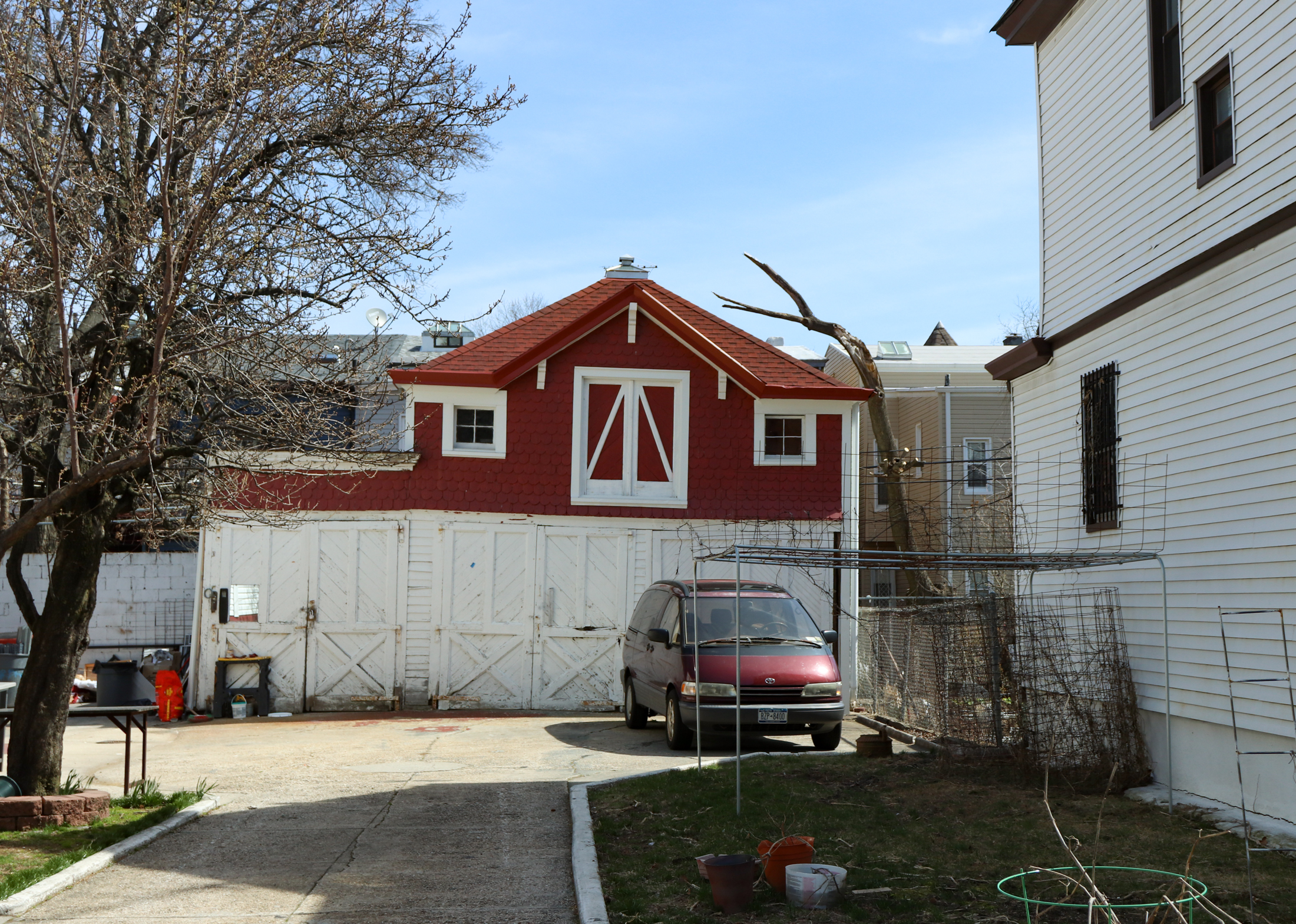
None of this was lost on real estate developers. While the older row house neighborhoods were already built up, between 1900 and 1930 there were still parts of the borough that had yet to be filled with homes. Many 20th century-built homes in Bay Ridge and other coastal neighborhoods have driveways and garages. Providing private parking would help sell homes. But this story is mainly about those neighborhoods that don’t have that amenity. But what if they could?
Neighborhoods such as Crown Heights South and Prospect Lefferts Gardens were barely developed in 1900. Most of the neighborhood south of Eastern Parkway wouldn’t see heavy development until the early ‘teens on into the 1920s. In 1902, the Eastern Parkway Improvement Company began one of their first projects in the area. It was a one-block development of upscale semi-detached houses on Union Street between Brooklyn and Kingston avenues.
These houses stood alone for many years before the same company and others began building row houses on other blocks that had been mapped out. This was a special block, with innovative features that would lead to it being called “Spotless Town.” The architect of the block was Henry M. Congdon. He laid out a private service alley for the houses on the south side of the block. It was originally marketed as a back entrance for deliveries and tradesmen, but as cars became must-haves for upscale buyers, garages and parking pads were created along its length.
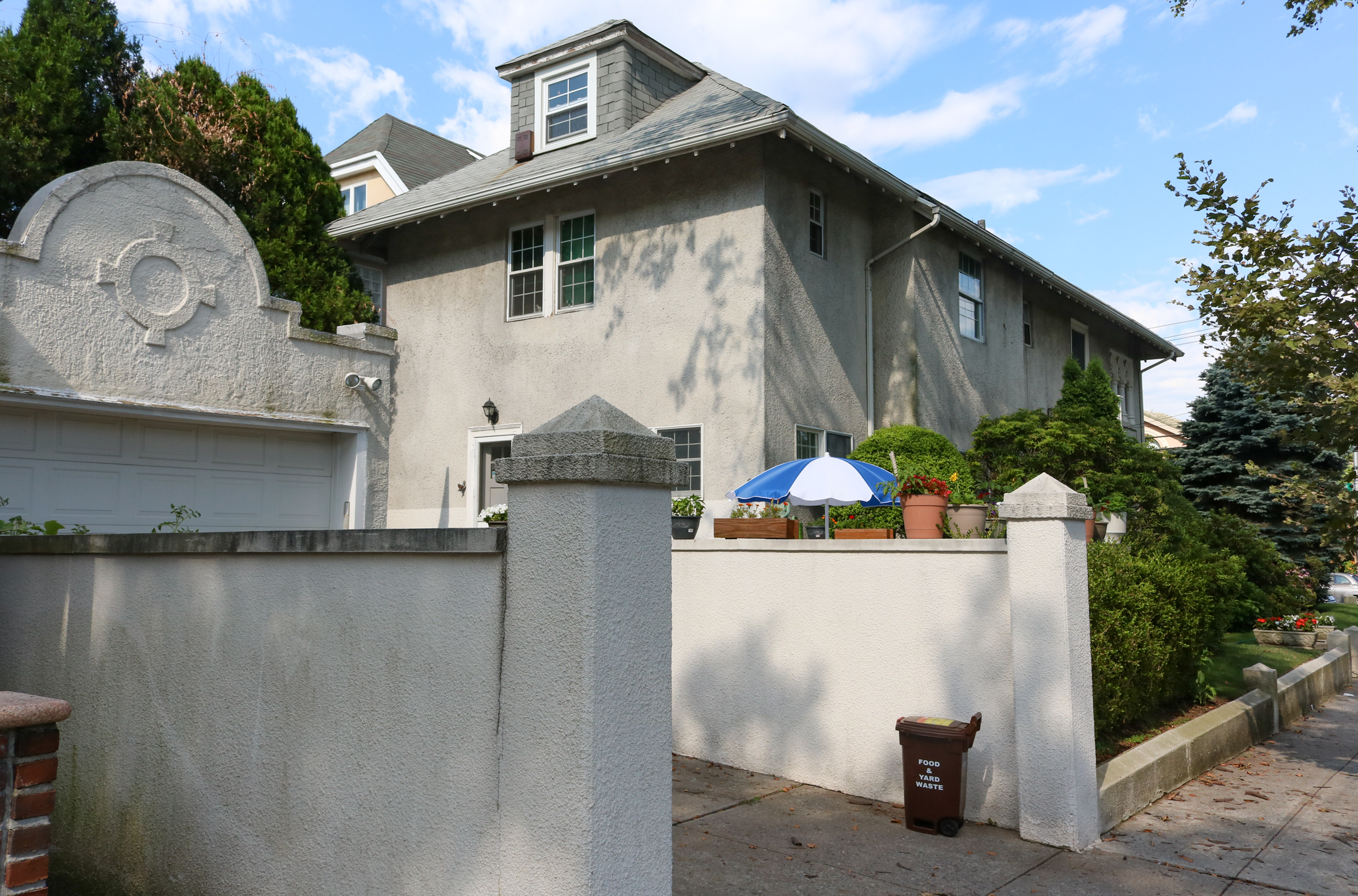
Other developers in the area eagerly ran with the idea and developed their houses with alleys mapped into their blocks. Most of the blocks between Union and Montgomery Street and between Brooklyn and Kingston avenues in Crown Heights South have alleys and therefore private parking for homeowners. Other blocks without alleys but with driveways and backyard garages can be found on other Crown Heights South streets and down into Prospect Lefferts Gardens and row house Flatbush.
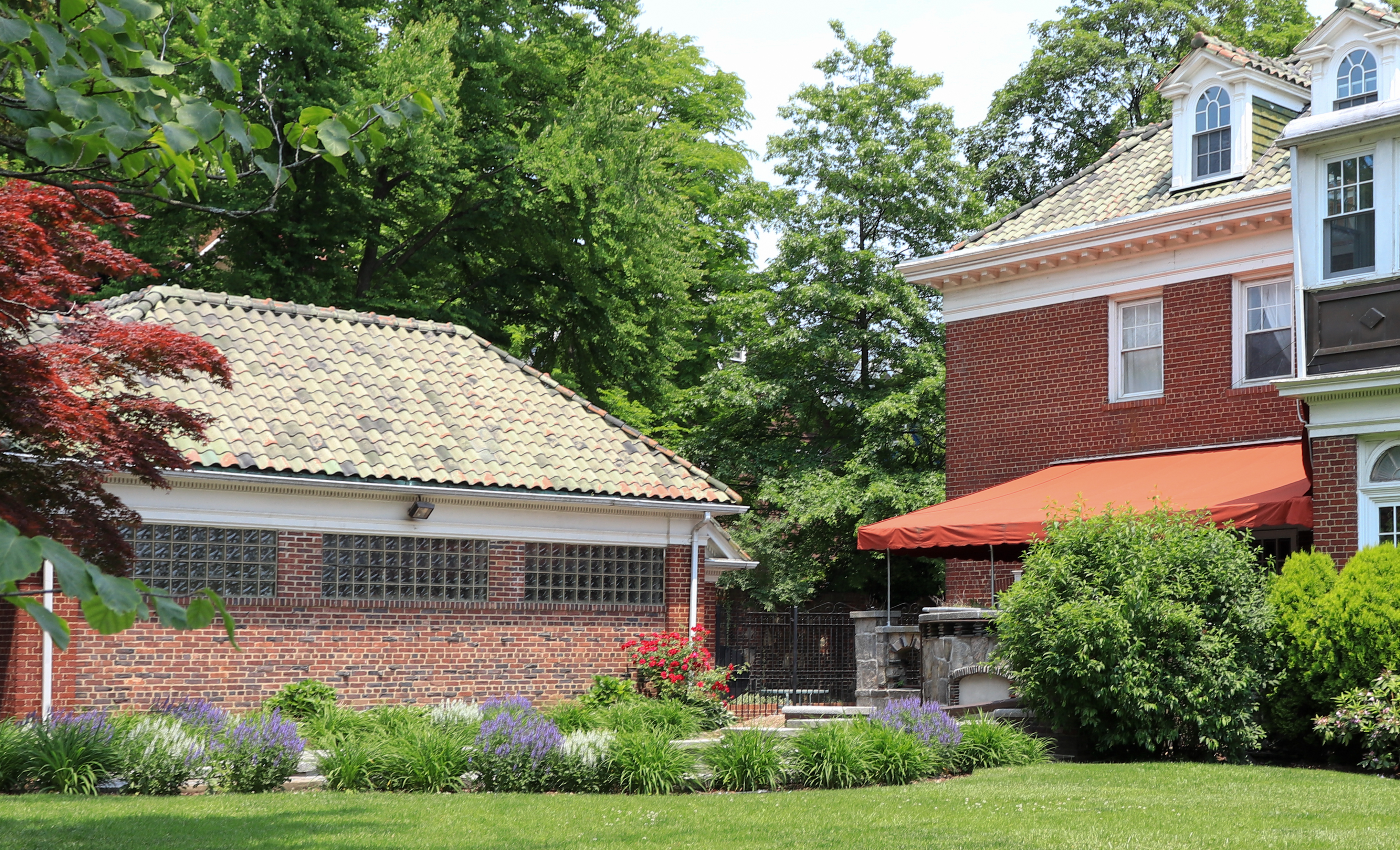
Limestone and other style row houses built in mirrored pairs with a shared driveway and individual garages are scattered through neighborhoods built up in the ‘teens and 20s or built in older neighborhoods when land became available. Flatbush’s landmarked Kenmore Terrace (1918-19), the group of semi-attached houses (1919) on St. Marks Avenue near the Children’s Museum, and the white cottages directly behind them in Crown Heights North on Prospect Place (1921) are all fine examples. The standalone red brick Colonial Revival homes on Maple Street in Prospect Lefferts Gardens (1920s) all have driveways and garage space – a must-have feature almost as important as the homes’ modern conveniences. The house at 59 Maple Street even has a porte cochere.
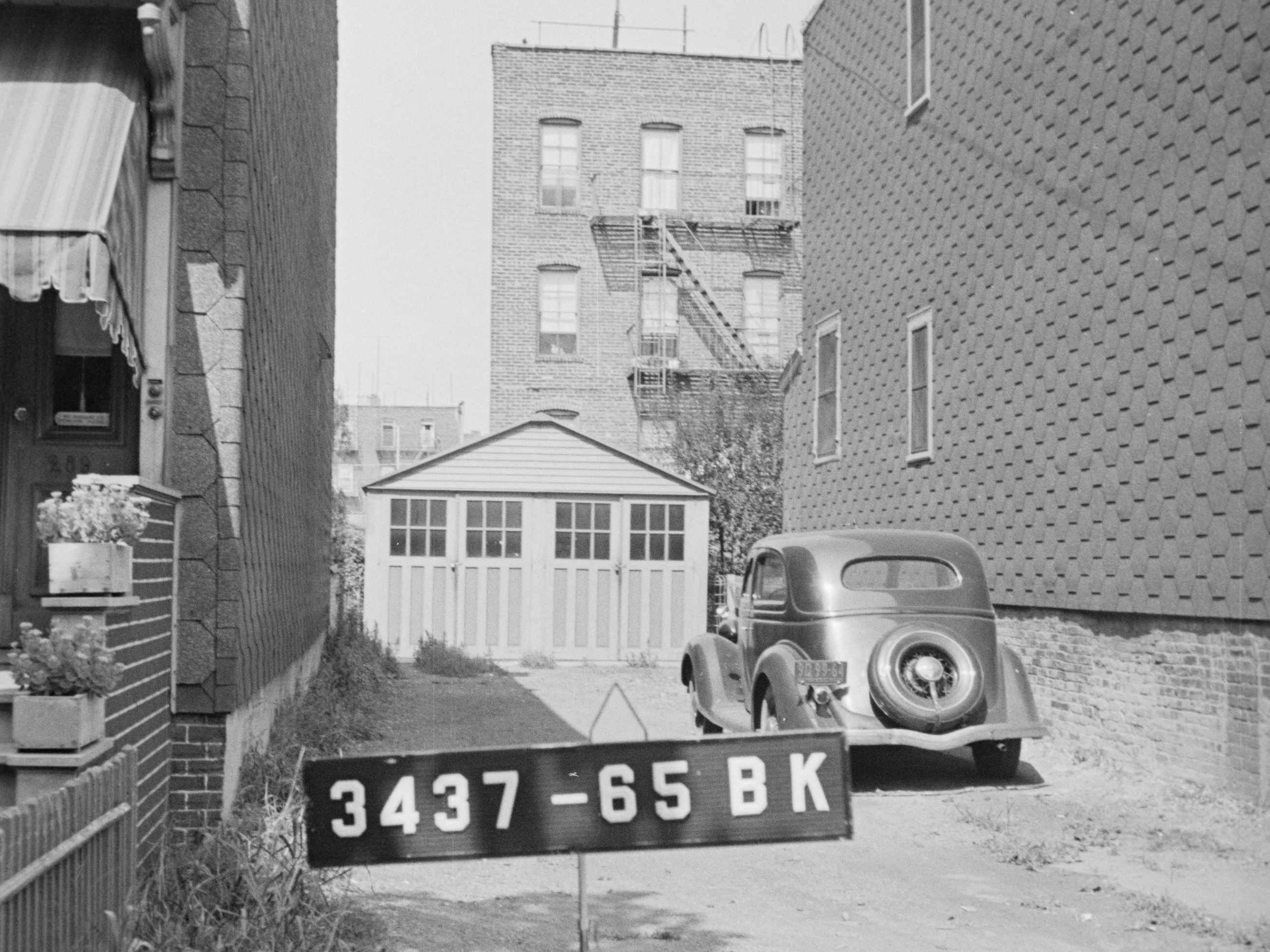
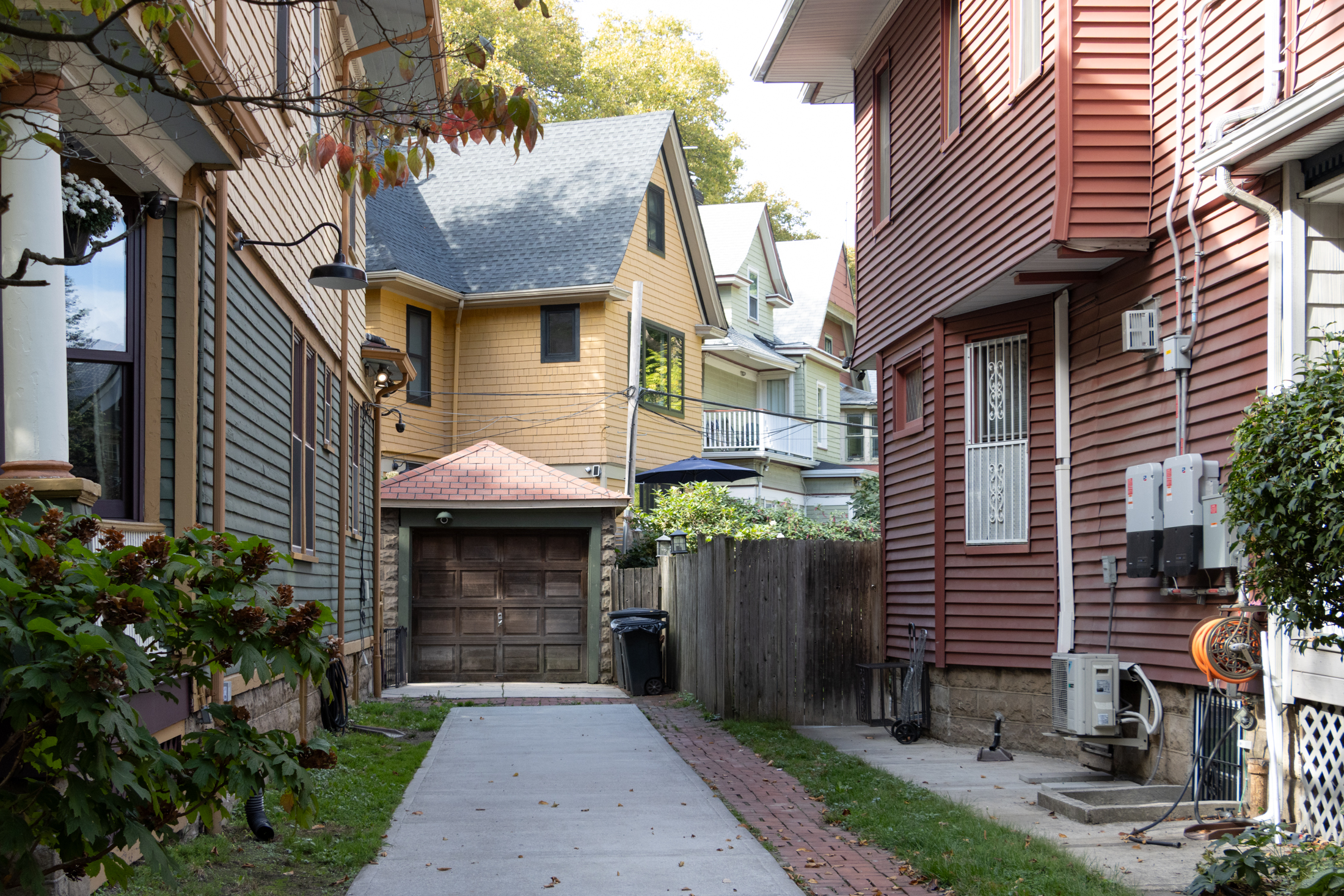
So, lucky for all those homeowners, but what about homeowners in earlier 19th century rowhouse neighborhoods? Unlike Philadelphia and other cities, New York City, with rare exceptions, was not planned with service alleys. Outside of renting a garage space somewhere, on-street parking is the only way to go if you want a car in the city. As the 20th century marched towards the 21st, some row house homeowners decided to go it on their own and create parking spaces in their front yards. No alternate street parking wars for them. But to do that, you need a curb cut.
Curb cuts fall under the city’s zoning laws, and as such have a lot of restrictions and conditions attached to any request. Plans by licensed engineers or architects must be submitted, and there are limits to width and placement. The driveway/parking space must be long enough to enable the vehicle to be completely enclosed on the property and not spill out onto the public sidewalk. There are also rules about how many curb cuts can be on a block, as each cut reduces the number of cars that can park on the street. Besides, they don’t look good and ruin the historic streetscape.
The city has never been fond of granting curb cuts, with exceptions made for handicapped access or other such homeowner needs. But people did them anyway. Sometimes the curb was not actually cut down, but the homeowner simply painted a yellow line on the curb or wrote “no parking” across the site. Bouncing over the actual curb was seen as an acceptable downside for the greater good of having one’s own space.
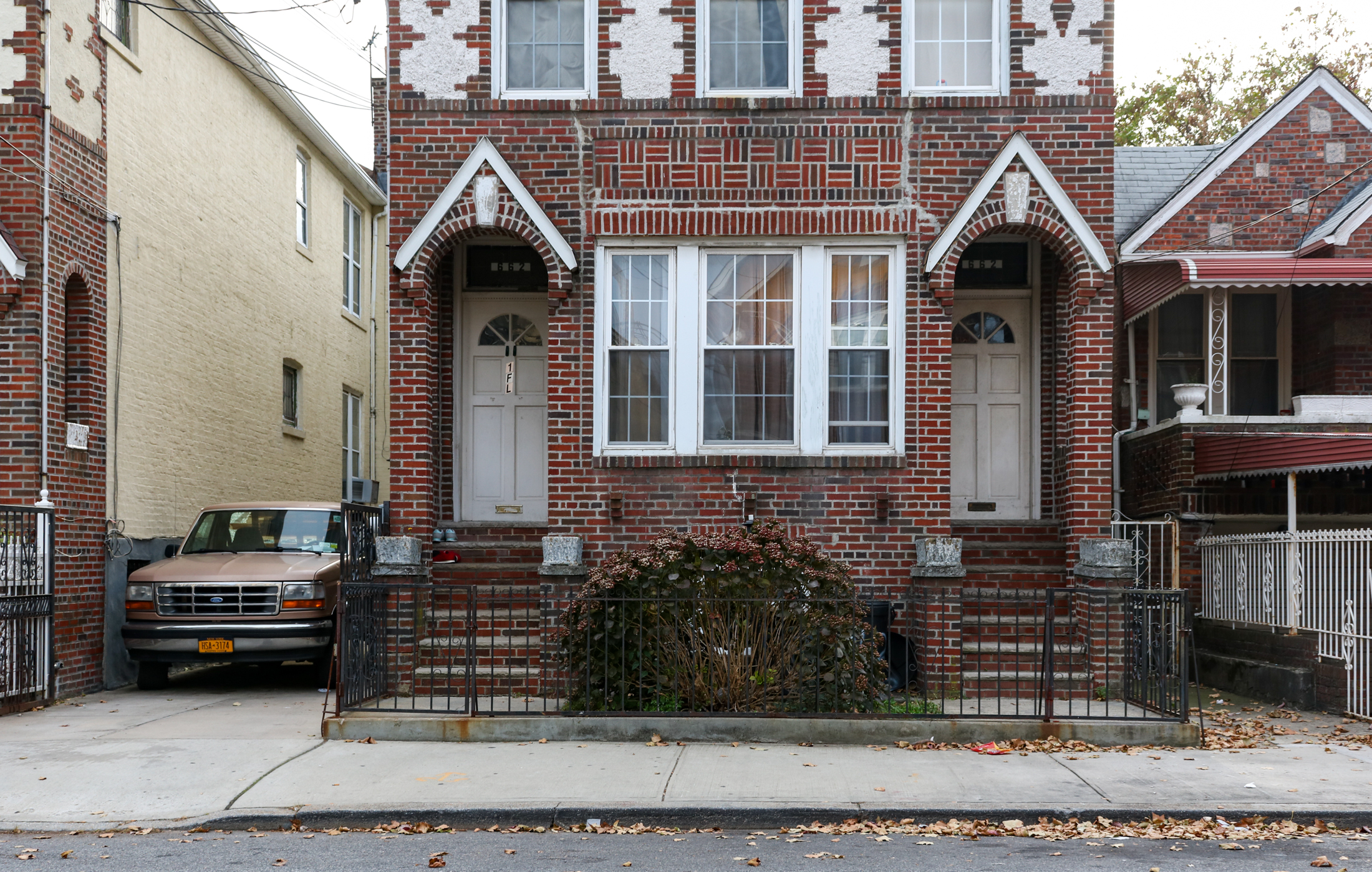
Many owners in every neighborhood at some point have tried to get an approved curb cut in front of their properties. In the past, some blocks were full of illegal cuts, relying on the fact that the authorities rarely checked on those areas, and owners felt they were necessary to protect their vehicles behind a sturdy fence. Today, those neighborhoods are gentrified and the reason for a cut may have changed, but the desire for one’s own guaranteed parking spot remains as old as the automobile.
Some enterprising homeowners wanted more than just a curb cut and their vehicle standing on their front space. They wanted a garage too. Many homes were built in the post-World War II era in Flatlands, Sheepshead Bay, and other outer neighborhoods with ground-floor garages, entered from a graded driveway. On-street parking on these blocks is spaced out between driveways.
The Story of Dr. and Mrs. Julius Schlein of Carroll Gardens
So why can’t a homeowner on a 19th century block in Carroll Gardens do the same? The question was asked by Dr. Julius Schlein in 1920. He was decades earlier than those Sheepshead Bay houses, but he had the same idea. The Schlein family lived at 382 Union Street between Smith and Hoyt Street on a block known locally as Doctor’s Row for the preponderance of physician homeowners on the block.
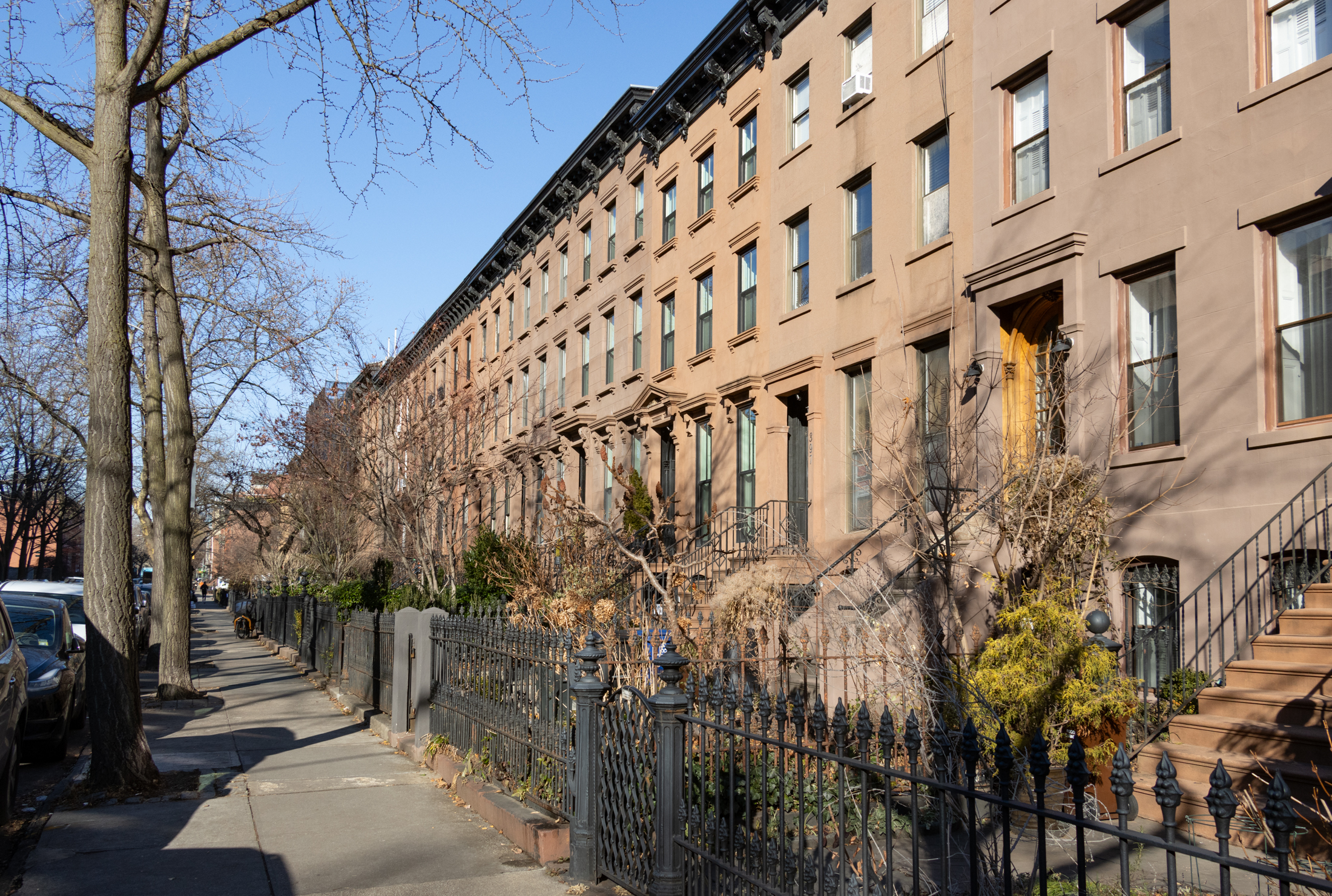
No. 382 was part of a row of Neo-Grec brownstones that took up most of that side of the block and were mirrored by similar houses across the street. They were most likely built in the 1870s, developed for comfortable middle-class professional people. Long Island Hospital is not far away, and may have employed many residents on the block.
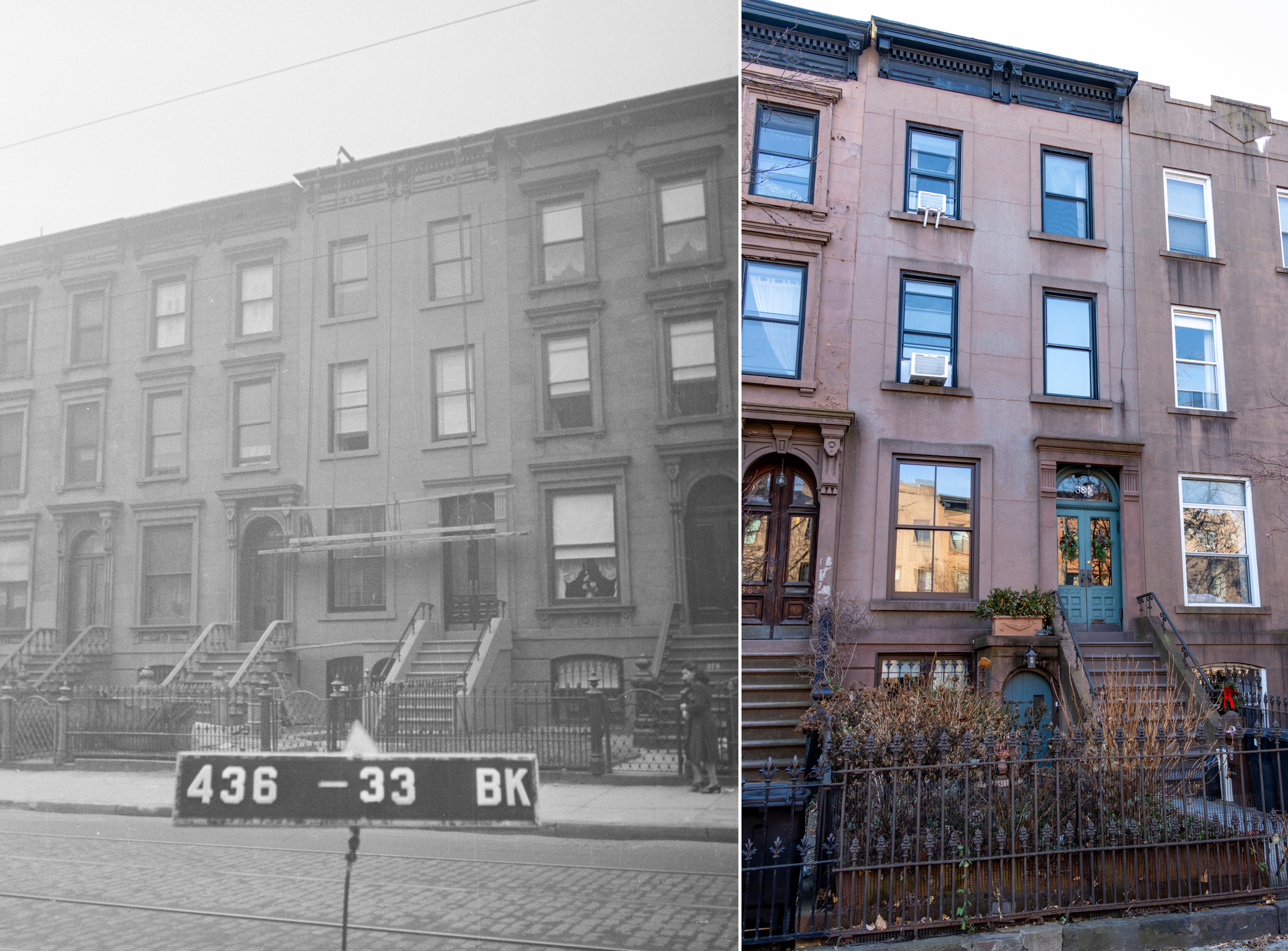
Dr. Schlein, with a permit from the Building Bureau, turned the basement ground-floor level of his house into a five-car garage. He then applied for a permit from the Highways Bureau to allow him to raze his courtyard and fence and construct a graded driveway leading to the entrance to his garage. He also needed a curb cut.
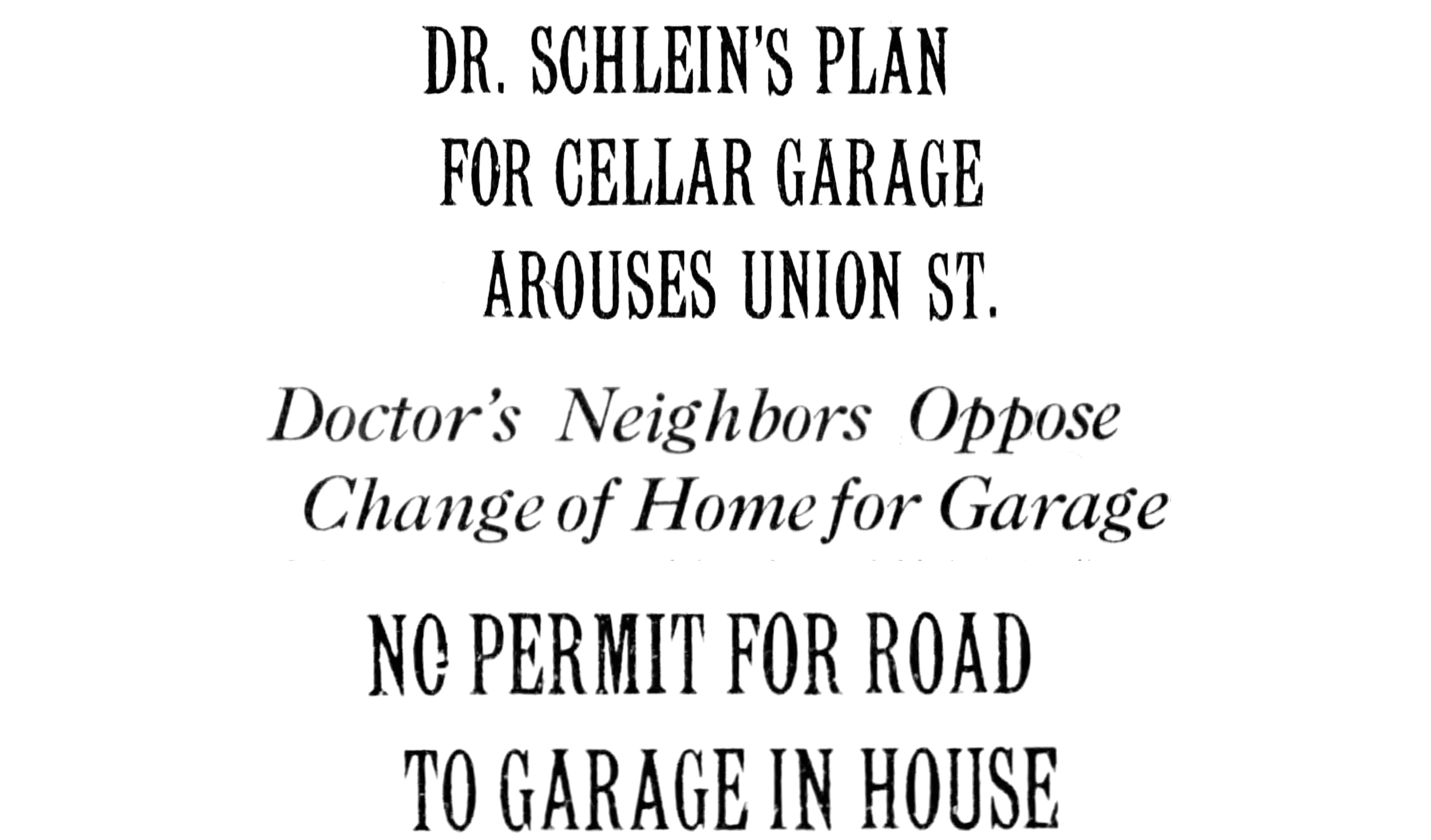
When his neighbors got wind of this they were up in arms. What did he think he was doing ruining the streetscape of this historic block? What gave him the right to lower the property values and quality of life of his neighbors? A group called the Union Street Taxpayers passed a resolution to stop the conversion. They cited gas fumes as a danger, writing that basement garages “produce poisonous exhaust vapors from gasoline engines which cause headaches, dizziness, and vitiating chemical blood effects in the inhalers thereof, and in many instances have actually caused death.”
As doctors, the signers knew what they were talking about. It seems odd that Dr. Schlein wanted to live above a garage under those conditions, but that was his plan. The Taxpayers couldn’t understand how the Building Bureau, today’s DOB, could issue a permit that allowed for a garage to be built in the basement of a private row house residence on a historic rowhouse block.
Mrs. Schlein couldn’t understand what the fuss was about. She declared that “the house is owned by us, and we should be permitted to do whatever we care to with the property.” She went on to say that the neighbors feared that the garage would be ugly. She insisted that they had good taste and would never build something ugly. It will be “dignified and even ornamental,” she told reporters.
Mrs. Schlein continued to disparage her neighbors and assert her rights as the property owner by saying, “If we have solved the matter to our own satisfaction, I see no reason why we should ask for the consent of the surrounding community.” She ended her interview with a last statement: “Indeed, after the work is over and our garage is in service, I am prepared to see out protesting neighbors who own automobiles embrace the idea as their own.”
The neighbors did not see it that way, and the case went to a judge. Judge Fawcett of the State Supreme Court didn’t see it that way either and ruled against the Schleins. They could not construct what he called a depressed runway connecting his basement to the street. There would be no raked driveway across their property and no use of a public, city-owned sidewalk as part of that driveway.
One would think that would be the end of it, but it wasn’t. The enmity between the Schleins and their neighbors went on. The doctor stopped construction of the garage, which was almost finished. A few weeks later, he decided to restore his yard. It had been torn up for the desired driveway. He wanted to cement it over, but his neighbors called the police to tell them that Dr. Schlein was hoeing his own front yard. Six officers were sent out to bring him to the station. The police captain didn’t see why the homeowner couldn’t do this and sent him home. The neighbors disagreed and another fight between the owners of 382 Union and the rest of the block ensued.
Dr. Schlein decided to sell the house. In a final act of revenge on his neighbors, he announced that he would only sell his property to Negroes. This wasn’t the first time a Brooklyn homeowner threatened his neighbors with this racist tactic; an owner in Park Slope did the same thing. It was assumed selling to Black people would be the worst thing he could possibly do, other than burning down the house. A Black owner, it was feared, would lower property values and would be the steppingstone for more Black families moving onto the block.
The president of the Union Street Property Owners, Dr. J. S. McNamara, and several other physicians on the block dared Schlein to “go to it.” Schlein told reporters that he would do just that, and already had several offers for the property. McNamara told the press, “To the persons imbued with the proper human qualities, the color of one’s skin is of secondary consideration.” Another doctor in the group, Dr. John O’Reilly, said that he would rather have Negro buyers on the block than persons who have contempt for the law.”
Whether or not Dr. Schlein and his wife sold to black people is unknown. Probably not. The papers lost interest and the story died. They did move, however, and bought a house on Clinton and President streets, not all that far away. By the 1930 census, there was only one doctor left on that side of the street, and all the other row houses became rental apartments with working-class first and second-generation immigrant families.
What some people will do in this city for a garage and a parking space!
Related Stories
- Living on Atlantic Avenue, the ‘Spine of Central Brooklyn’
- A Medieval-Inspired Service Center for the Autos of 1920s Crown Heights
- Living the Good Life on Eastern Parkway
Email tips@brownstoner.com with further comments, questions or tips. Follow Brownstoner on X and Instagram, and like us on Facebook.
What's Your Take? Leave a Comment