
Getting NYC Event Permits Is a Mess. They Want City Hall to Cut the Red Tape
Thousands of groups put on events in public space every year, but navigating the system system is “a maze,” said one East Harlem organizer.

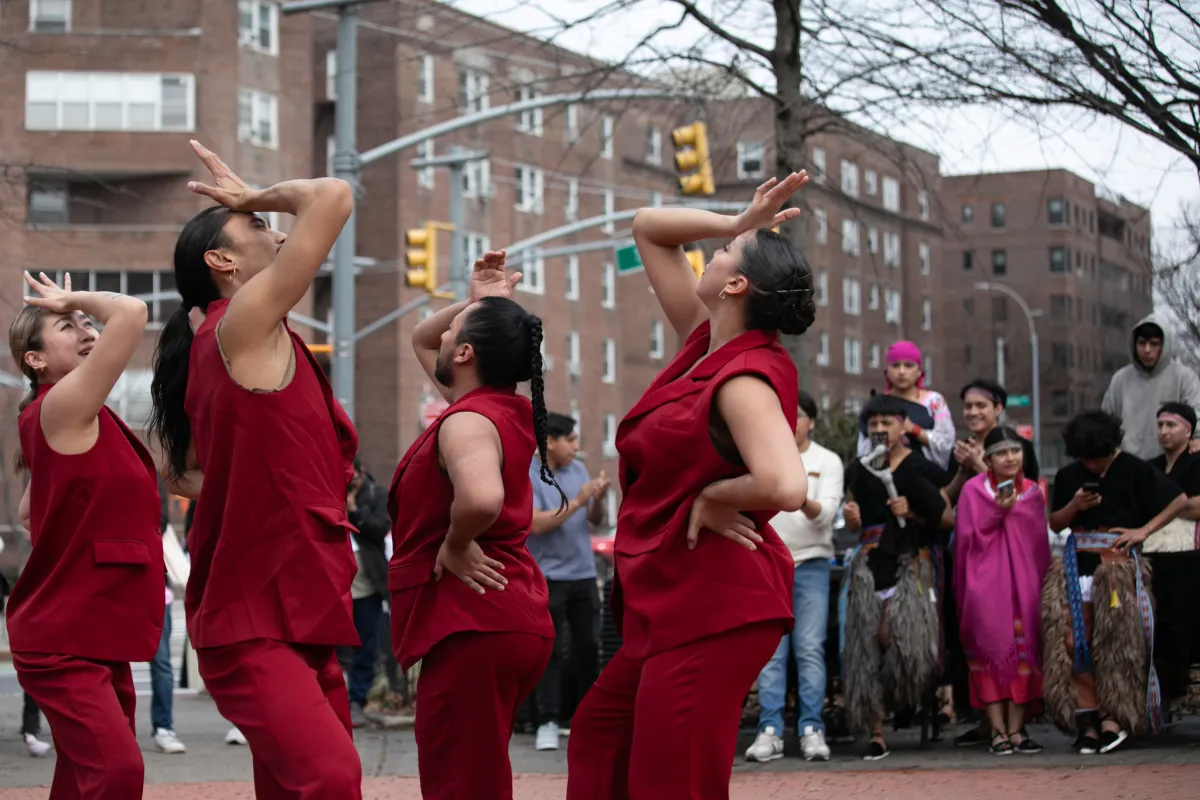
A modern jazz dance group performs during a festival at MacDonald Park in Forest Hills, Queens, March 8, 2026. Photo by Ben Fractenberg/THE CITY
by Jose Martinez
This article was originally published on March 10 at 5 a.m. EDT by THE CITY
As the founder of an organization that’s staged dance performances in public across Queens since 2014, Karesia Batan has navigated the winding path for securing city permits more times than she can count.
“It’s like, ‘Ok, where? Who do we call? What do you mean?’” said Batan, of the Queensboro Dance Festival, which puts on free dance performances, parties, and classes 30 to 40 times each summer.

Batan compares the city’s complex permitting process — which features an alphabet-soup array of agencies and offices that set guidelines for everything from block parties and street festivals to the use of stages, tents, and speakers — to “avoiding a bunch of trap doors.”
“It shouldn’t just be the Governors Balls and the Summerstages that can do this because they have a massive budget and they have a huge team,” she said, pointing to the annual three-day music festival in Flushing Meadows Corona Park and the yearly summer performances in Central Park and dozens of city parks.
“A lot of our public spaces are meant for the local community and they are smaller in scale,” said Batan, whose organization features Queens-based professional dance groups. “That doesn’t mean their impact isn’t great.”
In hopes of slicing through red tape, a new report from the Design Trust for Public Space makes a series of recommendations to Mayor Zohran Mamdani and city agencies on how to ease permitting hurdles for organizations that put on events in public space. That includes more than 30,000 acres of parkland, close to 600 privately owned spaces set aside for public use, and more than 200 Open Streets.
Matthew Clarke, the Design Trust’s executive director, credited the Parks Department and the Department of Transportation for doing an “incredible job with limited resources.” But he also conceded that the vast size of the city bureaucracy “is getting in the way of some of these issues.”
“It can take up to seven agencies to approve a very small event in New York City,” Clarke said, which could include any event that involves amplified sound or the sale of food.
To confuse things further, NYPD issues sound permits, while public art-installation clearance comes from the Department of Transportation, and the Street Activity Permit Office approves festivals.
The report titled, “Untaped: Removing Barriers for Public Space Programming,” makes the case for centralizing public-space programming within the mayor’s office to remove barriers.
“We’re not saying this should all just be absolved and that we should have a free-for-all,” Clarke said. “They’re all there for important reasons about protecting New York and protecting public spaces.”
“But it can get to the point where, unless you’re an expert in this, you can’t parse through all the information to understand some of these rules and regulations.”
Among the recommendations is to unite the Mayor’s Office of Citywide Coordination and Management, which provides oversight and coordinates larger events, with the Street Activity Permit Office, which issues permits for gatherings on city streets and sidewalks that can include block parties, rallies, clean-ups, and religious events.
Such a move, according to the Design Trust for Public Space, would potentially help streamline the winding process for securing permits. The Parks Department alone issues permits for more than 20,000 events a year.

“One of the goals of this is elevating this as an issue that needs a focus,” Clarke said. “There’s leadership that’s needed… and that’s not been the case for a long time.”
According to the report, there were more than 1.8 million permitted events in the five boroughs from 2018 through 2024, with sports-related events accounting for close to 80 percent of that total — and between 5,000 and 7,000 non-sports public events each month.
Another recommendation calls for the city to create a centralized website to make it clear what groups need in terms of permits, applications, and costs when they want to use public space.
A spokesperson for the mayor’s office declined to comment on the report, but the commissioner of the city’s Transportation Department said in a statement that he will be reviewing it.
“We look forward to reviewing these recommendations, and working with our sister agencies and partners to bring our streets to life with less red tape and more opportunities for activation,” said DOT chief Mike Flynn. “When we reimagine street space for people instead of cars, New Yorkers come together, business booms, and communities thrive.”
Carey King, the director of Uptown Grand Central — a nonprofit that organizes street clean-ups, performances, and festivals along East 125th Street — said she regularly gets calls for help from “confused” East Harlem residents and shopkeepers who want to make use of public space.
“It’s so dependent on what you’re applying for, what boxes you click, who your assigned rep is, if it’s on a street or in a park — it’s definitely a maze, it’s like a gamble,” she said. “I’m always like, ‘Send in the application’ and then they’re, like, saying a prayer that they did it the right way.”
King said that a clearer and more uniform permitting process could clear obstacles. She described it as complicated enough that some people who want to put on a block party instead throw up their hands — or “just open up the hydrant and put the chairs out in the street.”
“We want people to put together the block parties for their street,” she said. “And so we need to incentivize getting people out there.”
Batan, of Queensboro Dance Festival, said the path to permits “doesn’t need to be this hard.”
“Sometimes,” she said, “the thought that runs through my mind is, ‘all we’re trying to do is dance.’”
Related Stories
- City Moves Forward to Acquire Cooperative Community Farm in Windsor Terrace
- Long-Awaited Shirley Chisholm Recreation Center Officially Opens Today
- Funding Secured for a Total Rebuild of Coney Island’s Riegelmann Boardwalk
Email tips@brownstoner.com with further comments, questions or tips. Follow Brownstoner on X and Instagram, and like us on Facebook.
What's Your Take? Leave a Comment