
New Subway Gates Foil Fare Evaders, MTA Says
The updated barriers are intended to prevent fare beating, make it easier for passengers with mobility challenges to pass through, and speed up entries and exits.

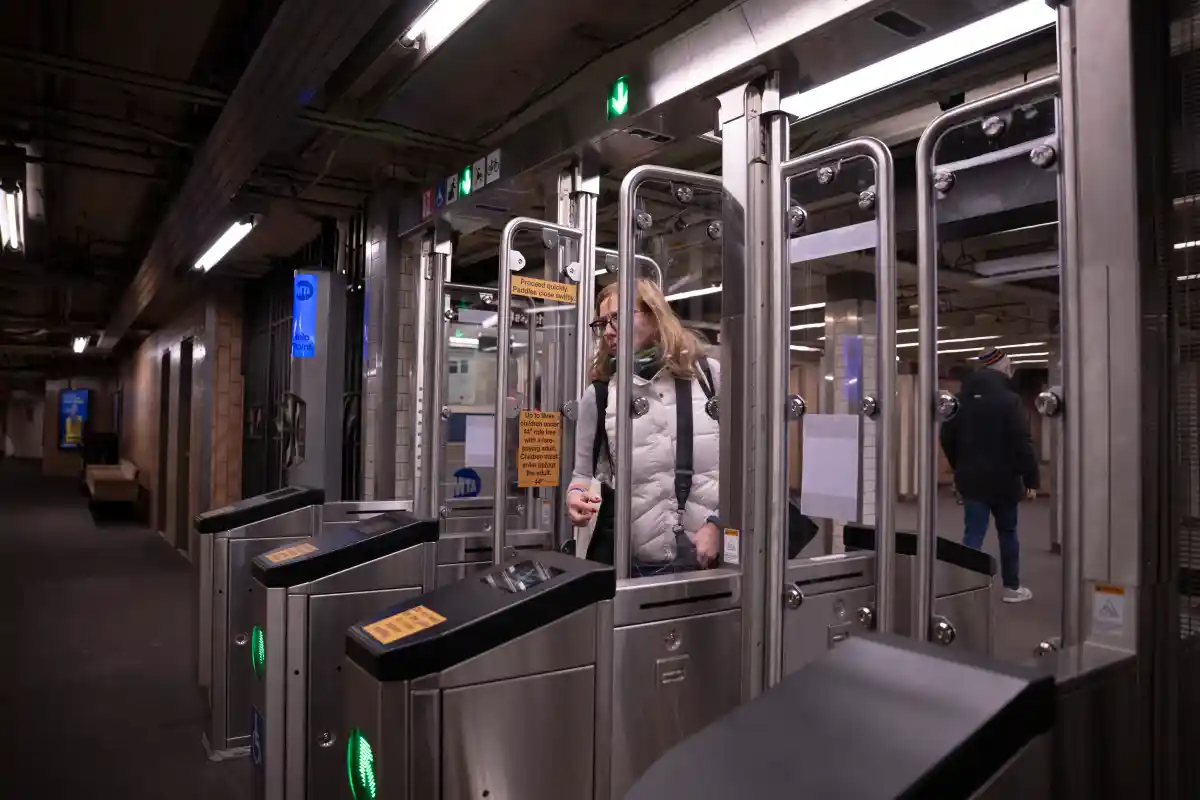
Modern fare gates the MTA is piloting at the 23rd Street 6 train station in Manhattan. Photo by Lloyd Mitchell
by Ethan Stark-Miller, amNY
Three models of modern fare gates that the MTA is testing across several subway stations have reduced fare evasion by 20 percent to 70 percent, depending on where they were installed, agency officials revealed on Wednesday.
Kathy Lee, deputy chief of staff at MTA Construction and Development, updated the agency board during its March 25 meeting on the program piloting the modern fare gates at 20 stations. The updated barriers are intended to prevent fare beating, make it easier for passengers with mobility challenges to pass through, and speed up entries and exits into and out of the system.
“The gates are contributing to substantial fare evasion reductions,” Lee said.
However, Lee presented the data, gathered from a sample of seven stations during the week of March 16, without identifying the specific locations included or which models were tested at them.
Jamie Torres-Springer, president of MTA Construction and Development, said the agency anonymized the data to avoid biasing the pilot’s outcome.
“If we start to say which station is performing in which way, then we’re suddenly saying what the data is by vendor, which doesn’t work, because we’re in the middle of a procurement,” he told amNewYork.
New fare gates a boon in fare evasion fight, MTA says
Lee said the presentation included only seven stations, even though the pilot is operating across 20 overall, because those are the locations where the agency has so far been able to capture data via video footage.
The station that saw the biggest drop, which MTA officials identified as “Station 1,” experienced a 70 percent reduction in its fare evasion rate — a raw decrease from 15.1 percent to 4.6 percent.
“Stations that previously had maybe 10 percent to 15 percent fare evasion, that’s been reduced by more than half since the new gates have been installed,” Lee said. “Also, stations…where there was already low fare evasion to begin with, 2 percent to 4 percent, even those stations, we’re seeing a decrease in fare evasion since the gates have gone in.”
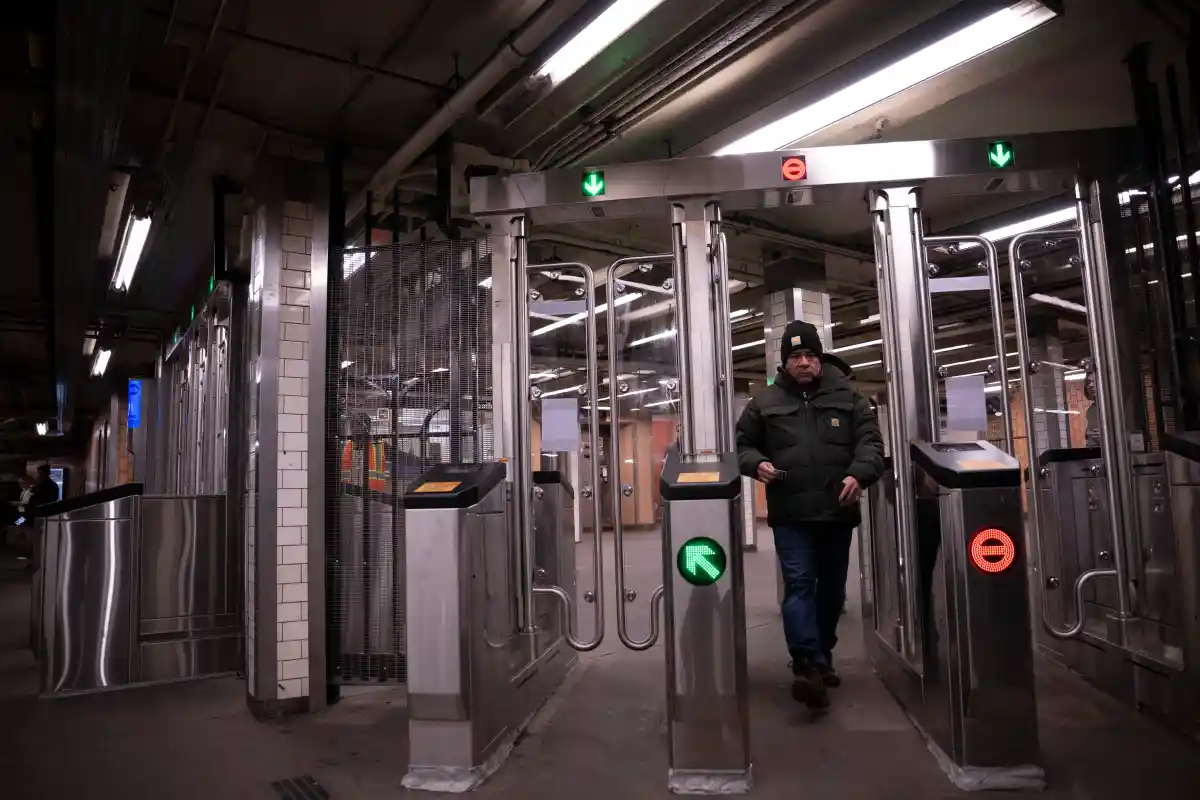
Although their designs vary, each of the three modern fare gate models features a combination of glass doors that swing open when riders pay at the OMNY readers and close a few seconds after they pass through.
The three prototypes, from the companies Cubic, Conduent, and STraffic, are also equipped with sensors and artificial intelligence. Those features are designed to detect when a rider tries to skip paying and whether they are going through in a wheelchair, with children, or carrying a large item.
Lee said the new gates aim to cut down on fare dodging by eliminating the emergency exit doors that accompany the current turnstyle fare arrays. She said riders going through the emergency doors without paying account for 52 percent of overall fare evasion.
Instead of using the separate exits, the new fare gates will remain open as long as riders are leaving the system.
Lee said that because the new gates have paddles that are 6 feet tall and leave a smaller gap underneath, they will also help prevent riders from jumping over or sliding under them, currently accounting for 32 percent of fare evasion.
Nonetheless, dozens of viral videos over the course of the pilot, launched late last year, have shown some crafty straphangers finding ways to cross the gates without paying.
Others have shown riders getting their limbs or items they are transporting caught in the doors.
Lee acknowledged that the MTA cannot eliminate all fare evasion, but said the new gates will go a long way toward cutting down “opportunistic” fare beating.
“We have many creative New Yorkers who have been able to get over and under, and they love sharing that with us on social media,” Lee said. “But we also know that most New Yorkers aren’t training for the high jump Olympics. They are not parkour aficionados.”
‘That’s the price of admission’
The MTA will assess the gates it is piloting by evaluating how they perform across a range of criteria, Lee said. On top of fare evasion, those include accessibility, customer experience, and maintainability, among other factors.
MTA Chair and CEO Janno Lieber said the agency will then qualify the gate contractors that satisfy those criteria and begin a competitive bidding process with one or more vendors that pass muster.
“That’s the price of admission; you have to pass the certification standards of this evaluation, and then you’re going to be in a bidding process that includes, what’s the price?” Lieber said.
The bidding competition will involve installing one or more of the prototypes at all entrances across 20 stations, Lieber said. The next phase differs from the current pilot, which only installed the new gates at one entrance per station.
The 20 stations could cover some that are already testing new fare gates or other stations where they have not previously been introduced, according to the MTA chair.
“It’s going to be a different mix, but it may include some of the stations that already have the initial pilot entrances,” he said.
The MTA’s current capital plan allocates $1.1 billion toward expanding whichever model it lands on to 150 stations across the system.
Editor’s note: A version of this story originally ran in amNY. Click here to see the original story.
Related Stories
- Brooklyn Subway Upgrades Will Speed Trains, Boost Accessibility
- MTA Explores How to Use AI to Monitor Thousands of Cameras in Transit System
- New Elevators Improve Accessibility at Sheepshead Bay Subway Station
Email tips@brownstoner.com with further comments, questions or tips. Follow Brownstoner on X and Instagram, and like us on Facebook.



How will these gates work when the person has a bicycle? Now one pays and goes in without the bike. And then opens the exit door, keeping it open with one foot, and bringing the bike in.